Supermassive Black Holes May Stifle Star Formation in Galaxies Millions of Light-Years AwayFebruary 23, 2026
ICE Boston arrests Haitian illegal alien with 28 adult arraignments, extensive criminal record – New Bedford GuideFebruary 23, 2026
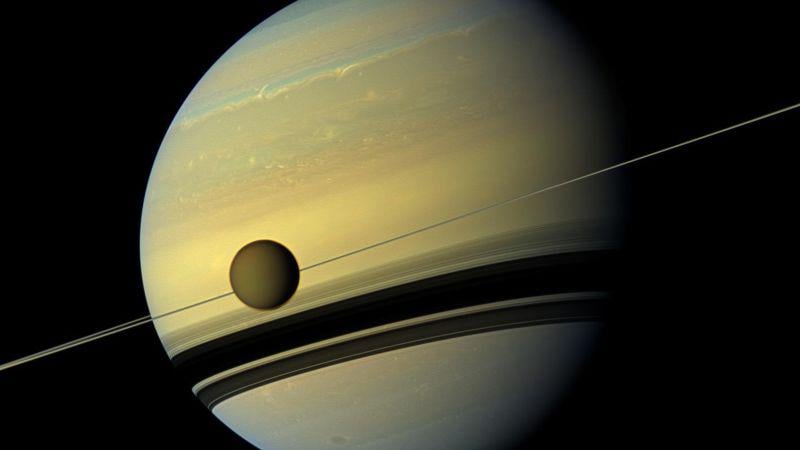
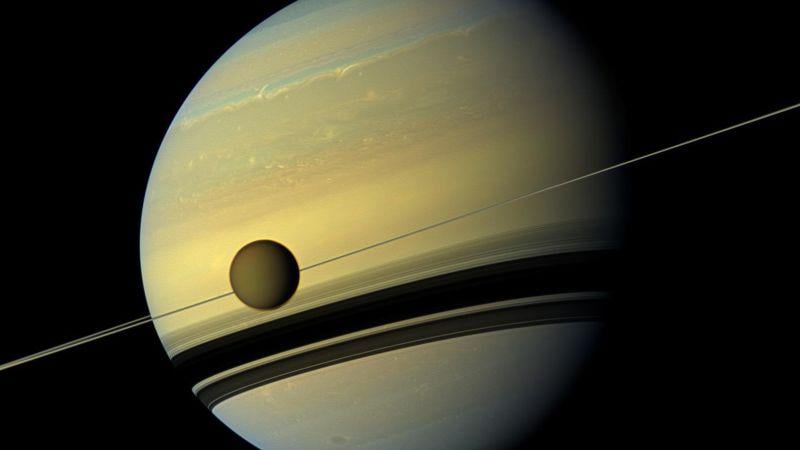
cnn on February 23, 2026 4:03 pm Saturn’s largest moon, Titan, is one of the solar system’s oddities. Now, researchers have unlocked key insights about this mysterious moon, including how it came to be. The answer may also shed light on the origin of Saturn’s beautiful rings. Shrouded in a thick haze, Titan is about half the size of Earth and even larger than Mercury — so massive that its gravitational pull makes Saturn wobble and tilt. Titan is also moving away from Saturn at a rate of 11 centimeters (4.3 inches) a year, far faster than astronomers [previously thought](https://www.nasa.gov/centers-and-facilities/jpl/saturns-moon-titan-drifting-away-faster-than-previously-thought/). Eventually, the moon could be [ejected](https://arxiv.org/abs/2110.05550) from its orbit entirely. But Titan’s drifting orbit is just one of [many puzzles](https://science.nasa.gov/solar-system/10-things-unsolved-mysteries-of-saturns-moons/) that astronomers are trying to solve about Saturn and some of its [274 moons](https://science.nasa.gov/saturn/moons/). Many of the questions have arisen from data collected by [Cassini](https://science.nasa.gov/mission/cassini/about-the-mission/), a spacecraft that explored the Saturnian system from 2004 to 2017.

1 Comment
Saturn’s largest moon, Titan, is one of the solar system’s oddities. Now, researchers have unlocked key insights about this mysterious moon, including how it came to be. The answer may also shed light on the origin of Saturn’s beautiful rings.
Shrouded in a thick haze, Titan is about half the size of Earth and even larger than Mercury — so massive that its gravitational pull makes Saturn wobble and tilt. Titan is also moving away from Saturn at a rate of 11 centimeters (4.3 inches) a year, far faster than astronomers [previously thought](https://www.nasa.gov/centers-and-facilities/jpl/saturns-moon-titan-drifting-away-faster-than-previously-thought/). Eventually, the moon could be [ejected](https://arxiv.org/abs/2110.05550) from its orbit entirely.
But Titan’s drifting orbit is just one of [many puzzles](https://science.nasa.gov/solar-system/10-things-unsolved-mysteries-of-saturns-moons/) that astronomers are trying to solve about Saturn and some of its [274 moons](https://science.nasa.gov/saturn/moons/). Many of the questions have arisen from data collected by [Cassini](https://science.nasa.gov/mission/cassini/about-the-mission/), a spacecraft that explored the Saturnian system from 2004 to 2017.