
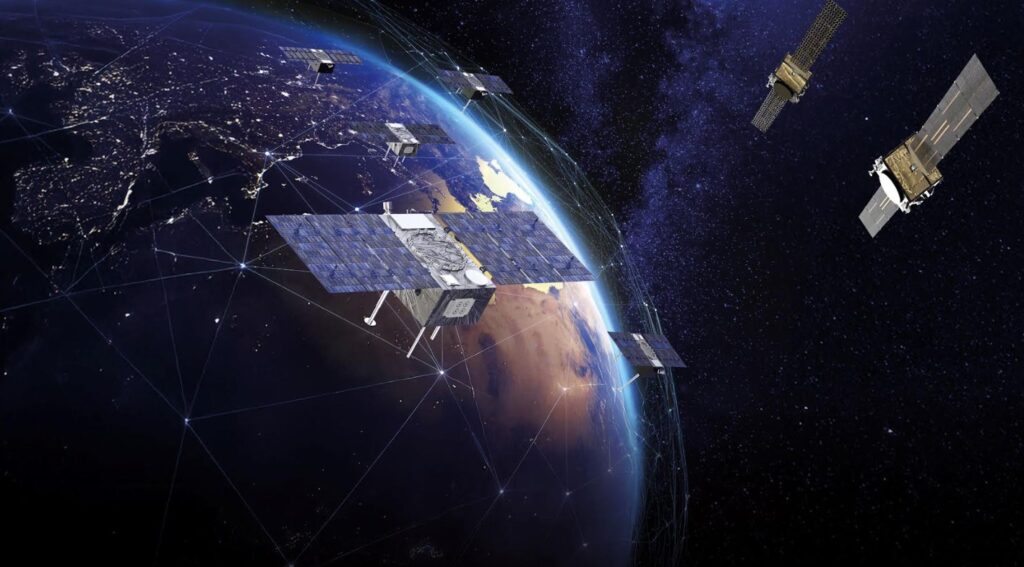
The first In-Orbit Demonstrator (IOD-2) satellite of ESA’s Celeste mission (formerly named LEO-PNT) has begun its journey towards launch. Last week, the satellite left the Thales Alenia Space site in L’Aquila, Italy, bound for Berlin, before heading soon to the launch base in New Zealand, marking a major step towards Europe’s next-generation satellite navigation system. From our cleanrooms to the launch pad, this milestone underlines the transition from concept to reality.
Global Navigation Satellite Systems (GNSS) like Europe’s Galileo have become indispensable — supporting applications in everyday life and helping drive economic growth. They also play a critical role in our safety and security. As reliance on navigation technology grows, new applications are emerging that demand extremely high availability, reliability and accuracy in every environment. There is now broad consensus that augmenting these systems with Low Earth Orbit (LEO) satellites, operating across multiple frequencies, will be a pivotal step in improving navigation performance.
Improved geolocation accuracy and integrity
At the forefront of this revolution, ESA’s Celeste in-orbit demonstration mission is emerging today as a real game changer. The 11-satellite constellation is expected to demonstrate how satellite in Low Earth Orbit will augment and diversify existing and future Medium Earth Orbit (MEO) GNSS systems, improving resilience and enabling new services in environments where today’s satnav cannot reach — deep urban areas, heavy foliage, polar regions and even indoors.
Recognizing the strategic importance of having LEO navigation capabilities, the European Space Agency (ESA) launched Celeste project in 2024, which is currently in its In-Orbit Demonstrator (IOD) phase. The Celeste demonstration constellation comprises 11 microsatellites that will be orbited, delivered by two prime contractors, with Thales Alenia Space building five spacecraft. The IOD-2 satellite is preparing for a launch scheduled for March 2026.
This program is designed to enhance resilience and exponentially boost the performance of existing navigation services. Built on a multi-orbit approach, it will work alongside Galileo and other satellite navigation systems to deliver centimeter-level geolocation accuracy, improved robustness, strong resistance to jamming and spoofing and low latency (fast signal acquisition). The Celeste mission is intended to support emerging use cases such as high-level vehicle autonomy — including continuous coverage in dense urban areas — Internet of Things applications, unmanned aerial and maritime vehicles and 5G/6G terrestrial network synchronization.
The first satellite to depart our cleanrooms is IOD-2. A large CubeSat (12U/16U) roughly the size of a suitcase and weighing around 30 kg, it carries payloads for broadcasting in L-band and S-band.
IOD-2 will validate the system definition and enable early signal transmission, while de-risking and demonstrating the core technologies for future Celeste satellites. Once deployed in orbit, it will operate for at least six months.
The four IOD satellites that follow will be larger and more complex. Weighing twice as much, they will carry additional payloads to test innovative signals across multiple frequency bands and demonstrate new service capabilities.
Once the full Celeste demonstrator constellation is in orbit by 2027, ESA will be able to assess how a LEO navigation layer can operate alongside Galileo and other MEO navigation systems. The project will deliver a fully integrated, end-to-end Celeste in-orbit demonstration mission, with the ambitious goal of launching the first satellite less than two years after kickoff. This accelerated timeline, combined with the technical complexity of the satellites, has been the main challenge as our teams prepared the first spacecraft for launch in early 2026.
About the Celeste in-orbit demonstrator mission
Thales Alenia Space teams in France and Italy are part of the ESA industrial consortium, with support from Europe’s partners, especially in Spain and Germany.
In orbit, Celeste will validate new capabilities designed to increase resilience and boost Europe’s navigation services.
At the forefront of satellite navigation in Europe
The Celeste mission leverages Thales Alenia Space’s proven leadership in satellite navigation — from EGNOS to Galileo Second Generation — together with the experience gained on related positioning and connectivity programs, including Native Positioning System and IoT initiatives such as Moonlight, Argos, Angels, Kineis and Omnispace. The teams have also drawn on strong collaborations with New Space players, helping bring new entrants into the ecosystem.
With the first satellites now on route, the program moves from preparation to launch — and toward the next generation of European satellite navigation.
red/f – 1267933
Rome, Italy, 02/23/2026 11:05
AVIONEWS – World Aeronautical Press Agency