
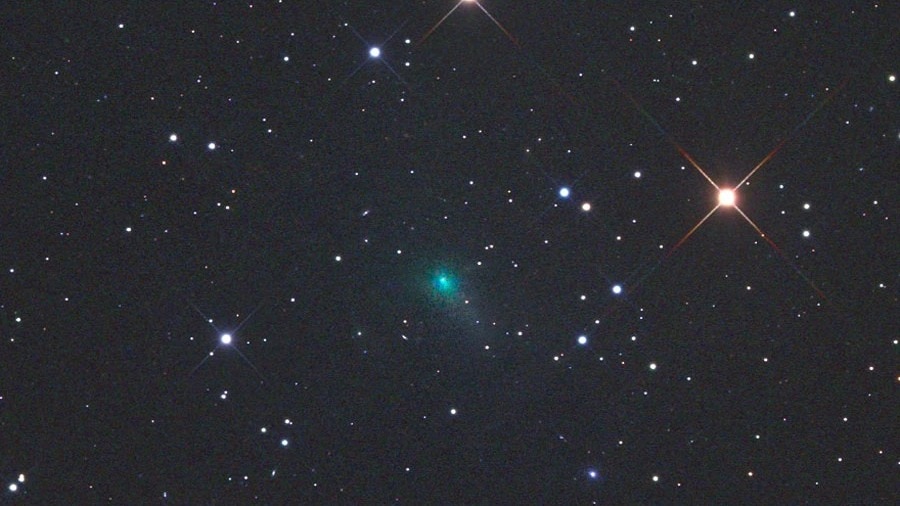
A newly discovered comet has garnered global attention and could soon light up the evening sky brighter than Venus.
The comet, officially called C/2026 A1 (MAPS), was first spotted by amateur astronomers in Chile in January and belongs to a special group known as Kreutz sungrazing comets.
But before you look up at the sky, it helps to understand what sungrazers actually are and what makes them a matter of interest for millions.
WHAT IS A SUNGRAZER COMET?
A sungrazer is a comet that passes dangerously close to the Sun during its orbit.
Unlike regular comets that stay millions of kilometres away, Kreutz comets pass extremely close to the Sun and are named after German astronomer Heinrich Kreutz.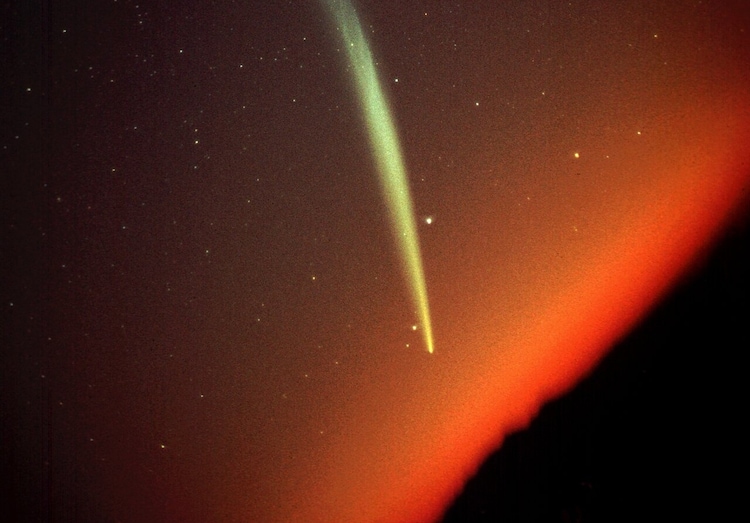
Comet Ikeya-Seki, captured on October 29 1965, was another stargazer. (Photo: NOIRLab)
When they do fly close to the Sun, the star’s intense heat causes the ice inside them to rapidly turn to gas, often making them glow brilliantly, sometimes bright enough to be seen in daylight.
There is, however, also a downside.
The heat from the sun that can make these comets shine bright can also, at times, rip apart the comets entirely.
WHERE DO SUNGRAZERS COME FROM?
All these bright Kreutz-family comets share a common origin.
At some point in the past, potentially in the 3rd or 4th century BCE, a giant cometary nucleus, more than 100 km in diameter, came extremely close to the Sun’s surface. That same comet later split into two major fragments and shed many smaller pieces.
Over centuries, those fragments kept returning, producing some of the most breathtaking comets ever recorded. The Great Comet of 1882, for instance, was at its brightest a hundred times brighter than the full Moon and dazzled the sky for several months.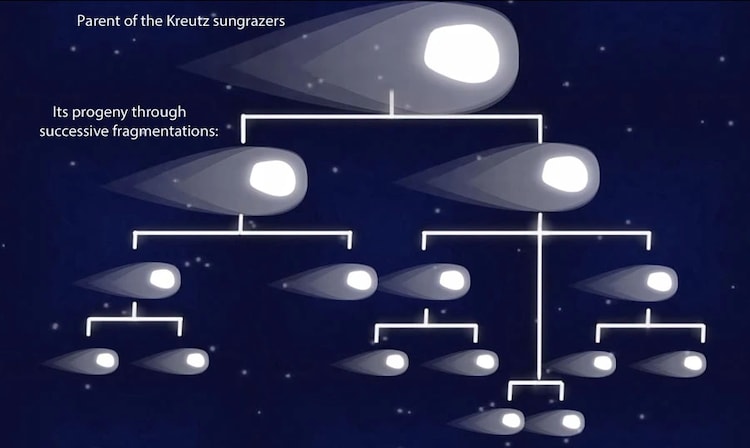
uccessive fragmentation of the Kreutz parent comet has given birth to hundreds of smaller comets. (Photo: Nasa)
WHAT IS COMET MAPS?
The MAPS program, run by a group of French amateur astronomers using telescopes in Chile, discovered the comet on January 13, 2026.
Their observation program is an acronym for their last names: Maury, Attard, Parrott and Signoret.
At the time of its discovery, comet MAPS was farther from the Sun than any previously discovered sungrazer, which suggests it could be relatively large.
MAPS will pass extremely close to the Sun from April 4 to April 5, 2026.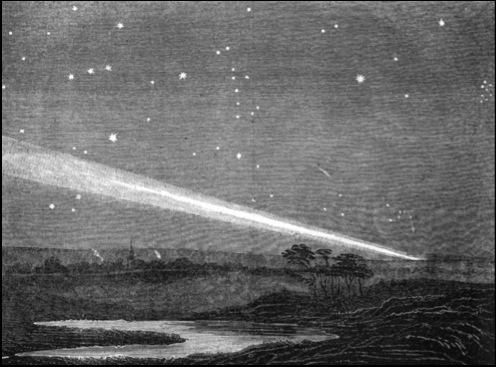
A drawing of Great March comet of 1843, a bright Kreutz sungrazer. (Photo: X/@JAtanackov)
The Southern Hemisphere is likely to get the best views, with the comet visible in the western sky after sunset. In India that would mean a possible glimpse of the flying comet, but only from the southern regions.
In the Northern Hemisphere, it would stay very low above the southwestern horizon at dusk. Whether it becomes a true spectacle depends entirely on one thing. That thing is a simple question about whether the comet will survive its fiery encounter with the Sun.
– Ends
Published On:
Feb 23, 2026