
The 1967 death of Soviet cosmonaut Vladimir Komarov was not an unforeseeable accident. It was a disaster that engineers documented in advance, a mission whose fatal flaws were known at every level of the Soviet space programme.
On the morning of April 23, 1967, a Soviet colonel climbed into a spacecraft at the Baikonur Cosmodrome in Kazakhstan, strapped himself in, and waited for launch. What made the moment extraordinary was not the mission. It was that the man inside had, days earlier, told a close friend he did not expect to come back.
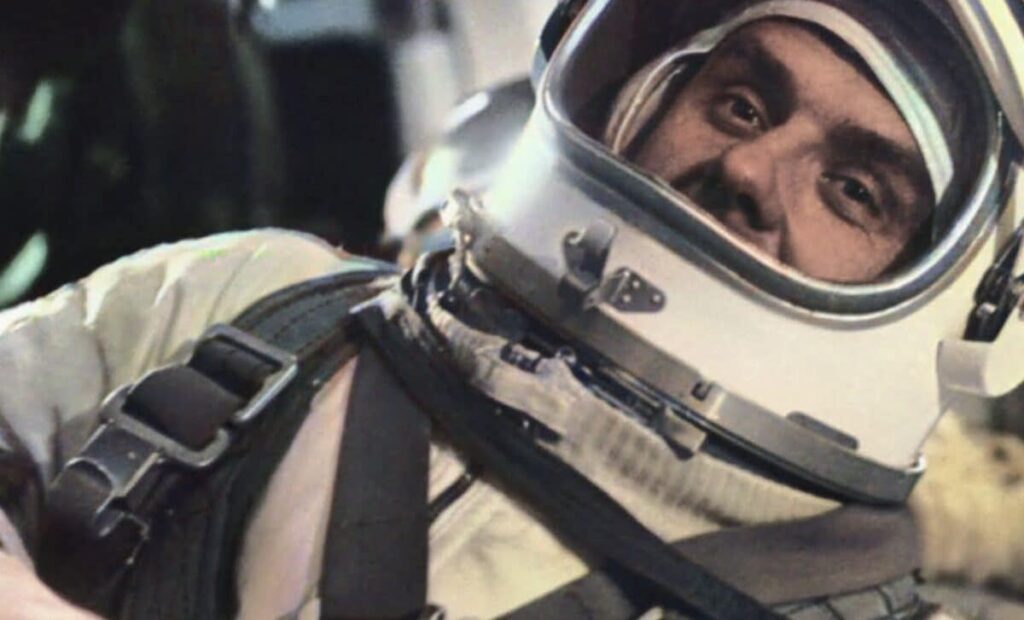
 Vladimir Komarov before the fatal accident. Credit: Sputnik
That friend was a KGB officer named Venyamin Russayev. What Russayev later described, in a BBC interview broadcast in 1997 and documented in the book Starman by Jamie Doran and Piers Bizony, was a conversation that exposed something deeply troubling: the cosmonaut’s death had not been an unforeseen tragedy, but a foreseeable consequence of decisions made far above his rank.
The spacecraft was Soyuz 1. The cosmonaut was Vladimir Komarov, 40 years old, a veteran of one previous spaceflight, and among the most experienced pilots in the cosmonaut corps. His backup was Yuri Gagarin, his closest friend and the most celebrated figure the Soviet Union had ever produced. Komarov launched anyway.
A Spacecraft With 203 Known Faults
Pre-launch technical inspections of Soyuz 1 identified 203 structural faults. Unmanned test flights had returned results that would have been fatal to a pilot. Gagarin, working with engineers, compiled a formal report cataloguing the defects and recommending postponement. The report was passed to Russayev, who attempted to route it up the chain of command.
The outcome, based on accounts in Starman, was that Russayev was banned from any further contact with the cosmonaut corps. General Secretary Leonid Brezhnev had committed to a launch timed to mark Soviet achievements, and that political calendar overrode the engineering consensus at every level.
 Vladimir Komarov preparing for the flight. Credit: TASS
The existence of the report remains disputed. Space historian Asif Siddiqi and others note it does not appear in official memoirs or Soviet-era documents. The book’s co-author Piers Bizony acknowledged the uncertainty in Space News: “Our book no doubt contains mistakes, and we genuinely welcome corrections of factual errors.”
‘I’m Not Going to Make It Back From This Flight’
Days before launch, Komarov told Russayev: “I’m not going to make it back from this flight.” Russayev recalled pressing him: “If you’re so convinced you’re going to die, then why don’t you refuse the mission?”
Komarov’s answer, as recorded in Starman and unrebutted in the sources reviewed: “If I don’t make this flight they’ll send the backup pilot instead. That’s Yura, and he’ll die instead of me. We’ve got to take care of him.” Russayev added: “He cracked. Maybe he just let out all the tension, and he began to cry.”
Critics in the space history community have questioned Russayev’s reliability, suggesting he may have overstated his role. Bizony defended him: “Russayev told us a story that was entirely credible. We regarded him as a decent and reliable source.” On launch day, Soviet journalist Yaroslav Golovanov, present at the pad, described Gagarin’s behaviour as “a sudden caprice” — Gagarin had arrived in flight gear demanding a spacesuit. Russayev’s interpretation was that Gagarin was attempting to take his friend’s place on the mission.
Twenty-Six Hours: The Technical Sequence of the Disaster
Soyuz 1 launched on schedule. Problems began within minutes. One of the two solar panels failed to deploy, cutting electrical power and degrading navigation. The craft began to rotate uncontrollably. Manual correction attempts made the spin worse. The thermal system deteriorated and communications became intermittent.
Ground control cancelled the planned Soyuz 2 launch and focused on recovery. Komarov spent five hours attempting to orient the craft using procedures he had not rehearsed in training, achieving a successful retrorocket burn on his 19th orbit. Re-entry itself was survivable.
.jpg) Soyuz 1 spacecraft (artistic depiction), the crash site, and Vladimir Komarov. Credit: rarehistoricalphotos
Soyuz 1 spacecraft (artistic depiction), the crash site, and Vladimir Komarov. Credit: rarehistoricalphotos
The fatal failure came during descent. The drogue parachute deployed; the main parachute remained tangled in its container. The reserve chute fouled on the drogue’s drag lines. Soyuz 1 hit the Kazakh steppe near Orenburg at near-terminal velocity on April 24, 1967, causing immediate structural disintegration and fire. Recovery teams found burning metal. A chipped heel bone was among the few intact fragments of Komarov’s remains.
The Last Transmissions and the Silence That Followed
United States listening posts in Turkey intercepted Komarov’s final transmissions. NPR’s reporting, drawing on Starman, described him as “crying in rage,” “cursing the people who had put him inside a botched spaceship.” The intercepts have been characterised consistently across multiple independent accounts, though their precise content has not been officially declassified.
Soviet Premier Alexei Kosygin reached Komarov by video link during the capsule’s final descent. Kosygin was in tears. Komarov’s wife was brought on the call. Kosygin told him he was a hero of the Soviet Union. No complete transcript of the exchange has been made public.
.jpg) Valentina Komarov, the widow of Soviet cosmonaut Vladimir Komarov, kisses a photograph of her dead husband during his official funeral, held in Moscow’s Red Square on April 26, 1967. Credit: rarehistoricalphotos
Valentina Komarov, the widow of Soviet cosmonaut Vladimir Komarov, kisses a photograph of her dead husband during his official funeral, held in Moscow’s Red Square on April 26, 1967. Credit: rarehistoricalphotos
The Soviet government attributed the death to parachute failure and did not acknowledge the pre-launch engineering objections or the political pressure behind the launch decision. Gagarin gave an interview to Pravda weeks later criticising the officials who had allowed his friend to fly. He died in a jet training accident in March 1968, eleven months after Komarov.
The Soyuz programme was grounded for 18 months and extensively redesigned. The redesigned vehicle became the backbone of Soviet and Russian crewed spaceflight for decades. No independent investigative commission equivalent to NASA’s post-Challenger inquiry was ever convened by the Soviet state. Vladimir Komarov was posthumously awarded the Hero of the Soviet Union title for the second time and remains, in the formal record, the first human to die on a spaceflight mission.