
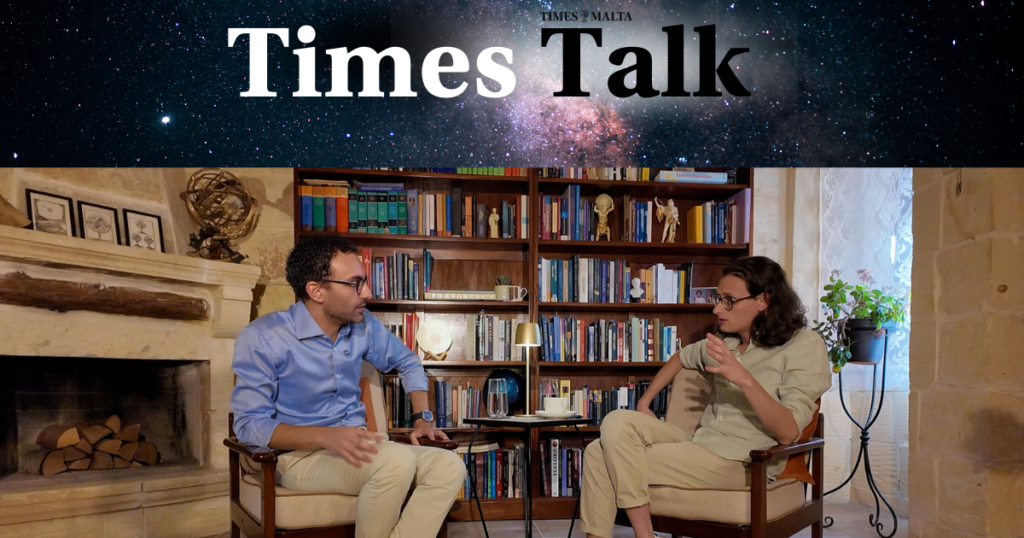
What are the chances that aliens are real? And if they are, what do they look like, where are they and how come they never visit? And if they were to visit, how would they even do it?
Is time travel to the past and to the future possible? It turns out it is – at least one way.
And what is the likelihood that there are other worlds like ours out there? The short answer is: very likely. The long answer is even more interesting.
In a wide-ranging 90-minute discussion on Times Talk, astrophysicist and professor Joseph Caruana breaks down the staggering reality of our existence – from the probability of humanity living in a computer simulation to the probability of time travel.
During the episode the 39-year-old Oxford-educated researcher and University of Malta lecturer explains why most of the universe is still a mystery and how scientists have managed to trace back its beginning 14 billion years ago. And along the way he answers a myriad of other questions.
Watch the full episode with professor Joseph Caruana here. Video: Antoine Farrugia Lauri
When will the world end? Will the universe end? What happens to us after we die? And how is human consciousness the way the universe finally knows about itself?
And from all that he knows about the universe, does it look like there is a God? Does the universe need a creator to keep it going? Did it even need a creator to begin with?
And is it possible that we are all living in a computer simulation? Short answer is: quite possibly.
A mysterious place
Caruana says even though there is a lot that we know about the universe, humanity remains in a state of profound ignorance about the cosmos.
He explains that everything we see—stars, planets, and galaxies—accounts for just a tiny fraction (around five per cent) of what exists. The rest is composed of dark matter and dark energy, mysterious entities that remain among the biggest known unknowns in physics.
The conversation dives into the big questions that usually occupy the realm of science fiction but are grounded in mathematical probability, such as time travel and the existence of extraterrestrial life.
Why it matters to look at the stars
Addressing critics of government spending on space exploration, Caruana argues that looking at the stars is the only reason we have modern essentials – from mobile phones and GPS, to MRI machines, digital cameras and kitchen hobs.
Beyond technology, he notes that studying the skies is a matter human curiosity and – more crucially – of survival, especially in monitoring asteroids that could hit the world and end human civilization.
Caruana carried out his doctoral research at the Department of Physics of the University of Oxford and is a Fellow of the Royal Astronomical Society.
At the University of Oxford he worked on the James Webb Space Telescope project, following which he moved to the Leibniz-Institut für Astrophysik in Berlin for a postdoctoral research position in astrophysics.
At Christ Church, Oxford, he tutored General Relativity and Cosmology.
Today, he lectures at the University of Malta’s Institute of Space Sciences and Astronomy (ISSA).
Outside the lab, he is a prominent environmental activist and President of Wirt Għawdex, recently receiving the 2025 Dark Sky Defender Award for his fight against light pollution.