
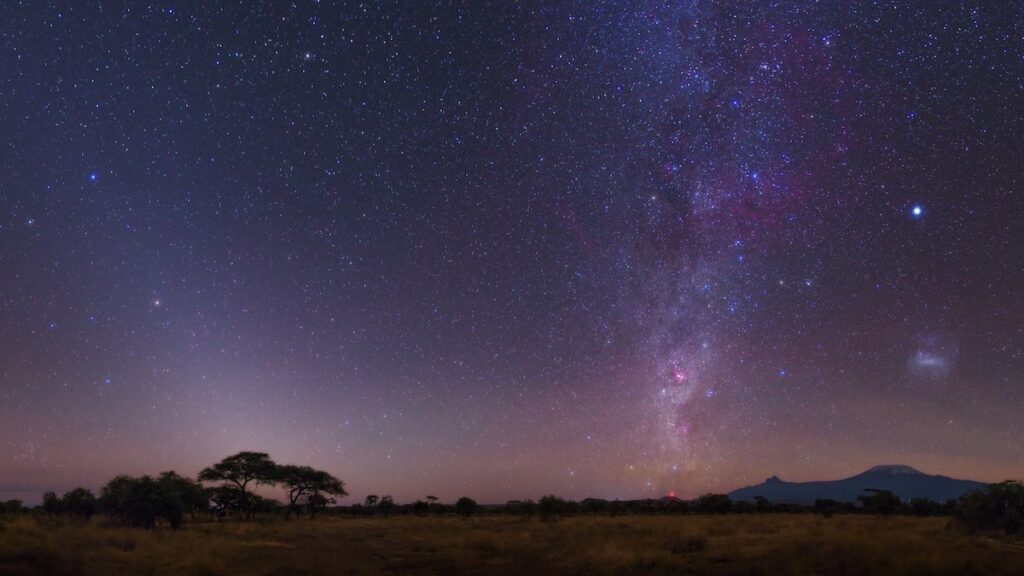
How to see the zodiacal light
While the zodiacal light is best seen at lower latitudes, its visibility extends to the mid-latitudes near the equinoxes.
To see the zodiacal light this season, head somewhere with truly dark skies—far from any light pollution—and a clear, unobstructed western horizon. Time your viewing for about 90 minutes to two hours after sunset and look west. The zodiacal light will appear to form a V shape with the Milky Way.
(A practical guide to stargazing.)
“For the morning apparition in autumn, look toward the east,” says Skiff. At this time of year, it is better to do so 90 minutes to two hours before sunrise. “In this case, the Milky Way will be nearly overhead, stretching from northwest to southeast, the two bands forming a huge X-shaped pattern of light in the sky,” says Skiff.
How can you tell the difference between the Milky Way and the zodiacal light? “The Milky Way starclouds have a clumpy or mottled and grainy texture, whereas the ‘zodi’ is very smooth and diffuse,” says Skiff. “Remarkably, the Milky Way is not as bright as the zodiacal light. Even thin clouds or moonlight will wash it out.”