
Scientists and researchers around the globe are constantly finding ways to analyze the changes from climate change. In a few years, those changes will be more intricately monitored from space.
One of the next-generation satellites funded by NASA that is set to launch in 2030 has ties to San Diego.
Dr. Helen Amanda Fricker is a glaciologist at Scripps Institution of Oceanography at UC San Diego, but most recently, she is leading a team to launch the EDGE satellite. That stands for Earth Dynamics Geodetic Explorer.
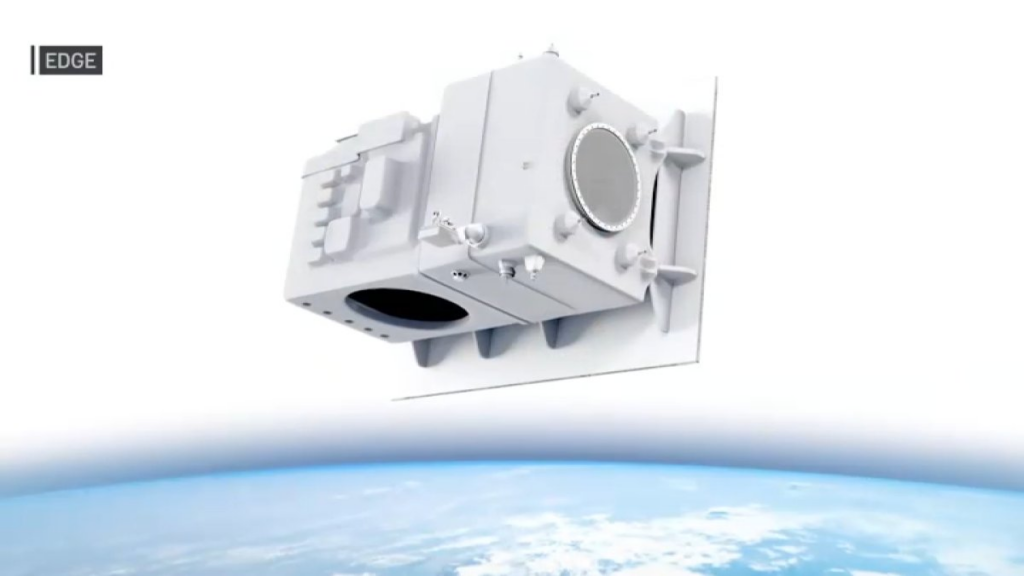
“Basically, it’s a big laser pointer in space, and it is measuring the height of the Earth at very high spatial resolution, so very high detail,” Fricker said.
Made up of five lasers with eight beams each, EDGE — when in orbit — will map the globe, almost like wrapping ribbons around it, to make three-dimensional observations of changes in sea-level rise, ice sheet loss and changes in vegetation.
“It improves our resilience, and information is what we need to navigate these next steps,” Fricker said.
If it sounds complicated, Fricker says to think of it like this: ”When kids are growing up in the kitchen, they’re measuring their height. The families are measuring their height, kid on the wall in their kitchen,” Fricker said.
Just like many parents measure the height of their growing children, the EDGE, in its own way, is doing the same thing.
”It’s just height change with time,” Fricker said. “What we’re doing with laser altimeter is no more complicated than that. We’re literally measuring the height of the Earth and how it’s changing with time.”
Earlier this month, NASA announced its decision to fund EDGE and another satellite mission through its Earth Systems Explorer program. The news came after years of hard work – proposing a satellite mission is no easy feat. It was hours of hard work and collaboration, presentations, questions and answers, and waiting.
In June 2025, the nearly 1,000-page proposal for EDGE was sent and reviewed by an evaluation panel. The panel also reviewed three other mission submissions.
”It’s like being under this massive scrutiny and review. Every word you write has to be like, ‘Is that really the right thing? Are we really going to do that?’” Fricker said. “And you have to be super sure, like anything that you’re not sure about is going to get scrutinized.”
After a site visit to NASA’s Goddard Space Flight Center in Maryland in September, the government shutdown began on Oct. 1.
”Everything is going, going, going full on, and then suddenly, nothing. It’s a shutdown, can’t do anything,” Fricker said.
By January, she had another opportunity to speak with NASA about EDGE before a decision on which projects would be chosen and funded.
”We knew we had a very solid team and a great proposal, and everyone’s got faith in it or else we’re not going to be still doing it, and they’ll believe the mission can be successful, but still, there are three other teams,” Fricker said.
Then, in early February, Fricker got the call.
”I actually saw a penny on the ground, and it was right before the phone call came,” Fricker said.
It was perhaps a stroke of good luck ahead of the good news. NASA told Fricker her EDGE satellite mission had been selected.
“It was just such an extraordinary, I guess, relief, but just so happy that they also see the value in the mission we’re doing, and the proposal was good enough that it hit the bar they were looking for,” Fricker said.
So what’s next? Fricker says there were already around 60-80 experts working on the mission, but from here, they will be staffing up and getting people into key positions.
This is the first mission a principal investigator from UC San Diego has led.
”I’m hoping I’m not the last one, but I’m paving the way,” Fricker said.
For Fricker, who worked on NASA’s ICE-Sat and ICE-SAT-2 satellites, she says the trajectory of her career has guided her to EDGE.
”A lot of my knowledge and training as an undergrad has led to this moment,” she said.
EDGE will receive no more than $355 million for its mission, which is expected to launch in 2030.