
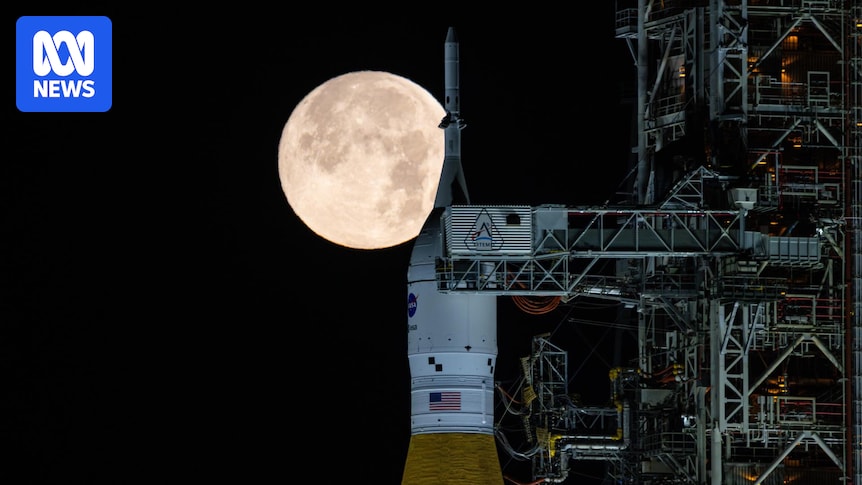
For the first time since 1972, NASA is sending humans around the Moon.
Four astronauts, including the first woman and the first African American, could be making their way towards the Moon in early March.
The historic mission — Artemis II — is a 10-day space voyage decades in the making.
After years of delays on both Artemis I and Artemis II, the latest testing of the rocket indicates it may be ready to lift off as early as March 6 US time (March 7 Australian time).
“The excitement for Artemis II is really starting to build. We can really start to feel it, it’s coming,” said Lori Glaze, the acting associate administrator for NASA’s Exploration Systems Development Mission Directorate in a press conference overnight.
“Every night I look up at the Moon, and I see it and feel excited because she’s calling us, and we are ready.”
Australian of the Year and trained astronaut Katherine Bennell-Pegg said this was a historic mission.
“I hope the whole of Australia is going to be looking up as humans go back out around the Moon for the first time in more than half a century,” she said.
“Let yourself be amazed by the things that humanity can do in times of … international collaboration.”
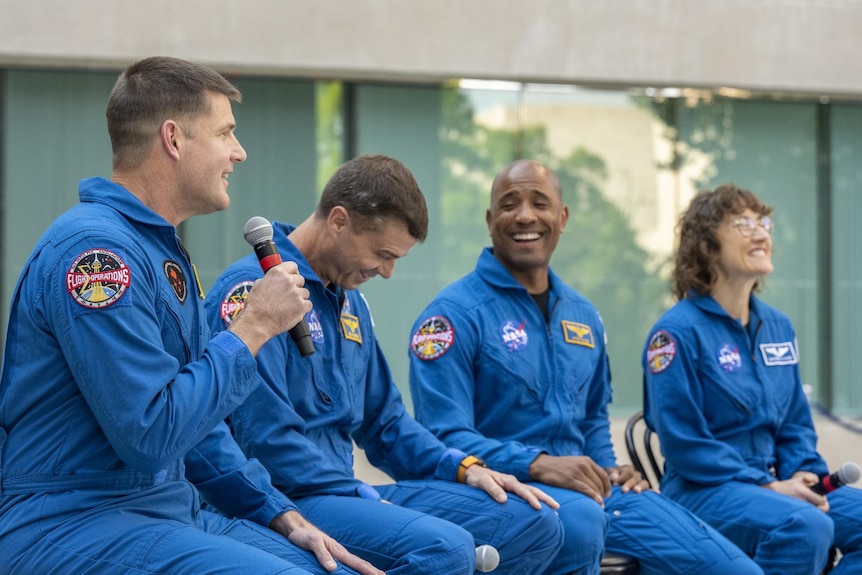
The four astronauts — (L-R) Jeremy Hansen, Reid Wiseman, Victor Glover, and Christina Koch — will be the first people to visit the Moon in over half a century. (Supplied: NASA/Keegan Barber)
If Artemis II succeeds, not only will it be the first mission to fly humans around the Moon in more than 50 years, it may potentially send humans further into space than they’ve ever been.
Here’s what you need to know before it takes off.
What is Artemis II?
Artemis II is the second flight in NASA’s Artemis campaign, but is the first with humans aboard.
The four astronauts on the Artemis II mission — commander Reid Wiseman, pilot Victor Glover, and mission specialists Christina Koch and Jeremy Hansen — will be the first humans to travel to the Moon in more than 50 years.
The last crewed mission to the Moon was Apollo 17 in 1972.
The mission will launch on a rocket called the Space Launch System (SLS), which uses some components from NASA’s space shuttle program, which ended in 2011.
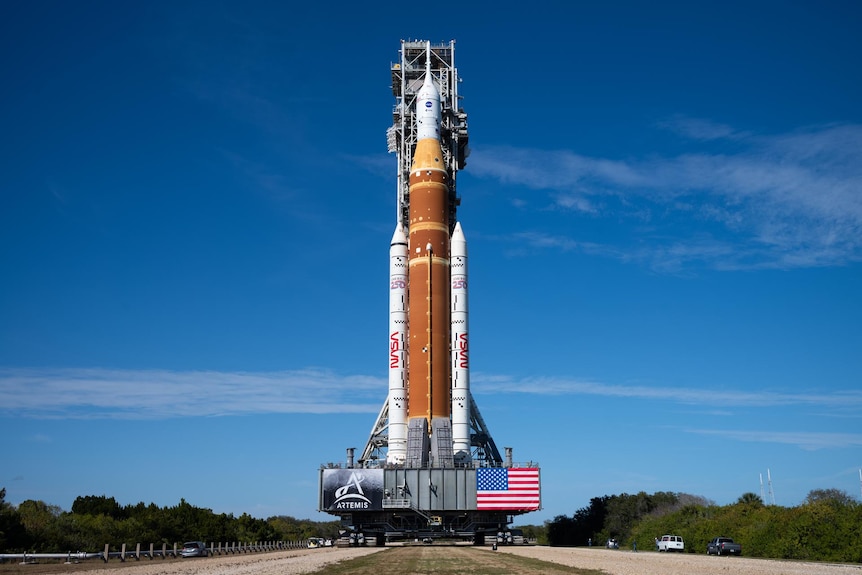
The Orion capsule sits on top of NASA’s Space Launch System rocket, which has components used during the space shuttle era. (Suppled: NASA/Joel Kowsky)
The spacecraft — called Orion — has been built specifically for the Artemis mission and will hold the astronauts in a dome-shaped capsule.
Together, the SLS rocket and Orion spacecraft is around 30 storeys tall, with the astronauts entering the spacecraft about 25 storeys up.
During Artemis II, astronauts will test Orion’s manual controls for the first time, as well as see how the life support systems respond.
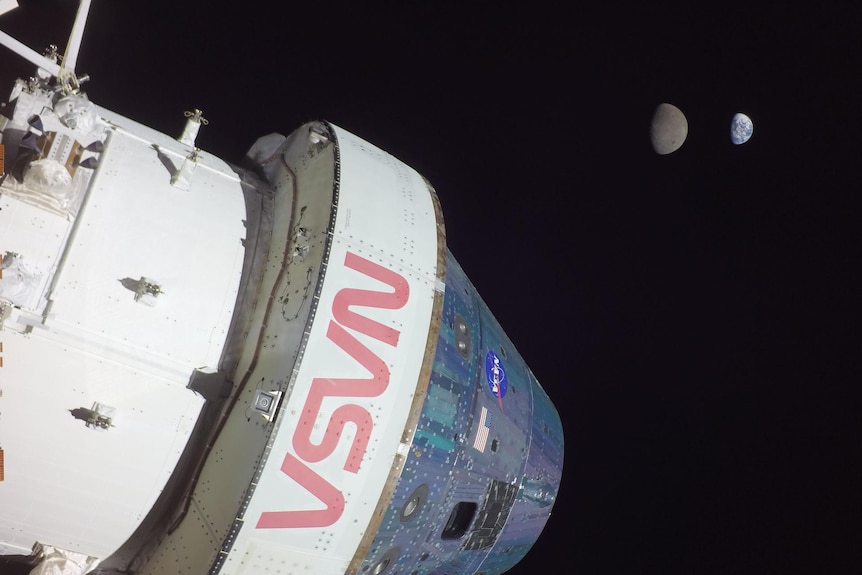
Orion captured the Earth and Moon on the Artemis I mission. (Supplied: NASA)
After launch, the team will orbit the Earth for 24 hours before they make their way to the Moon to do a large, looping orbit that will take it beyond the Moon’s far side and slingshot back to Earth.
NASA ‘playing Russian roulette’ with astronauts’ lives, ex-engineer says
As it ploughs through Earth’s atmosphere, the Orion spacecraft will experience extreme heat of about 2,760 degrees Celsius.
The spacecraft’s heat shield was damaged on the first flight — Artemis I, which was “crewed” with test dummies. NASA has deemed it safe for crewed travel, but some people in the space community are not convinced.
The next mission — Artemis III — is planned to put humans back on the Moon for the first time since Apollo. Further in the future, the Artemis program is aiming to get people back to the Moon for longer periods, with a Moon base, and then onto Mars.
How does Artemis II compare to Apollo missions?
According to Adam Gilmour, the CEO of Australian rocket company Gilmour Space Technologies, NASA’s slow and steady approach to the Artemis program is similar to the Apollo missions.
The inside story of the Challenger disaster
“In the Apollo missions, they made incremental leaps forward in what they tested,” he said.
“One of the first big missions was a very similar mission [to Artemis]. They did a figure-eight around the Moon.”
While the astronauts are not going to land on the Moon in this mission, they have been tasked with investigating lunar geology on the far side of the Moon and undertaking several other science experiments on the 10-day mission.
The Orion capsule also uses similar heat shield technology developed for the Apollo missions with a few tweaks.
Will Artemis II be the furthest people have travelled from Earth?
Maybe, but we won’t know until the astronauts get there.
Artemis II could potentially send humans further beyond the Moon than they’ve been before. But, that will heavily depend on two things:
Firstly, how far away the Moon is from Earth. At its closest, the Moon is about 356,000 kilometres away, but at its furthest it is about 406,000km away.
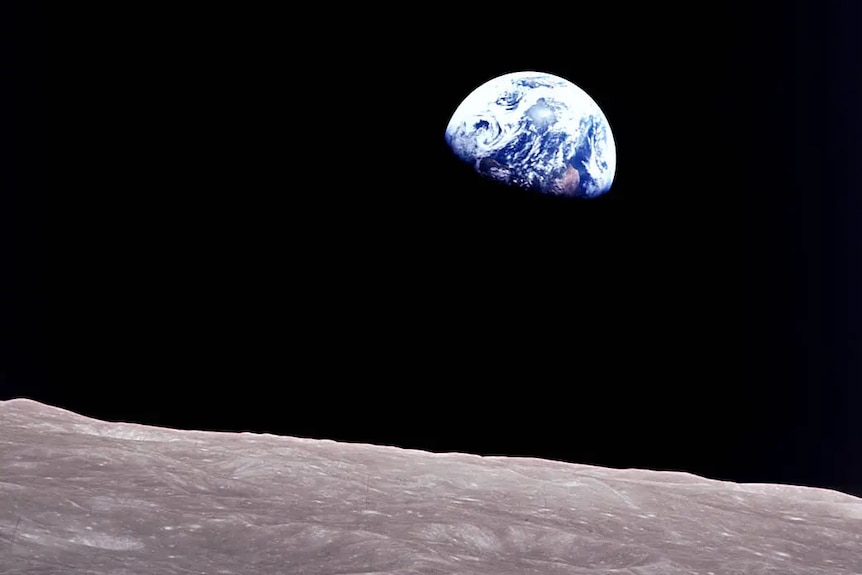
You may get to see images of Earth from the Moon’s far side like this one from the first Apollo mission to orbit the Moon. (Supplied: NASA)
Secondly, how close the spacecraft will be to the Moon — that could be anywhere from 7,500 to 19,000km.
The current record is held by the crew of the Apollo 13 mission, who went 400,171km from Earth after they had to undertake an emergency manoeuvre when a mid-mission explosion damaged the orbiting spacecraft.
The orbit took them 250km above the surface of the Moon.
Can we expect delays?
Potentially yes. Nothing is certain until minutes before the launch.
Hydrogen leak delays Moon mission by at least a month
NASA had planned to launch Artemis II in early February but this was delayed due to cold weather and the detection of hydrogen leaks just five minutes from the end of a full two-day dress rehearsal.
A similar issue occurred during the first Artemis mission, which was pushed back three months.
The launch was scrubbed twice — once due to a faulty engine temperature reading and once due to a hydrogen leak found during fuelling.
There are a few days in March, starting with March 6 and including March 7,8, 9 and 11 (US times).
If it gets delayed in March, the next window to launch is early April.
How can I watch it?
NASA will stream the launch on its YouTube channel.
Because we likely won’t know when the launch will happen until a few hours before, it’s best to keep an eye on NASA’s social media accounts.
What role will Australia play in the Artemis II mission?
Australia is one of 61 nations signed to the Artemis Accords, an agreement governing the exploration and use of outer space.
While Australia’s space program is much smaller than NASA, Ms Bennell-Pegg said Australia was contributing to the missions.
“[The Australian Space Agency is] supporting Australia to contribute to the Artemis mission and preparing to contribute more throughout the Artemis program,” she said.
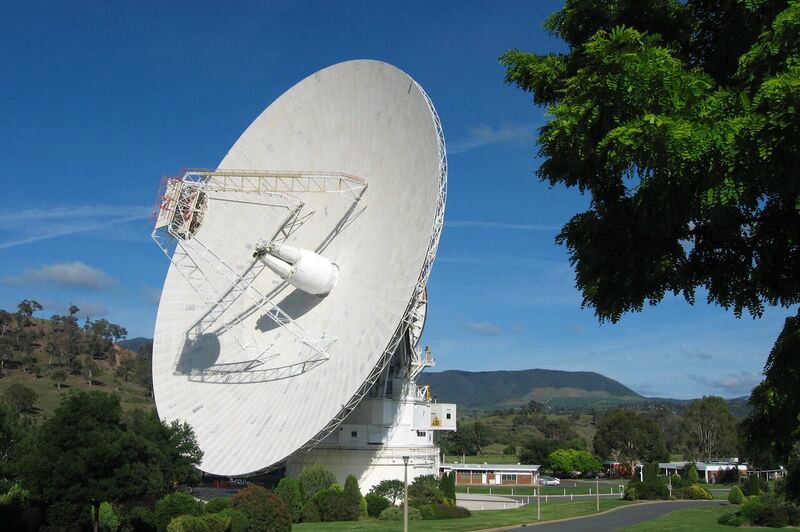
The Tidbinbilla space communications system is one of three stations around the world that will monitor the Artemis II mission. (Supplied: Canberra Deep Space Communication Complex)
Australia will play an essential role in tracking and supporting communications with Artemis via NASA’s Deep Space Network station at Tidbinbilla, near Canberra.
“[It will track] functions like 4K video, remote operations, telemedicine, tracking of the health and safety of astronauts,” Ms Bennell-Pegg said.
“So a lot more people can really feel what it’s like to be out there at that forefront of human endeavour.”