
If we’re willing to think about the future, the farther ahead we extrapolate, the farther along the inevitable path towards our thermodynamic end state: the heat death of the Universe. Star-formation will eventually end, and then the last shining stars will burn out. Galaxies will dissociate due to gravitational interactions, ejecting all masses and leaving only supermassive black holes behind. And then those black holes will decay via Hawking radiation, leaving only cold, stable, isolated bodies, from which no further energy can be extracted, all accelerating away from us within our dark energy-dominated Universe.
At least, that’s what will happen in our far future based on our current cosmic picture: the best one we’ve figured out as of 2026. But this troubles a great many people, including our reader Mary Luce, who writes in to inquire:
“I know I’ll be long dead and the earth long gone, but it still makes me sad to think the universe will die. That there will arise a time when everything that came before is meaningless. Instead of our universe dying, why can’t the vacuum’s expansion lead to another Big Bang? […Can anything] rejuvenate the universe and stop it from dying?”
This is a big question: not just from the perspective of physics and cosmology, but existentially as well. Here are the sober facts, along with the best alternative scenarios that could avoid this seemingly inevitable fate.
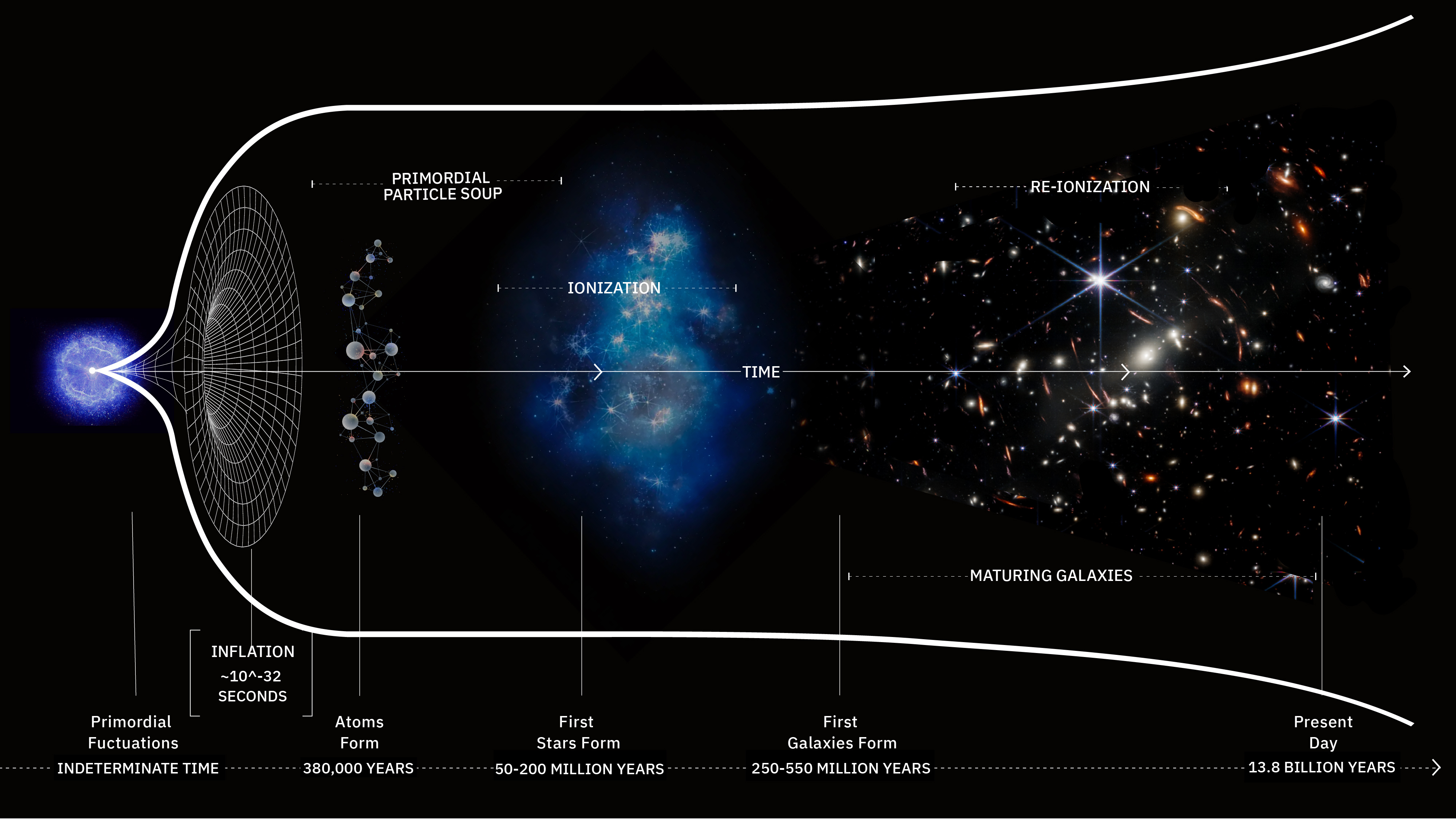
At the start of the hot Big Bang, the Universe was rapidly expanding and filled with high-energy, very densely packed, ultra-relativistic quanta. An early stage of radiation domination gave way to several later stages where radiation was sub-dominant, but never went away completely, while matter then clumped into gas clouds, stars, star clusters, galaxies, and even richer structures over time, all while the Universe continues expanding. The expansion rate evolves dependent on the sum total of all the forms of energy present within it, linking the observed expansion to the energy contents of our cosmos.
Credit: Big Think / Ben Gibson / NASA / Pablo Carlos Budassi
It’s true: the Universe, much like everything that has ever existed within it, will someday die. We normally look at death as the moment when the processes that were “keeping something alive” cease to operate, and we do this for living things and non-living things alike. Whereas for a human, we might look at things like:
our beating hearts,
our respirating lungs,
our ability to eat and drink and digest and incorporate those nutrients into our bodies,
and our body’s ability to transport oxygen and create new cells,
a very similar line of reasoning applies to things like planets, stars, and galaxies.
A planet like Earth is alive because there’s biological activity happening on and within it. Because our Sun is heating up over time, it’s inevitable that Earth’s temperature is going to continue to increase. At some point, likely within the next two billion years, those temperatures will rise so high that our oceans will boil away; shortly after that, it’s expected that life on our planet will go completely extinct. Then, about four to five billion years later, our Sun will run out of hydrogen fuel in its core, evolving into a red giant. Although the simulations still have hefty uncertainties for what the fate of the inner planets will be, the Sun’s expansion looks like it’s going to swallow Mercury, Venus, and yes, probably the Earth as well. At that point, our planet will be gone completely.
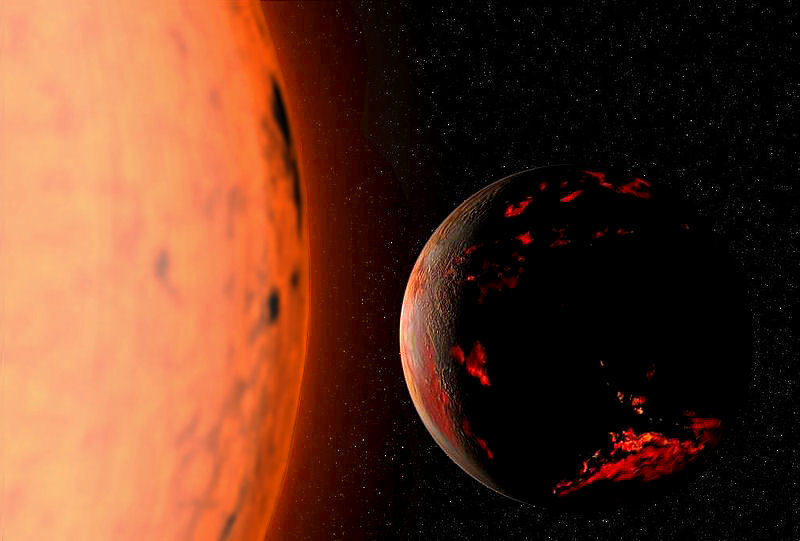
As the Sun becomes a true red giant, the Earth itself may eventually be swallowed or engulfed, but it will definitely be roasted as never before during the subgiant phase and the evolution into a red giant. It remains to be determined whether any of the effects of swallowing Mercury, Venus, or even possibly Earth will be noticeable by a distant alien civilization.
Credit: Wikimedia Commons/Fsgregs
The Sun will meet its demise shortly thereafter. As it exits the red giant phase, it enters the asymptotic giant branch stage of its life, where it sheds its outer layers in pulses. Finally, its now-inert core contracts down to form a white dwarf, while the prior ejecta get heated up and ionized, creating a planetary nebula. Over time, the white dwarf will cool and fade away in an end-state known as a black dwarf: the eventual end-state of all but the most massive stars that will ever form.
Stars may continue to form for many trillions of years, and potentially even after the last reserves of gas have been expelled from a galaxy. While stars of all colors and masses — from blue giants to red dwarfs — will burn through their fuel and die, the brown dwarfs of the Universe will persist. These failed stars have only a fraction of the mass of a true star, but many are born in binary systems. Over long periods of time, and sometimes very long periods of time, their orbits will decay, and the two components will inspiral and eventually merge.
When that occurs, the conditions within the new object’s interior may yet be right for nuclear fusion to proceed. A new star, a low-mass red dwarf, could be born from this process. It is anticipated that this is how the final stars, or the last sustained sources of light and energy, will arise in the Universe.
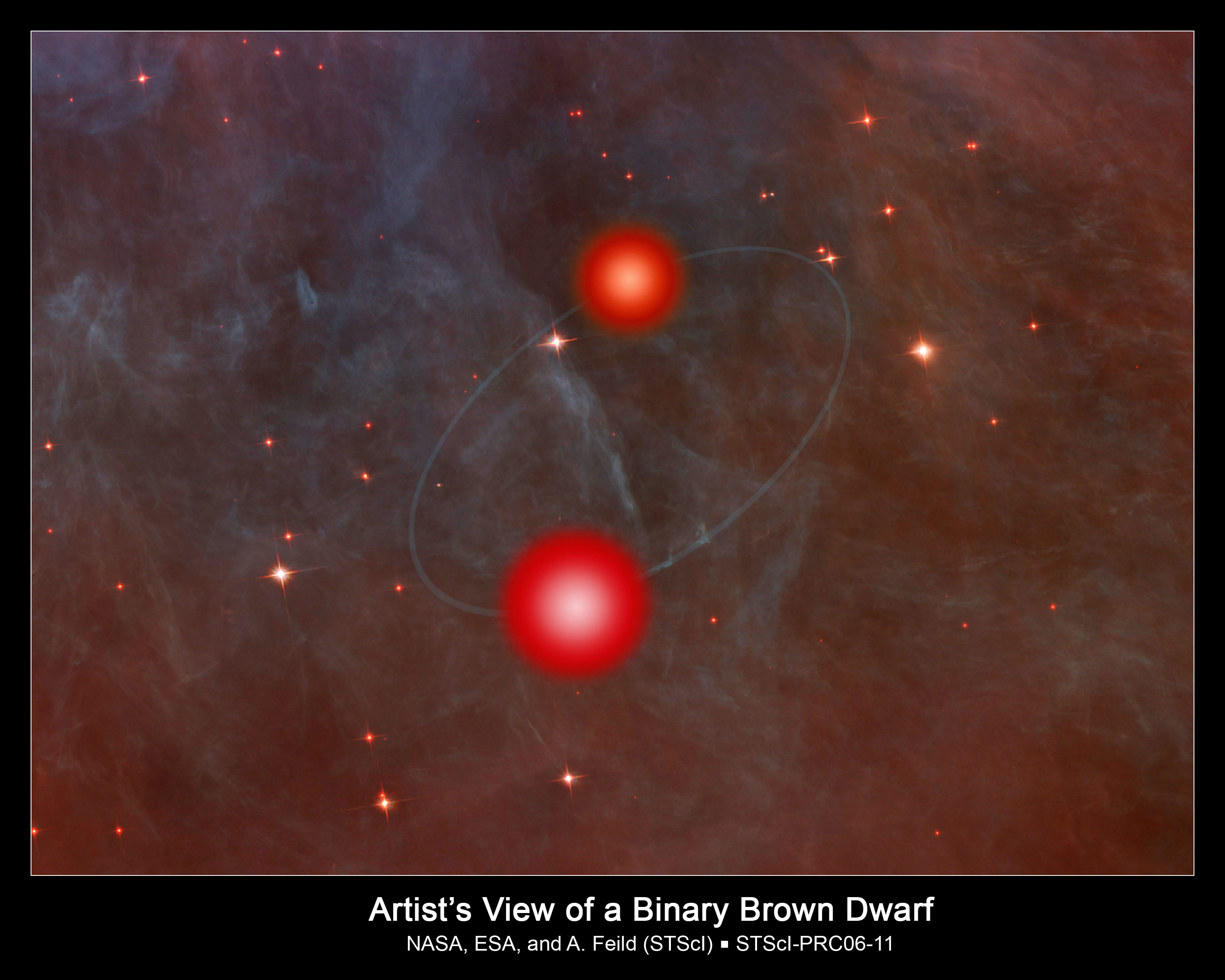
Just as stars often exist in binary, trinary, and more populous multi-star systems, so too do brown dwarfs: failed stars. It’s possible that there are binary brown dwarf systems with sufficient separations to enable the inspiral and merger of these components a very long time from now, where they will ignite hydrogen fusion in the post-merger red dwarf that forms: even after the host galaxy is fully gas depleted. If any orbiting worlds exist at the right distance around the newly formed red dwarf, life may eventually arise even quintillions of years into the future, or potentially even more.
Credit: NASA, ESA, and A. Feild (STScI)
The galaxies that are so familiar and ubiquitous in our Universe today will die, at least in a sense, as well. For the first few billion years of cosmic history, galaxies formed and grew by accreting more and more material from the intergalactic medium, as well as by merging together to form larger, more mature galaxies. Supermassive black holes formed (possibly before the galaxy itself), growing as matter falls into them, and structures grew richer and larger over cosmic time.
And then dark energy began dominating the Universe’s expansion: an event that occurred about 6 billion years ago. Accretion from the intergalactic medium still occurs, but its rate has dropped. Mergers still occur too, but only within large-scale structures that had already become gravitationally bound before dark energy became dominant.
Over long periods of time, all the galaxies within a bound structure will merge together, forming one giant galaxy. Our Local Group — like all galaxy groups and galaxy clusters — will experience this, eventually creating a super-galaxy known as Milkdromeda. And within that galaxy, not only will stars live-and-die, and not only will star-formation cease once all of the gas has been consumed, but gravitational interactions will eject most of those stellar corpses, as well as the planet remnants that orbit them.
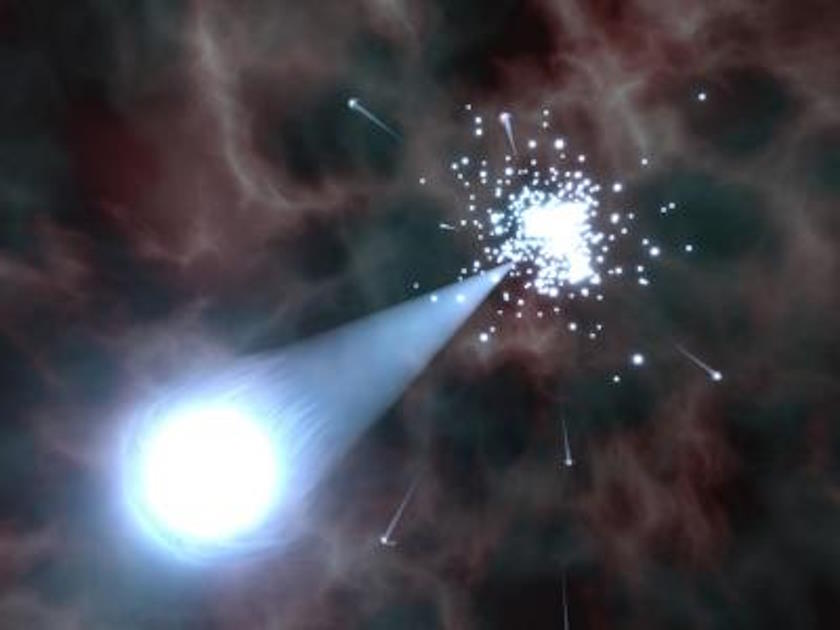
When a large collection of objects gets gravitationally bound together, like in a star cluster or a galaxy, repeated gravitational interactions will inevitably eject the lowest-mass members, while leaving the higher-mass ones more tightly bound towards the center. In the very far future, this should lead to nearly all stars and stellar remnants being ejected from a galaxy, while the supermassive black hole at its center grows evermore massive.
Credit: Tomohide Wada/4D2U/NAOJ; Science/AAAS
On even longer timescales, the remnant black holes that were created, whether from stellar explosions, neutron star mergers, a collapsing gas cloud, or having grown into supermassive behemoths, will all evaporate. The process of Hawking radiation, which arises simply by having quantum fields exist in the curved space around a black hole, ensures that all of these black holes will eventually be transformed into radiation: mostly photons, with a little bit of matter-and-antimatter emitted in the very end stages. For a black hole the same mass as our Sun, that will take around 1067 years, and for the heaviest supermassive black holes, we’re talking well over 10100 years.
And therefore, as our question-asker Mary inquired this week, it may seem like everything we do or don’t do, accomplish or don’t accomplish, who we’re kind to or cruel to, and who we love or hate is cosmically irrelevant in the end. It won’t just be the Earth that disappears, or the Sun, or the Solar System, or the Milky Way. It will be the entire Universe, on long enough timescales, that ends. All the life on all the worlds across all of space and time that ever comes into existence will die, as will all of the stars and stellar remnants. The galaxies will dissociate and disappear, leaving only isolated masses expanding away from one another, with no energy left to extract.
When a black hole either forms with a very low mass, or evaporates sufficiently so that only a small amount of mass remains, quantum effects arising from the curved spacetime near the event horizon will cause the black hole to rapidly decay via Hawking radiation. The lower the mass of the black hole, the more rapid the decay is, until the evaporation completes in one last “burst” of energetic radiation. The longest-lived black holes will be the most massive, with decay timescales exceeding 10^100 years.
Credit: ortega-pictures/Pixabay
To many, this is a sad, depressing thought. When we think sad or depressing thoughts about what’s to come, it’s a very human impulse to try and figure out a way to change it. The idea of time travel to the past came about in fiction long before it came about in theoretical physics, as it was our imaginations and our desire to change the trajectory of human civilization that inspired it. When it comes to the fate of the Universe, physicists and astrophysicists of all different varieties have worked on many of the same things, including attempting to figure out ways to avoid this type of fate.
One way out is to imagine that dark energy — the culprit and driving force behind the accelerated expansion of the Universe — can in some way change over time. There is, at present, some evidence for dark energy weakening over time, although the results from the DESI collaboration, which provide the strongest evidence to date for such a scenario, are highly ambiguous. If dark energy does evolve over time, then all of a sudden this fate for our Universe isn’t necessarily a done deal. Depending on how dark energy evolves, several other possible fates may be on the table.
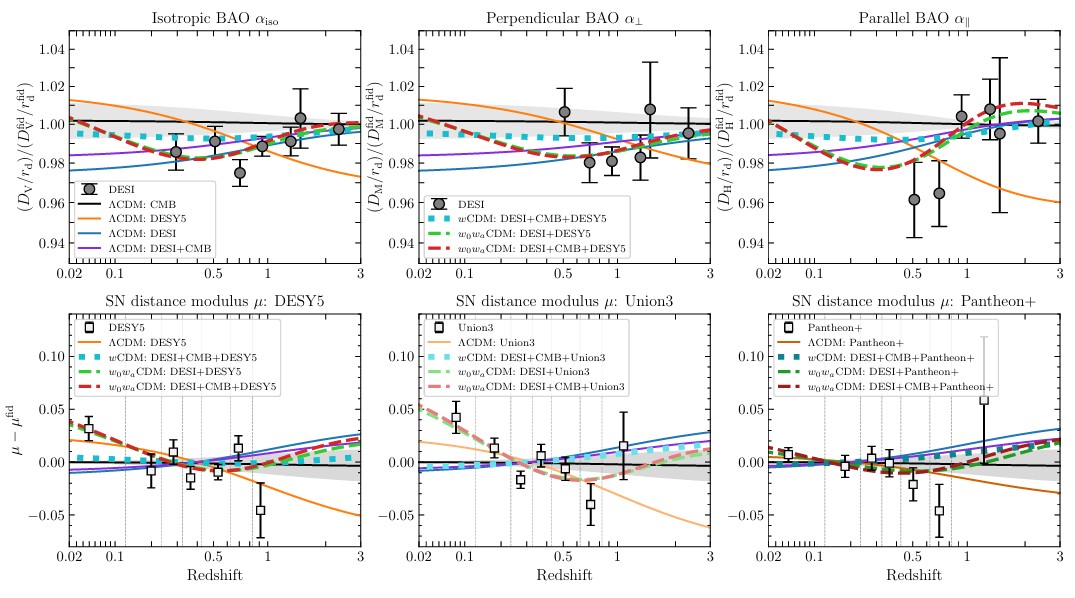
Looking at the data points from DESI (top row) or from the various supernova collaborations (bottom row), it’s very clear that the data, at this point in time, is not sufficiently good to robustly discriminate between the various options for how dark energy is behaving in the Universe. The fact that the three different supernova samples, DESY, Union, and Pantheon+, give such different answers from one another should be a troubling indication that we haven’t yet uncovered the full story. However, the possibility of dark energy evolving must be duly considered.
Credit: DESI Collaboration/M. Abdul-Karim et al., DESI DR2 Results, 2025
One scenario would be where dark energy decayed away entirely, and where it decayed into particles like matter, antimatter, and radiation. Under this scenario, the Universe would cease accelerating eventually, and would instead enter a critical state: on the border between expanding forever and recollapsing. In this scenario, the structures of the Universe wouldn’t dissociate and accelerate away from each other, but would instead be eternally reachable to a fast enough observer within the Universe. That simple scenario is a lot less depressing.
It’s also possible that dark energy doesn’t evolve by decaying away, but rather evolves by changing its equation-of-state. In this scenario, the “energy” of dark energy remains, but how that energy affects the cosmic expansion evolves over time. The best evidence from DESI indicates that dark energy used to be stronger than a cosmological constant in terms of its accelerating effects, and has weakened over the past few billion years to now be weaker than a cosmological constant in terms of cosmic acceleration. If dark energy continues to change in this fashion, it could eventually behave as a decelerating force, potentially leading to a situation like cosmic recollapse and a Big Crunch. It’s possible that, in the aftermath of that state, a new Universe, with a new Big Bang-like scenario, will emerge.
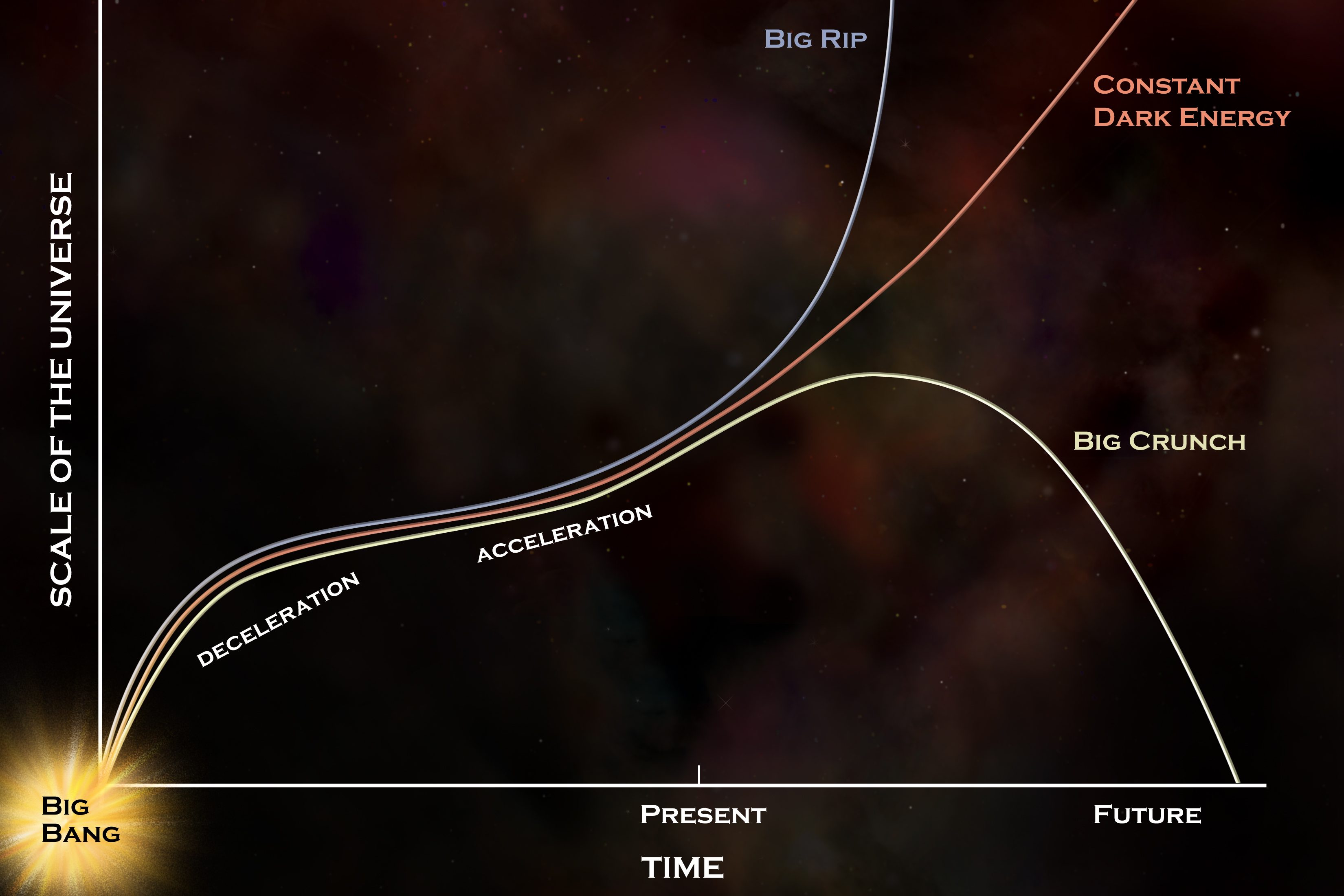
The far distant fates of the Universe offer a number of possibilities, but if dark energy is truly a constant, as the data best indicates, it will continue to follow the red curve, leading to the long-term scenario frequently described on Starts With A Bang: of the eventual heat death of the Universe. If dark energy can strengthen, weaken, or reverse sign over time, however, all bets are off, and alternative possibilities, like a Big Crunch or a Big Rip, suddenly abound.
Credit: NASA/CXC/M. Weiss
On the other hand, it’s possible that dark energy was and always has been a cosmological constant, and that this is because the vacuum our Universe has been trapped in a “false minimum” state ever since the end of cosmic inflation. If there’s a “true minimum” that’s lower in energy, and that’s potentially even at zero energy, as compared with the quantum vacuum today, then it becomes possible for our Universe — somewhere in space and at some point in time — to quantum tunnel from this false minimum into the true minimum state. If and when that occurs, the laws of physics themselves will change, and hence everything that’s bound together by our laws of physics (galaxies, stars, molecules, atoms, protons, etc.) will be destroyed.
This destruction will be unusual and unfamiliar: the energy liberated by the tunneling will create new particles, antiparticles and radiation, similar to how those same quanta were created in the hot Big Bang. Existing particles will now obey new laws of physics, and so existing structures will be destroyed and replaced by new structures that obey different laws. Wherever this vacuum transition occurred, a “bubble of destruction” will originate, expanding outward at the speed of light, and destroying everything that it touches. In this way, too, it’s possible for our Universe to not end in a heat death, but to experience a rebirth event instead.
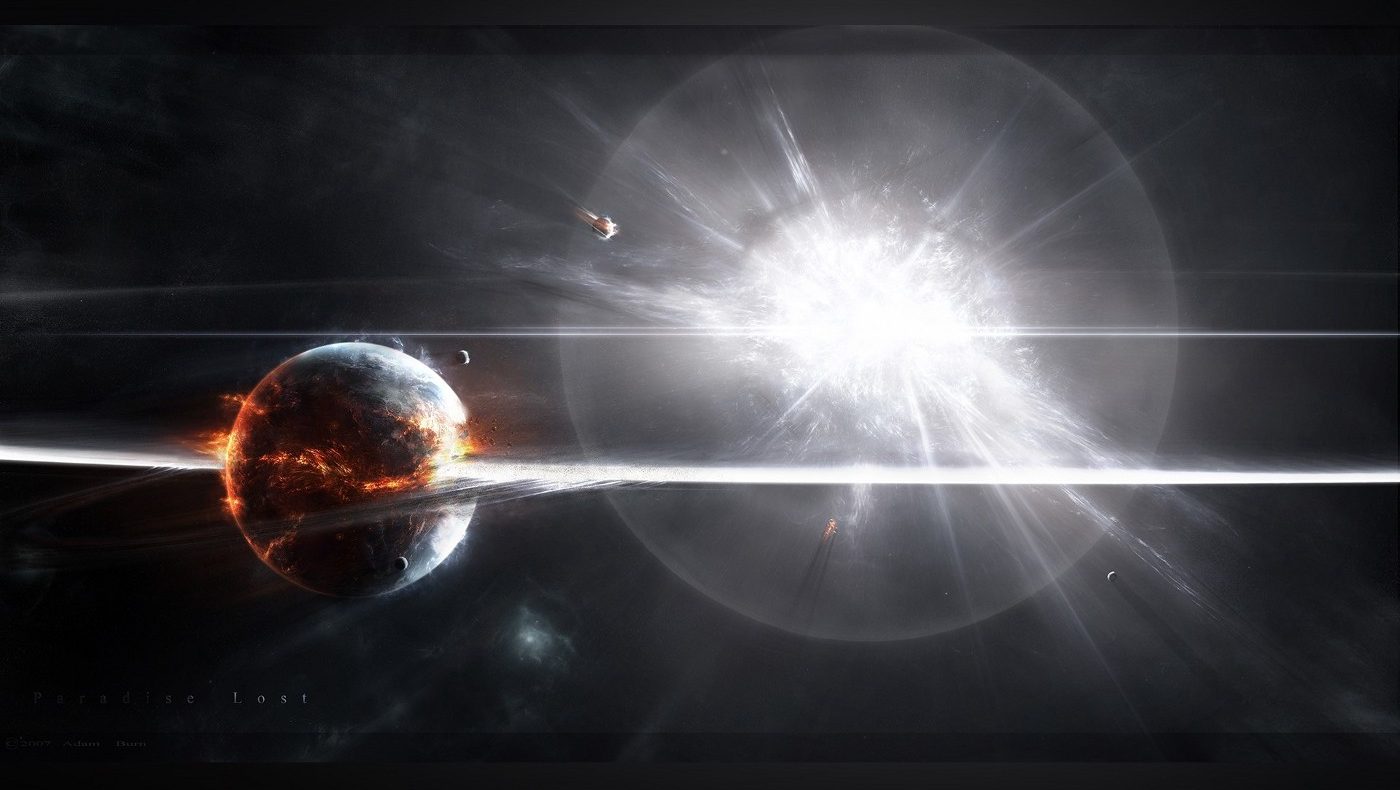
In a vacuum decay scenario, our Universe exists in a false minimum state, and it’s possible to arrive, either through quantum tunneling or an energetic kick that causes us to leave that state, to enter a true (or truer) vacuum state. If that happens anywhere, every bound structure, from protons on up, will be destroyed in a “bubble of destruction” propagating outward at the speed of light.
Credit: Darkspace.net forums
Another less talked about possibility is that dark energy neither a cosmological constant nor is it evolving, but that simply it has the property that its accelerative properties are more severe than a cosmological constant would imply. This scenario, known as phantom dark energy, would neither lead to dark energy decay nor to a Big Crunch, but instead a scenario where dark energy got stronger and stronger over time, eventually leading to a different catastrophe: the Big Rip. On much shorter timescales, objects would be destroyed from the outside in: first galaxy clusters, then galaxy groups, then galaxies, stellar systems, stars, planets, molecules, atoms, protons, and space itself would be torn apart.
In the aftermath of this, we could arrive at a new Big Bang-like event in what has been called a rejuvenated Universe. In this sense, the Universe would still die, but could be reborn in a phoenix-like event.
Even if none of these exotic scenarios occur, it’s possible that some evidence of your existence — in the form of information — could make its way into a baby Universe if you fell into a black hole. It’s not necessarily an adventure for the faint of heart: no one knows what happens inside a black hole and it’s difficult to imagine surviving the journey, but it’s a possibility that shouldn’t be ignored just because it carries its own discomforts with it.
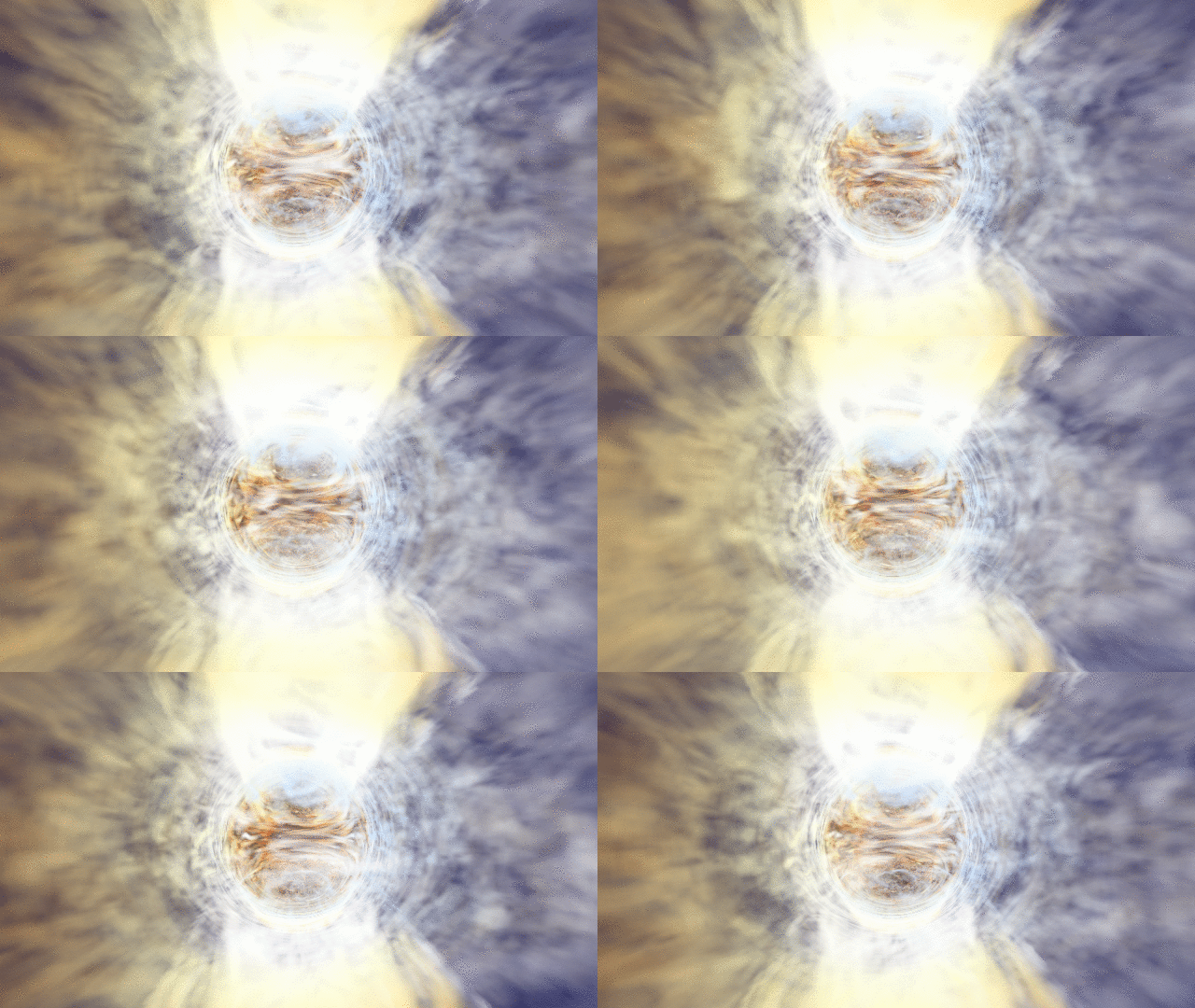
From outside a black hole, all the infalling matter will emit light and is always visible, while nothing from behind the event horizon can get out. But if you were the one who fell into a black hole, your energy could conceivably re-emerge as part of a hot Big Bang in a newborn Universe.
Credit: Andrew Hamilton, JILA, University of Colorado
However, even if none of these scenarios are true and the Universe does end, far in the future, with our cold, lonely, “heat death” fate awaiting us, that doesn’t mean, as was assumed in the initial question, that “everything that came before is meaningless.” The meaning of existence is not some scientifically testable or provable idea like the ultimate fate of the Universe; it is an inherently subjective idea that depends on you: the one who is existing. This can be frustrating for those of us who demand external answers to even unanswerable questions, but it can also be freeing once you realize this is the case.
Without external constraints on the meaning of your existence, you become free to choose for yourself what gives meaning to your existence. That includes choices like who you love, who you’re kind to, whether you value truth or loyalty or honesty, and where you put your time and energy. Although there is indeed a vast Universe out there — a Universe where there are likely a myriad of untold lifeforms and possibly even civilizations out there — there is still no credible evidence for an inhabited world other than Earth. This means that, in all the known Universe, there’s no one else we can count on to love us, be kind to us, help us survive, and teach us right from wrong. It is, at least for now, just us. While the fate of our Universe may be beyond us to control, the ability to give meaning to our own lives lies within each of us.
Send in your Ask Ethan questions to startswithabang at gmail dot com!