
Senior figures at NASA have issued a stark warning regarding the safety of Earth from space-borne threats. Speaking at a major science conference, planetary defence experts revealed that thousands of ‘city-killer’ asteroids remain undetected, and currently, there is no active system in place to deflect them should a collision course be confirmed.
Dr Kelly Fast, the Planetary Defence Officer at NASA Headquarters, addressed the American Association for the Advancement of Science (AAAS) in Phoenix, Arizona. She identified mid-sized asteroids as her primary concern. These objects, typically measuring around 140 metres (460 feet) or larger, are capable of causing devastating regional damage rather than global extinction. Dr Fast stated that it is the ‘asteroids we don’t know about’ that keep her awake at night.
While agencies track massive asteroids—the kind depicted in disaster films—and small debris strikes Earth daily without consequence, the middle ground poses a unique problem. Estimates suggest there are approximately 25,000 of these mid-sized near-Earth objects. However, humanity has only catalogued about 40 per cent of them. This leaves roughly 15,000 significant space rocks completely unaccounted for.
Deflection Technology Exists but Lack of Preparedness Remains
The issue is not just detection, but defence. In 2022, NASA successfully conducted the Double Asteroid Redirection Test (DART), crashing a spacecraft into the minor moon Dimorphos at 14,000 mph to alter its trajectory. This mission proved that humanity possesses the physics and engineering knowledge to push a threatening rock off course.
However, Dr Nancy Chabot, the DART mission lead from Johns Hopkins University, explained that while the technology exists, the infrastructure does not. ‘We worry about these city killer asteroids,’ Chabot said. ‘DART was a great demonstration but we don’t have that sitting around ready to go if there was a threat we needed to use it for.’
Dr Chabot emphasised that building a deflection craft takes considerable time—time that Earth might not have if an asteroid is spotted late. Currently, space agencies lack the necessary funding to keep planetary defence systems on standby.
NASA’s documentary “Planetary Defenders” explores the science of asteroid detection and efforts to protect Earth from cosmic threats.
The Challenge of Detection and Future Solutions
Finding these objects is notoriously difficult. Many orbit the Sun in a way that keeps them hidden in the glare of daylight or are simply too dark to reflect enough light for standard telescopes to catch. Dr Fast noted that even with the best current telescopes, finding these dark rocks is a slow process.
To address this, scientists are preparing to launch the Near-Earth Object (NEO) Surveyor space telescope next year. This advanced equipment will use thermal signatures to spot dark asteroids and comets that have previously evaded detection. The goal is to find the asteroids before they find Earth, giving humanity the necessary lead time to construct a defence.
Current Cosmic Visitors and Future Risks
As these warnings are issued, a massive comet is currently making its way through the inner solar system. Comet Wierzchoś (C/2024 E1), discovered in March 2024 by Polish astronomer Kacper Wierzchoś, is approaching its closest point to Earth. With a diameter of roughly 8.5 miles (13.7 km)—about two-thirds the length of Manhattan—it is a significant celestial body, though it poses no collision threat.
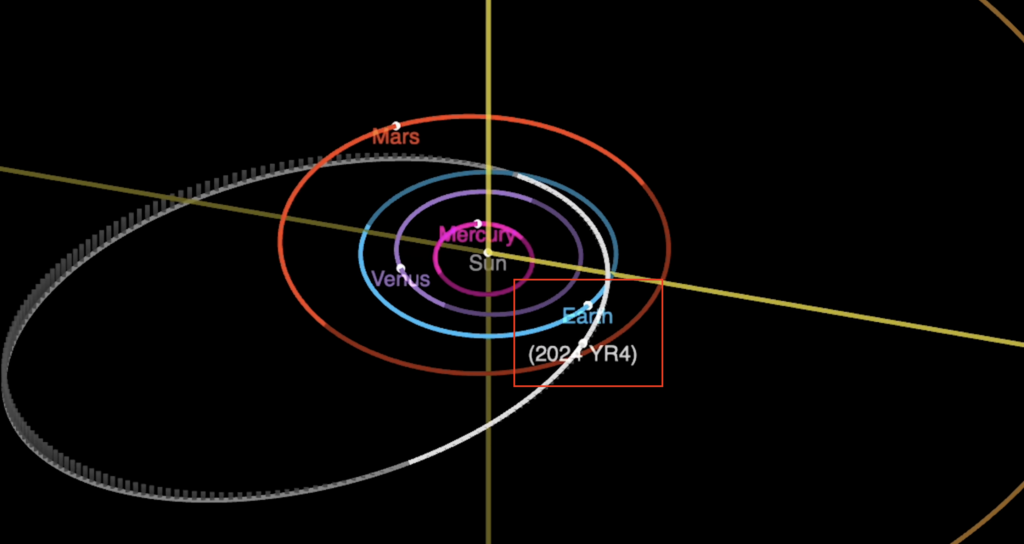
Looking further ahead, experts are monitoring asteroid YR4. Identified in 2024, this rock has a 4 per cent probability of striking the Moon in 2032. While a lunar impact would not destroy Earth, it presents a complex challenge for space defence experts, some of whom have proposed using nuclear devices to destroy the rock before it can cause a crash landing on the lunar surface.