
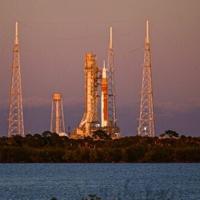
CAPE CANAVERAL, Fla. — NASA’s rescheduled launch of Artemis II is still weeks away, but excitement is steadily building as the window approaches.
Recent launches to the International Space Station may make human spaceflight seem routine. But Artemis II represents a significant step beyond low-Earth orbit. While astronauts regularly travel about 250 miles above the planet, this mission will send four crew members to sling around an object roughly 250,000 miles away on a 10-day journey around the moon and back — a distance not traveled by humans in more than 50 years.
The mission will test critical systems needed for future lunar landings and sustained exploration near the moon. Engineers working on the program describe it as a once-in-a-generation opportunity and say it feels like living in a dream to help make it happen.
That growing anticipation is also being felt locally.

Shreveport Bossier Astronomical Society observatory.
At the Shreveport Bossier Astronomical Society’s observatory off Highway 175, regular stargazing events tap into the natural curiosity many people have about the moon and the broader solar system.
“Well, members of the Shreveport Bossier Astronomy Society are interested in all kinds of aspects of space,” said Cran Lucas, president of the society. “There are a number of people that have a great interest in just lunar observing,” he said, while others are more interested in planets or distant stars.
Lucas says Artemis II has the potential to capture global attention — not only for its scientific objectives, but for what it could inspire.
Lunar image captured by Cran Lucas, Shreveport Bossier Astronomical Society.
Cran Lucas, Shreveport Bossier Astronomical Society
“There are a lot of scientific reasons, of course, because there’s a lot we still don’t understand about the moon,” he said. “But there are also a lot of interesting things there for the future.”
The engineering, mathematics, biology and technological innovation required for such a mission could also energize a new generation of scientists and engineers.
“I hope that this kind of effort is going to reinvigorate people’s interest in science and space and mathematics and engineering,” Lucas said. “Because we need these kinds of people to help keep our society going.”
The Society will hold several stargazing parties at the observatory in the coming months, with the next ones happening April 25 and May 23. More information is available at their website.