
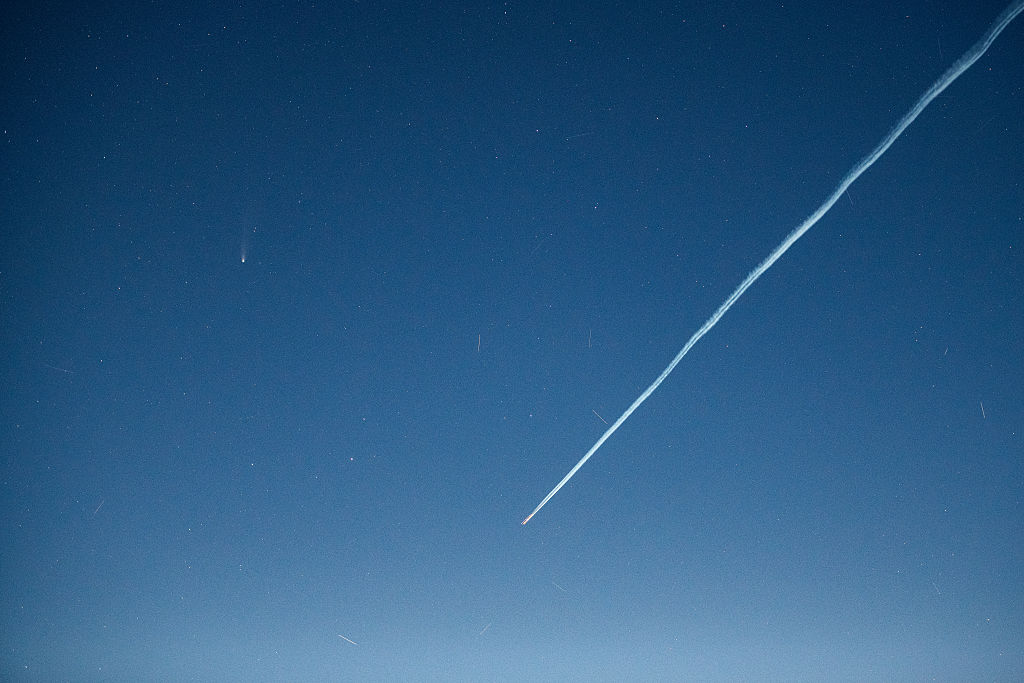
A planetary defense specialist is cautioning that humanity remains unprotected against as many as 15,000 near-Earth asteroids that have yet to be detected and could potentially destroy a city. (Photo by Lorenzo Di Cola/NurPhoto via Getty Images)
NurPhoto/NurPhoto via Getty Images
Bruce Willis and Ben Affleck stopped a Texas-sized asteroid from crashing into the Earth in the 1998 science-fiction movie “Armageddon.” But a NASA expert said recently the greatest concern isn’t the massive, Hollywood-style asteroid — it’s the ones scientists haven’t found yet.

Speaking at the American Association for the Advancement of Science (AAAS) conference in Phoenix, planetary defense officer Kelly Fast warned that thousands of near-Earth asteroids capable of destroying a city have yet to be detected — and humanity currently has limited protection against them.
Article continues below this ad
Fast said that small asteroids strike Earth frequently, so they’re not a major concern. She added that scientists are also less worried about the massive, movie-style asteroids because their locations are already known. But the “in-between” ones — that’s “what keeps me up at night,” she said.
“It’s estimated there are about 25,000 of those, and we’re only about 40 percent of the way through,” Fast said. “It takes time to find them, even with the best telescopes.”
What is an asteroid?
An asteroid is a small, rocky object that orbits the sun, according to NASA.
Article continues below this ad
Most asteroids are found in the asteroid belt between Mars and Jupiter, but some travel on paths that bring them closer to Earth — these are called near-Earth asteroids.
Asteroids are remnants from the early solar system, formed about 4.6 billion years ago. They range in size from a few feet across to hundreds of miles wide.
While most pose no threat, scientists monitor near-Earth asteroids whose orbits intersect with Earth’s path.
Article continues below this ad
Can we stop an asteroid from hitting Earth?
In some cases, yes — but it depends on size, composition and warning time.
According to The Planetary Society, scientists focus on deflecting an asteroid rather than destroying it. Even a slight shift in its orbit, made years in advance, could cause it to miss Earth entirely.
“If a big asteroid is found to be on a collision course with Earth we need to deflect it,” The Planetary Society wrote. “This means we change the asteroid’s orbit enough to make it miss Earth. The more warning time we have, the more options we have. There are a variety of deflection techniques that could save Earth from an incoming asteroid. They range from using a large spacecraft’s gravity to pull the asteroid off course, to sending up a kinetic impactor to slam into the asteroid, or even using nuclear detonations. But all of these deflection techniques still need more study and work so they’re ready to use when we need them.”
Article continues below this ad
What was the last asteroid to hit the Earth?
According to The Planetary Society, the most notable recent asteroid strike was the Chelyabinsk meteor, which detonated over Russia on Feb. 15, 2013.
The roughly 20-meter space rock caused a powerful airburst that injured about 1,500 people and damaged thousands of buildings. It did not leave an impact crater but demonstrated the potential danger of mid-sized objects.
Article continues below this ad