
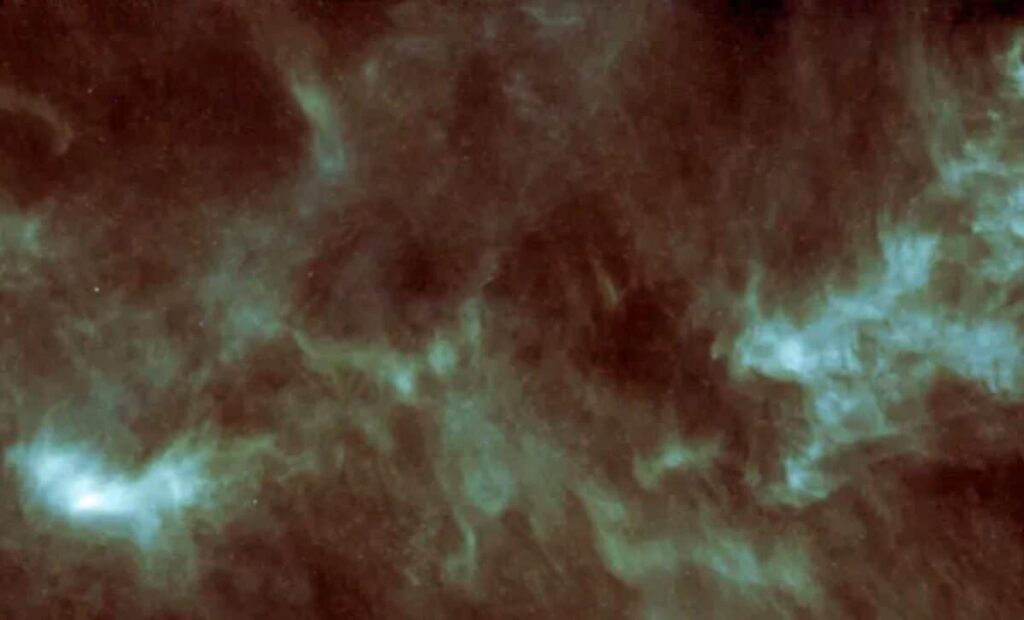
Astronomers have discovered a chemical called methanimine in the core of a pre-stellar cloud 554 light-years away, a finding that could offer vital clues about how life might begin on other planets. This organic molecule, found in the cold gas and dust of the L1544 cloud, suggests that chemical processes essential to life are already at work in nascent star systems.
The discovery, published by astronomer Yuxin Lin and his team, underscores the potential role of such molecules in seeding future planets with the basic building blocks of life. As the gas cloud L1544 collapses into a new star system, its chemical makeup may play a pivotal role in shaping planets that could eventually support life.
L1544: A Star-Forming Cloud of Possibilities
The Taurus Molecular Cloud, home to L1544, is a dense region of gas and dust where new stars are born. These pre-stellar cores, like L1544, are crucial stages in the star formation process. Despite their seemingly tranquil state, these regions are hotbeds of chemical activity, setting the stage for the creation of new stars and their surrounding planets.
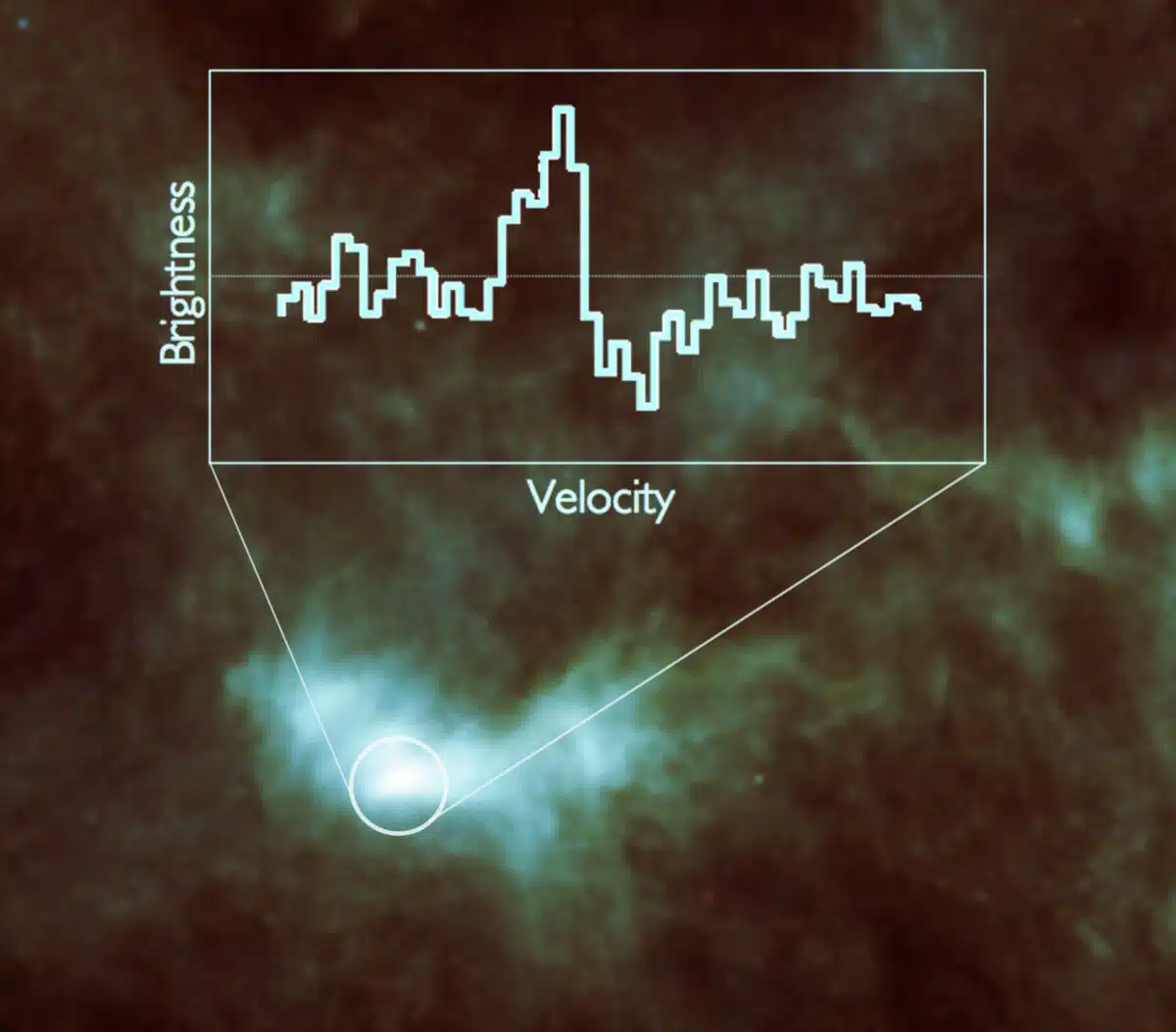 Graph of brightness and velocity data from L1544. Credit: ESA/Herschel/SPIRE/HIFI/Caselli & al.
At first glance, L1544 appears to be a calm, quiet place in the vastness of space. But according to Yuxin Lin and his team, this is actually the perfect environment for studying the molecular precursors to life. As material from the outer parts of the cloud gradually falls toward the center, it brings with it a cocktail of chemicals, including methanimine. This organic molecule, which forms in the colder, outer layers, could eventually make its way into the planets that will form from the collapsing cloud.
Methanimine: Life’s Must-Have Molecule
As outlined in the paper published in The Astrophysical Journal Letters, methanimine (CH2NH2), a simple organic compound, may seem basic, but it plays a critical role in the complex chemistry that leads to life. Positioned in the middle of a chain of reactions that produce larger organic molecules, methanimine contains carbon, hydrogen, and nitrogen; three of the fundamental elements that make up life as we know it.
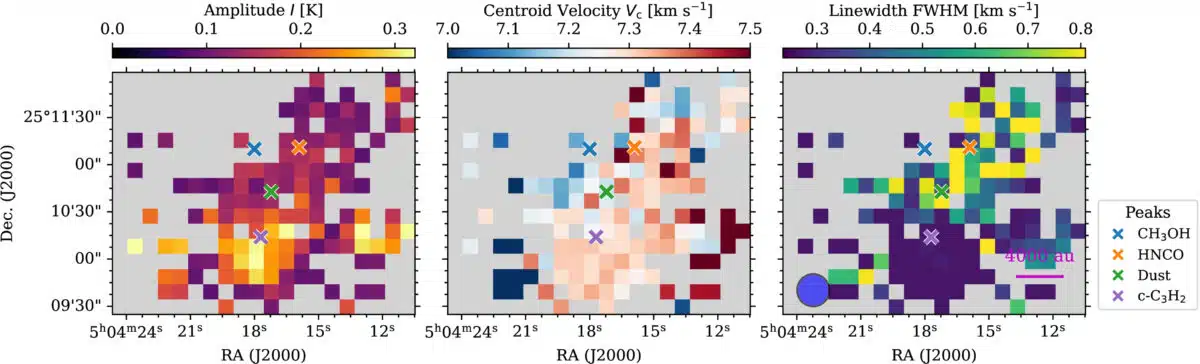 The image shows the spatial distribution of molecular peaks in a star-forming region with color-coded plots for amplitude, velocity, and linewidth. Credit: The Astrophysical Journal Letters
The presence of methanimine in a pre-stellar core like L1544 is significant. As the core collapses and eventually forms a new star and its planetary system, the chemical ingredients like methanimine that are scattered throughout the cloud could be inherited by the forming planets. This means that, over time, future planets might have organic molecules ready to jump-start life’s complex chemistry. According to Lin and his colleagues:
” This indicates that prebiotic nitrogen-carbon chemistry continues efficiently up to the onset of gravitational collapse, providing key constraints for astrochemical models and the early stages of chemical complexity leading to amino acids.”
The Cosmic Reach of Life’s Ingredients
If this organic molecule can form in one pre-stellar core, it’s highly probable that similar molecules are forming across countless other star-forming regions throughout the galaxy. According to the research team, this suggests that the building blocks for life may be widely distributed throughout the universe.
As more stars and planets are born from clouds like L1544, the seeds of life could be scattered across immense stretches of space. By understanding how these chemicals form and gather in star-forming clouds, astronomers gain valuable knowledge of how planetary systems might develop the potential to support life. This study strengthens the idea that organic molecules could be key players in the emergence of life on habitable worlds.