
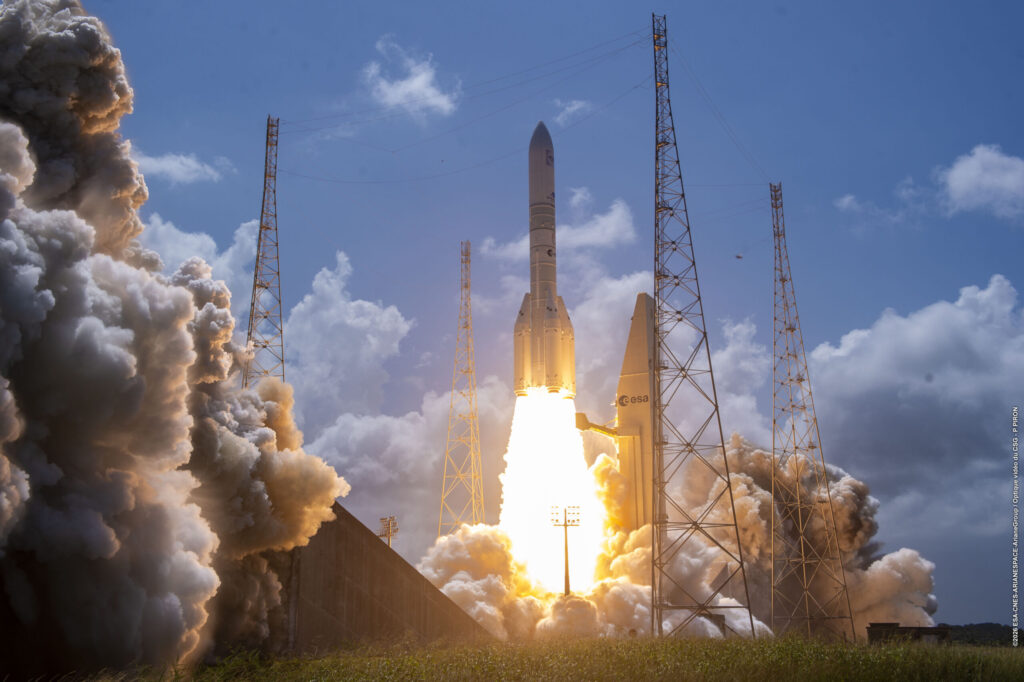
Europe’s largest and most powerful rocket ever made its maiden flight earlier this month, delivering 32 satellites to low-Earth orbit (LEO) for customer Amazon Leo—the e-commerce and logistics titan’s budding satellite constellation, billed as a rival to SpaceX’s rapidly expanding Starlink network.
Launched Thursday, the mission was the debut of Arianespace’s Ariane 64, which stands about 20 storeys tall and doubles the payload of the company’s Ariane 62 variant. Both are versions of the launch provider’s Ariane 6, which debuted in 2024 and replaced the Ariane 5 family as the European Space Agency’s (ESA) workhorse launch vehicle. The Ariane 62 configuration, denoting two solid rocket boosters, was used for the previous five Ariane 6 launches.
The flight was Arianespace’s 359th overall and first of 2026. It was also the rocket’s first mission for a commercial customer.
Josef Aschbacher, director general of the ESA, said the flight means the agency’s fleet of rockets is “now complete, but we will not rest.” In addition to Ariane 6, it uses Avio’s Vega-C. Both vehicles are competitors to SpaceX’s reusable Falcon 9 and Falcon Heavy, which accounted for the vast majority of FAA-authorized commercial space operations in 2025.
“Today’s successful flight marks a major milestone for Arianespace, for our customer Amazon Leo and for the whole European space sector,” said David Cavaillolès, CEO of Arianespace, in a statement. “With the first flight of Ariane 64, Europe’s heavy-lift launcher has demonstrated its ability to deliver the most demanding large-scale constellation missions.”
We Have Liftoff
The Ariane 64 lifted off from Europe’s Spaceport in French Guiana, the ESA’s primary launch site. The agency provides about two-thirds of the site’s annual budget.
The “4” in the three-stage, heavy-lift spacecraft’s name denotes its four P120C boosters, which allow it to carry more than 20 metric tons to LEO—twice the payload of the Ariane 62. Per ESA, the 32 Amazon Leo (formerly known as Project Kuiper) satellites weighed about 20 metric tons. They were stored within the vehicle’s 65-foot-tall payload fairing, also making its debut.
The satellites were deployed about 1 hour and 54 minutes into the mission to an orbit about 290 miles above Earth. Ariane 6 rockets will launch a further 17 Amazon Leo missions contracted by Amazon. The constellation will ultimately require more than 80 launches, leveraging Arianespace as well as American launch providers SpaceX, Blue Origin, and United Launch Alliance (ULA). Thursday’s launch was the first conducted by a European provider.
Arianespace said the P120C boosters, developed for ESA by parent company ArianeGroup in partnership with Avio, will in the “near future” be phased out for more powerful P160C boosters that are about 1 meter longer and carry 14 metric tons more propellant. The P120C also serves as Vega-C’s first stage.
“Now, Europe has two versions of Ariane 6 heavy launcher to meet all of its needs,” said Martin Sion, CEO of ArianeGroup. “Our teams are already working to improve the launcher’s competitiveness through the development of evolutions that will increase its payload capacity. In 2026, we will therefore accelerate production and integrate major improvements so that Ariane 6 will be even better.”
Ariane Steps Up
The ESA predicts there will be about 100,000 satellites orbiting the Earth by 2030, and it hopes for European launch providers—rather than SpaceX or other American competitors—to lead the way.
Though Amazon is an American customer, Ariane 64’s debut marks a key step for Europe’s launch capabilities. The successful flight could give European customers the confidence to purchase additional missions. European officials have not been shy about their ambition for greater control over ESA missions.
“If we want to maintain our independence, ensure our security, and preserve our sovereignty, we must equip ourselves with the means for strategic autonomy, and space is an essential part of this,” said Philippe Baptiste, France’s minister for higher education and research, following Ariane 6’s 2024 debut.
In 2025, ESA opened the European Launcher Challenge to procure launch services for missions spanning 2026 to 2030. Among the candidates are emerging players such as Germany’s Isar Aerospace, whose two-stage Spectrum rocket tumbled back to Earth during an initial test flight in March. Spectrum was the first commercially built European rocket to launch from continental Europe, and a second flight is expected later this year.
ArianeGroup in October 2024 was one of four companies the ESA funded to develop reusable launch systems, which could help it compete with SpaceX’s low-cost Falcon 9 and Falcon Heavy.