
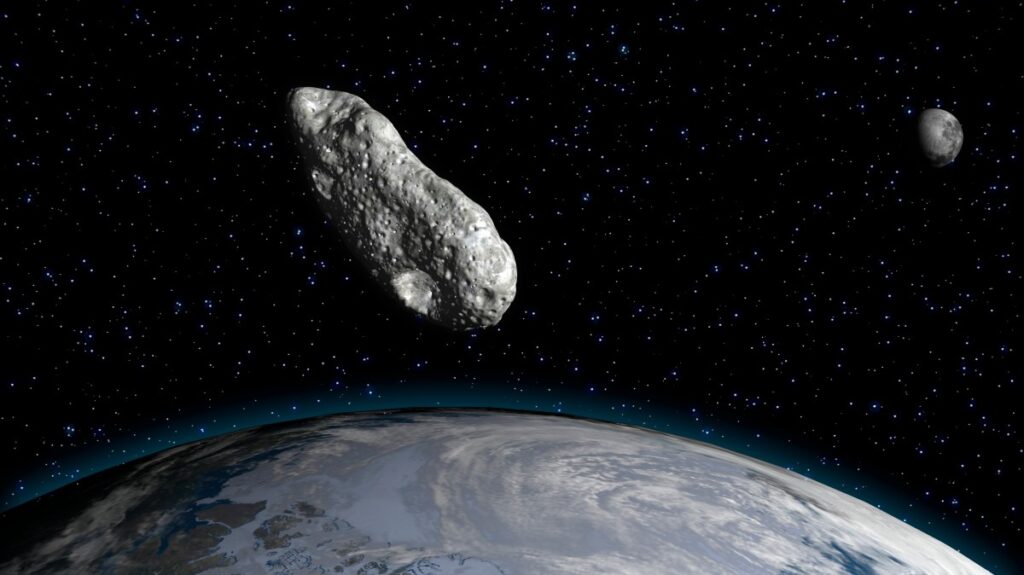
Humanity has no way to deflect the tens of thousands of asteroids near the planet’s orbit that are capable of demolishing cities, space chiefs have said. One admitted it “keeps me up at night”.
Kelly Fast, a planetary defence officer at Nasa, told the American Association for the Advancement of Science, in Phoenix, Arizona, that there were 25,000 asteroids near Earth that measured more than 140 metres in diameter. Nasa only knows the location of about 40 per cent of them.
Fast said that telescopes were straining to spot them because they accompanied the Earth in orbit around the Sun. Most asteroids are spotted when they reflect sunlight, but the Near-Earth Object Surveyor space telescope, which will launch next year, will use thermal signatures to detect dark asteroids and comets that were previously invisible from Earth.
Fast said her job was to “find asteroids before they find us” and, if necessary, develop ways of “getting asteroids before they get us”.

Kelly Fast
NASA/JOEL KOWSKY
In 2022, Nasa experimented with deliberately crashing a spacecraft called Dart (Double Asteroid Redirection Test) into Dimorphos, a mini moon in orbit around an asteroid, at 14,000mph, proving that it was possible to alter a space rock’s path.
However, Nancy Chabot, a planetary scientist at Johns Hopkins University who led the mission, said it “keeps me up at night” that there are no other Dart-like spacecraft ready to launch if an asteroid were detected tomorrow on a collision course with Earth.
Last year an asteroid called YR4 measuring up to 90m wide, caused widespread concern after it was deemed to have a 3.2 per cent chance of crashing into Earth in 2032.
Upon further investigation, Nasa downgraded the chance to zero, but Chabot said: “We don’t have [another] Dart just lying around. If something like YR4 had been headed towards the Earth, we would not have any way to go and deflect it actively right now.”
The James Webb Space Telescope will track the asteroid this week as there is about a 4 per cent chance it could hit the moon. Such a collision would generate a flash bright enough to be visible from Earth.

The James Webb Space Telescope
NASA/ALAMY
Chabot said Nasa had the technology to develop craft to protect the Earth. “We could be prepared for this threat,” she said. “We could be in very good shape. We need to take those steps to do it. If anything keeps me awake, it’s that.”
• How scientists could stop a planet-killing asteroid
Fast said that small space rocks strike the Earth regularly and pose very little threat. She added that extremely large asteroids, those sometimes dubbed “planet killers” similar in size to the one that wiped out the dinosaurs 66 million years ago, were generally easier to track.
“We’re not so much worried about the really large ones because we know where those are. It’s the ones in between that could pose regional damage.”