
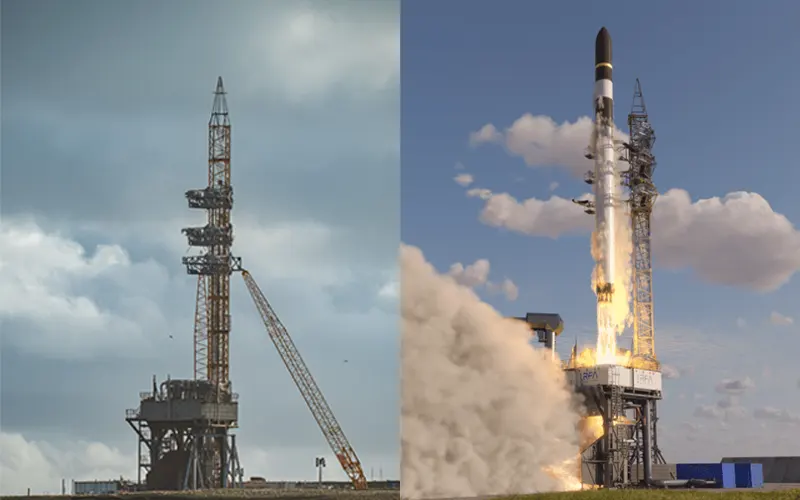
 Credit: RFA
German rocket builder Rocket Factory Augsburg (RFA) is making significant progress toward once again attempting an inaugural flight of its RFA ONE rocket. The company is currently moving forward with commissioning its launch pad at SaxaVord Spaceport as it works toward a hot fire test of the rocket’s first stage.
The RFA ONE rocket is a 30-metre tall two-stage rocket designed to be capable of delivering payloads of up to 1,300 kilograms to low Earth orbit. The company is also developing an optional kick stage called Redshift that can be configured for a wide range of applications.
In August 2024, as the company was preparing for the inaugural flight of its RFA ONE rocket, an anomaly during a first-stage hot fire test caused the vehicle to burst into flames, resulting in the total loss of the stage. Over the last 18 months, the company has been manufacturing a replacement for the destroyed first stage and upgrading the vehicle’s upper stage to resume preparations for launch from SaxaVord Spaceport on the island of Unst off the northern coast of Scotland.
Speaking to European Spaceflight in early February, Rocket Factory Augsburg CEO Prof. Dr. Indulis Kalnins, who replaced Dr. Stefan Tweraser in April 2025, explained that the rocket’s first stage is in the process of being transported from Augsburg in Germany to the launch site on Unst. The rocket’s upper stage, which has received upgrades to its single Helix engine and the associated control software, is expected to follow in the next few weeks.
On 10 February, the company announced that the new umbilical tower had been raised, standing at 52 metres high. The tower will support and stabilise the rocket and provide propellant, power, and data connections. The company has begun commissioning the repaired and upgraded launch pad. The only element still to be added is the water tanks for the water deluge system. Kalnins, however, stressed that the company is taking its time with all pre-flight testing.
“We are taking the time to do it properly. We remain aggressive, fast, and flexible, but the wild times “before August 2024” are over,” said Kalnins.
Assuming a successful first flight, RFA expects to achieve an initial launch cadence of up to four flights per year over the following two years. In parallel, the company is working to improve the performance of its RFA ONE rocket.
As RFA prepares for the inaugural flight of its vehicle, fellow German launch services startup Isar Aerospace is making final preparations for the second flight of its 28-metre-tall Spectrum rocket.
Spectrum’s first flight in March 2025 ended in failure less than thirty seconds after liftoff. The company is currently targeting no earlier than 19 March for the launch of its second Spectrum rocket. It had planned to attempt a launch in January, but an issue with a pressurization valve forced a delay.
Keep European Spaceflight Independent
Your donation will help European Spaceflight to continue digging into the stories others miss. Every euro keeps our reporting alive.