
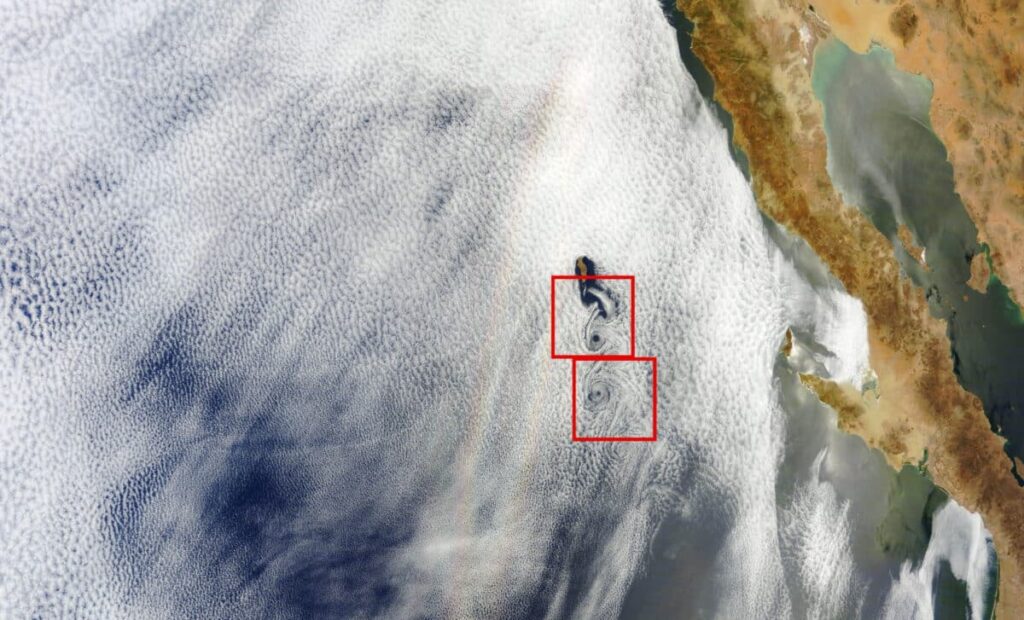
A 2012 satellite image has revealed a striking atmospheric illusion unfolding above the Pacific Ocean. The image, taken by NASA’s Terra satellite, shows two luminous streaks running parallel to each other near Guadalupe Island, roughly 150 miles (240 kilometers) off Mexico’s western coast. At first glance, they resemble twin rainbows suspended over a sea of clouds. But the science behind the spectacle tells a different story.
The phenomenon is not a pair of rainbows but a single “glory” appearing distorted due to the satellite’s scanning method. At the same time, a separate and equally uncommon series of swirling cloud formations, known as Von Kármán vortices, trailed behind the island. The fact that both appeared side by side was purely coincidental.
These events unfolded above thick stratocumulus clouds covering this region of the Pacific, making the scene visible from orbit. While both phenomena rely on specific atmospheric conditions, their formation mechanisms are entirely distinct.
A Single Glory That Looked Like Two
Glories are multicolored optical displays similar to rainbows, but they form in a very different way. While rainbows emerge from reflection and refraction as sunlight passes through falling raindrops, glories are produced by backward diffraction. That process occurs when sunlight bounces directly off tiny water droplets in clouds or mist.
According to NASA’s Earth Observatory, glories only appear at the anti-solar point, directly opposite the sun from the observer’s perspective. In this 2012 case, the glory formed adjacent to Guadalupe Island and appeared to stretch for more than 300 miles (480 kilometers).
Although the satellite image seems to show two distinct glories running parallel, it is in fact a single circular phenomenon. Normally, glories appear as concentric multicolor circles when viewed from the ground or from aircraft, since the diffracted light radiates outward toward the observer. Even from space, they typically look circular. NASA’s Columbia space shuttle observed the first glory from orbit in 2003, and it appeared as a ring.
This time, the distortion came from the way the Terra satellite scans Earth. According to Earth Observatory representatives cited by Live Science, the satellite “scans the Earth’s surface in swaths perpendicular to the path followed by the satellite.” As a result, the image shows cross-sections of the same circular glory scanned twice. The two rainbow streaks run parallel on either side of the satellite’s trajectory, with perfectly inverted colors: from red to blue on the left, and from blue to red on the right.
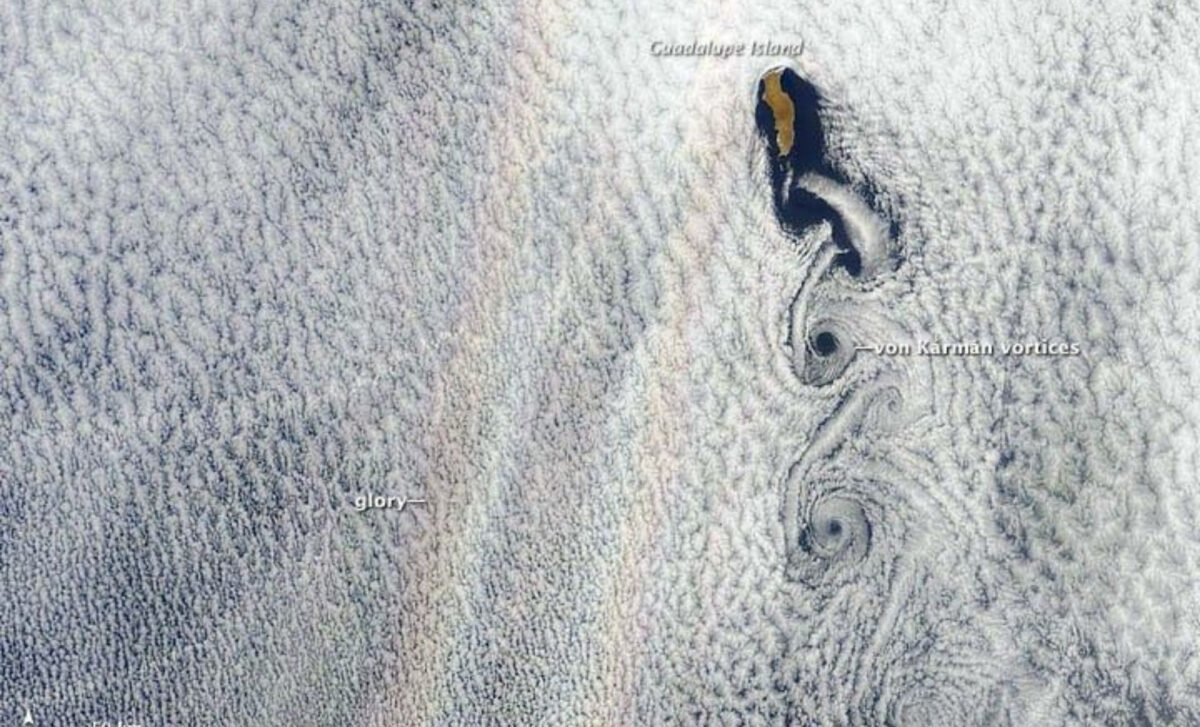 The satellite image collected by NASA in 2012 shows two spectacular weather phenomena over the Pacific Ocean – © NASA
Rare von Kármán Vortices Swirl in the Clouds
Just south of Guadalupe Island, another rare atmospheric feature appeared in the same frame: a chain of swirling cloud patterns known as Von Kármán vortices. These vortices form when airflow is disrupted by a tall landmass, especially over oceans. In this instance, the disturbance was caused by a volcanic mountain ridge in the northern part of Guadalupe Island, which rises more than 4,200 feet (1,300 meters) above sea level.
As air moved past the island, it separated and created alternating swirling eddies in the clouds. The image shows a line of remarkably well-defined spirals trailing from the island’s southernmost point. These structures are uncommon and require very specific atmospheric conditions to develop clearly.
Though both the glory and the vortices were visible thanks to the thick stratocumulus cloud deck, their formation processes were unrelated. Their simultaneous appearance was a coincidence? an alignment of atmospheric physics and orbital timing.
From Earth to Venus and Beyond
Until recently, glories had only been observed on Earth and within the dense clouds of Venus. That made the phenomenon relatively rare in planetary science. In April, astronomers detected what they believe to be the first extrasolar glory on the exoplanet WASP-76 b, located about 637 light-years from Earth. the finding suggests that glories may be more common across the universe than previously thought.
Back in 2012, though, the Terra satellite’s image captured something simpler and just as compelling: a fleeting alignment of light, cloud, and topography over a remote Pacific island. A warped rainbow that wasn’t a rainbow at all, beside vortices shaped by a volcanic ridge rising from the sea. For a moment, Earth’s atmosphere staged a display that looked almost unreal, yet was entirely natural.