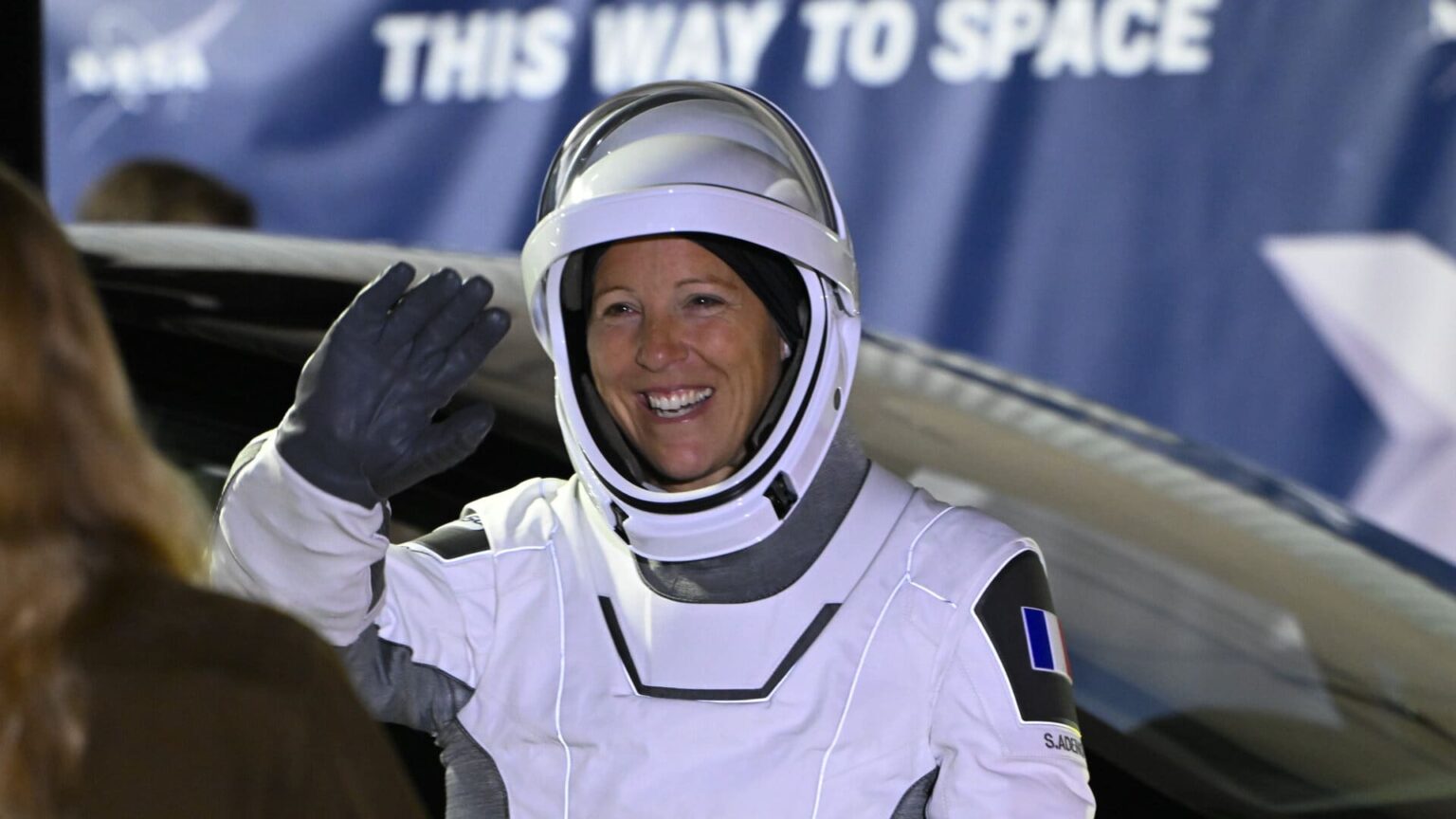
First-time flyers, Sophie Adenot and Jack Hathaway, arrived aboard the International Space Station (ISS) late on Valentine’s Day, marking the start of a very long mission for Adenot.
The mission launched aboard a Falcon 9 rocket from the Kennedy Space Center in the USA on Friday morning. The capsule orbited Earth for the following 34 hours in order to catch up with the space station before docking on Saturday evening.
Adenot will spend the next nine months aboard the ISS as part of the εpsilon mission, which is expected to be the longest mission conducted by the European Space Agency aboard the ISS. During that time, the astronaut will conduct up to 36 experiments, including seven developed by CNES, the French space agency. These experiments will cover human physiology, climate research, and even technology demonstrations.
“The εpsilon mission highlights ESA’s commitment to maintaining a continuous human presence in low‑Earth orbit and related utilisation, starting with science. Sophie is the first career astronaut of the Class of 2022, the ‘Hoppers’, to fly,” said ESA director of Human and Robotic Exploration, Daniel Neuenschwander. “She transitioned directly from basic training to mission‑specific training and consistently performed above expectations. I am proud of the exceptional work carried out by Sophie and by our teams, a group of talented ‘εpsilon’ making all this possible.”
Missions such as this are vital not only understand space travel but improving life on Earth as well. We have learned a great many things from various experiments aboard the ISS, including water purification, development of pharmaceuticals and much more.
As the ISS approaches its end of life, scheduled for 2030, or sooner, there are bound to be far more experiments happening aboard the now ageing space station. When the orbital laboratory is gone, it will likely be replaced by commercially owned and operated space stations. What that means for the future of space research is unclear at this stage.
[Image – ESA – S. Corvaja]
Let’s talk tech!
Get the tech news you want to read. Take our reader survey and tell us how we can help you better.