
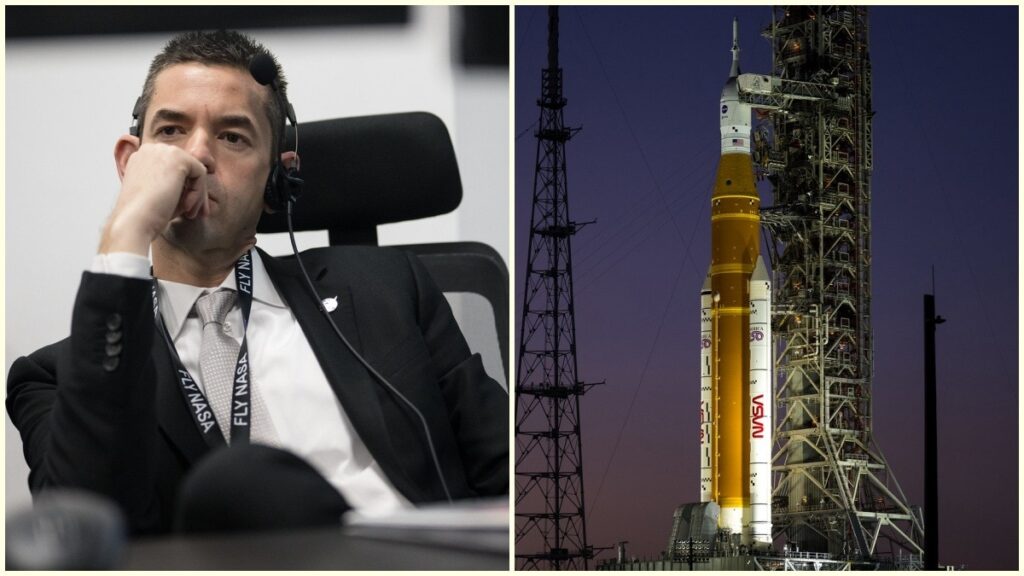
Nasa is working through a series of technical and operational challenges as it prepares for Artemis-II, the first crewed mission in its plan to return humans to the Moon in more than five decades.
The mission, which will send astronauts around the Moon aboard the Space Launch System (SLS) rocket and Orion spacecraft, is a crucial step toward building a long-term human presence in lunar orbit and on the Moon’s surface.
Speaking about the progress of the program, Nasa chief Jared Isaacman said that the space agency is committed to openness as engineers address problems uncovered during testing.

“For a program as costly and important to national security as Artemis, the public is entitled to the facts,” he said, emphasising transparency about both successes and setbacks.
WHAT IS WRONG WITH ARTEMIS-II MOON ROCKET?
One of the key challenges involves propellant system seals and fuelling interfaces on the SLS rocket. During a recent confidence test conducted on February 12, engineers evaluated seals that had been repaired or replaced after earlier wet dress rehearsal tests.
The results showed significantly lower hydrogen leak rates compared with previous testing, suggesting progress in addressing a major technical concern.
The test ended earlier than planned, not because of a failure, but because engineers gathered enough data to continue analysis without further troubleshooting.
Nasa reviewed the results the following day and released a public update soon after, timing the announcement carefully alongside a crewed mission launch to the International Space Station to avoid confusion.
Nasa Administrator Jared Isaacman monitors the countdown of the launch of a SpaceX Falcon 9 rocket. (Photo: Nasa)
WHAT IS NASA DOING TO FIX MOON ROCKET?
Despite these improvements, Artemis-II preparations remain complex. Nasa officials say it is not unexpected to encounter difficulties following the long gap between Artemis-I in 2022 and the upcoming crewed mission, especially given the scale of the rocket system and the cryogenic fueling technologies involved.
Engineers are continuing to refine procedures and hardware to ensure reliability.
Isaacman noted that lessons learned now will shape future missions. For Artemis-III, Nasa plans to “cryoproof” the vehicle before it reaches the launch pad and redesign propellant-loading interfaces currently under review.
These changes are intended to make future launches more predictable and efficient.
The Artemis program is designed as a long-term lunar exploration effort, with plans for repeated missions and eventually a sustained human presence on and around the Moon. Nasa expects the program’s architecture to evolve as new technologies emerge and industry partnerships expand.
For now, Nasa officials stress that astronaut safety remains the top priority. Engineers continue to analyse test data, refine systems, and prepare hardware for flight readiness reviews.
“There is still a great deal of work ahead,” Isaacman said, adding that Nasa “will not launch unless we are ready” as the agency prepares for humanity’s return to deep space exploration.
– Ends
Published By:
Sibu Kumar Tripathi
Published On:
Feb 16, 2026