
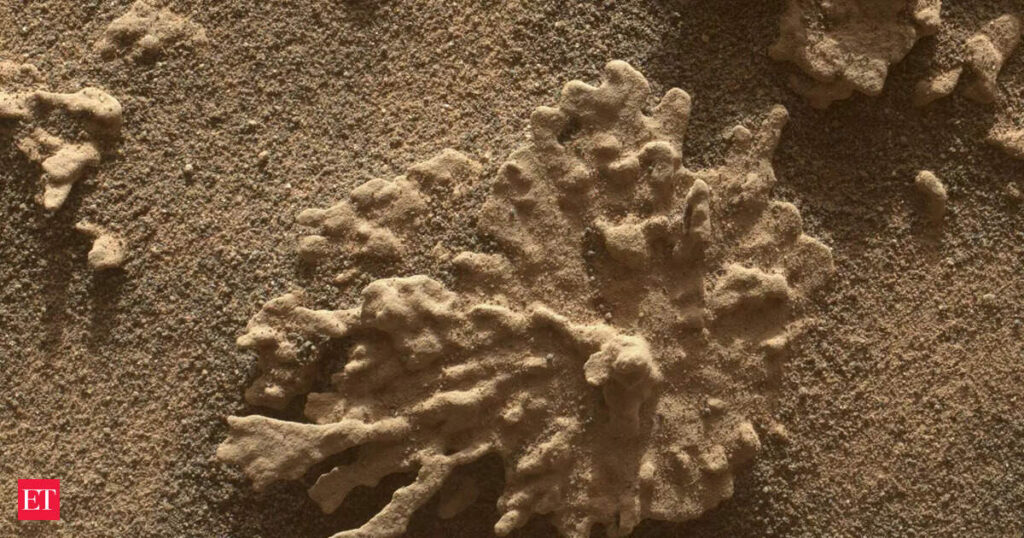
NASA’s Curiosity rover made a striking discovery in 2025 after drilling into a site believed to be an ancient lake bed on Mars. The rover detected long-chain organic molecules known as alkanes, compounds that scientists say could represent chemical remnants of ancient life.
Researchers noted at the time that these molecules may have originated from fatty acids, which on Earth are common building blocks of cell membranes. The finding added weight to the long-standing theory that Mars may have supported life billions of years ago, though it stopped short of being definitive proof.
What was the Mars organic molecules discovery?
In a paper published last week on February 4 in the journal Astrobiology, a team led by Alexander Pavlov of NASA Goddard Space Flight Center argued that the presence of these molecules “cannot be readily explained” by non-biological processes alone.
This is especially puzzling given that the Martian surface has been exposed to millions of years of intense radiation after the planet lost much of its protective atmosphere, conditions that typically destroy complex organic molecules.
 Live EventsAlso Read: A 400-year-old explosion, one of the biggest humans have ever witnessed, seen over 25 years as NASA shows Kepler Supernova’s uneven expansion
Could non-biological processes explain the molecules?
One leading alternative theory suggests that carbon-rich dust particles and meteorites may have deposited long-chain organic molecules on Mars. Scientists have proposed that Mars’ ancient atmosphere could have allowed these compounds to accumulate over time.However, Pavlov and his colleagues found this explanation insufficient. By modeling how approximately 80 million years of radiation exposure would degrade these molecules, they concluded that the original concentration of alkanes must have been significantly higher than previously estimated.
The team examined multiple non-biological mechanisms, both individually and in combination, but none could fully account for the inferred original abundance of the molecules.
Does this point to life on Mars?
The researchers argue that biological processes similar to those observed on Earth remain one of the strongest explanations. “We argue that such high concentrations of long-chain alkanes are inconsistent with a few known abiotic sources of organic molecules on ancient Mars,” they wrote.
Still, the team is cautious about making any new claim. They acknowledged that unknown non-biological processes could exist and may yet explain the findings.
“We agree with Carl Sagan’s claim that extraordinary claims require extraordinary evidence and understand that any purported detection of life on Mars will necessarily be met with intense scrutiny,” the researchers concluded. “In addition, in practice with established norms in the field of astrobiology, we note that the certainty of a life detection beyond Earth will require multiple lines of evidence.”
Despite the uncertainty, scientists see the discovery as an important milestone in the search for extraterrestrial life. Mars, once shaped by vast oceans, rivers, and lakes, remains one of the most promising candidates for past habitability in our solar system.
Pavlov and his team say further study is needed to better understand how rapidly organic molecules break down in Mars-like rock under Mars-like conditions before any conclusions can be drawn about the presence or absence of life.
FAQsWhat is the Mars organic molecule discovery? The Mars organic molecule discovery refers to long-chain organic compounds, known as alkanes, detected by NASA’s Curiosity rover after drilling into an ancient lake-bed site on Mars. These molecules are significant because similar compounds on Earth are often linked to biological processes, though they are not direct proof of life.Does this discovery mean life once existed on Mars? No. Scientists stress that the finding does not confirm past life on Mars. While a recent NASA-led study suggests the molecules are difficult to explain using known non-biological processes alone, researchers caution that unknown chemical mechanisms could still be responsible. Multiple lines of evidence would be required to confirm life.Why are scientists calling for more research? Researchers say more study is needed to understand how organic molecules break down in Mars-like rocks under Martian conditions, especially after long exposure to radiation. This will help determine whether the molecules could realistically survive without biological input before drawing conclusions about the planet’s past habitability.
Add  as a Reliable and Trusted News Source