
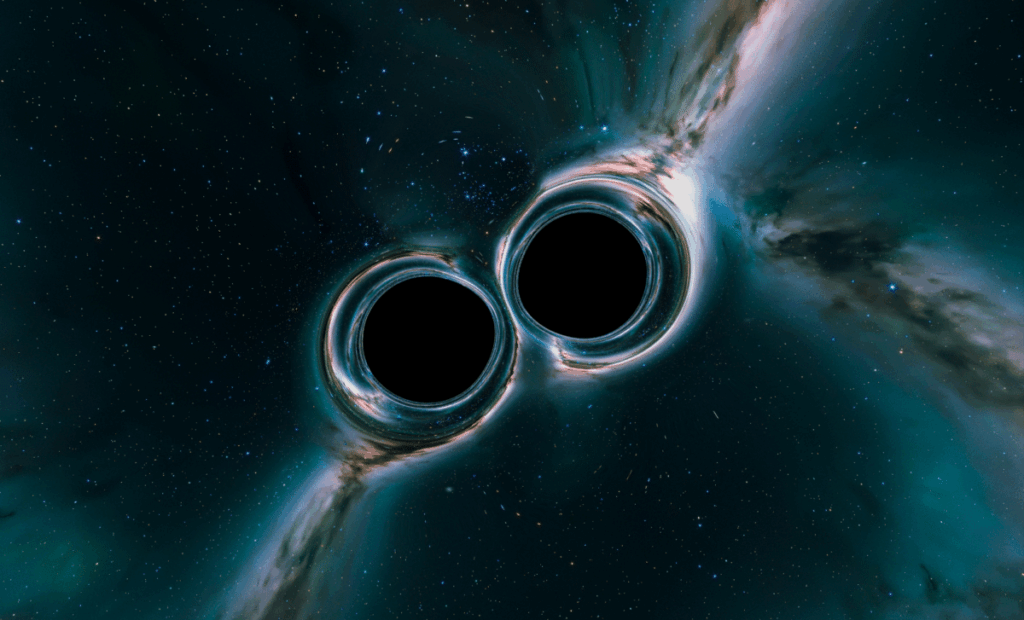
Scientists have used the loudest gravitational wave signal ever recorded to put Albert Einstein’s century-old theory of general relativity to its toughest test yet. This extraordinary signal, known as GW250114, emanated from the merger of two black holes approximately 1.3 billion light-years away from Earth. The clarity of the signal, roughly three times clearer than previous detections, provided a unique opportunity to rigorously analyze the behavior of black holes and test the very foundations of Einstein’s understanding of gravity.
A New Chapter in Gravitational Wave Detection
The detection of gravitational waves, first observed in 2015, has revolutionized our understanding of the cosmos. These ripples in space-time, caused by cataclysmic cosmic events like black hole mergers, offer scientists a new way of probing the universe. The latest event, GW250114, represents a significant leap forward in the precision and sensitivity of gravitational wave detectors. Scientists at the Laser Interferometer Gravitational-Wave Observatory (LIGO) in the U.S. were able to capture the waves with unprecedented clarity, thanks to a decade of improvements to the detection technology. The signal provided not only a wealth of information about the black holes involved but also allowed researchers to test Einstein’s general theory of relativity with an accuracy never before possible.
“This event made it very, very obvious that, indeed, this prediction of general relativity was present in the signal, which was really exciting,” said Keefe Mitman, a postdoctoral researcher at the Cornell Center for Astrophysics and Planetary Science.
The precision of the measurements confirmed the predictions made by Einstein more than 100 years ago, reaffirming the validity of his theory in the face of increasingly complex cosmic phenomena. The exceptional clarity of the signal from GW250114 provided insights that allowed the researchers to identify the “ringdown” phase of the black hole merger, a key stage where the newly formed black hole vibrates, emitting gravitational waves that encode crucial information about its mass and spin.
 The two LIGO gravitational wave observatories in Washington and Louisiana are separated by a distance of roughly 1,880 miles (3030 km). This allows scientists to measure millisecond-level differences in gravitational wave signals. (Image credit: The Virgo collaboration/CCO 1.0)
Gravitational Waves: The Final Frontier of Testing Einstein’s Theory
One of the most compelling aspects of this discovery, published in Physical Review Letters, was the ability to identify and measure distinct features of the gravitational wave signal that confirm predictions made by Einstein. In the aftermath of a black hole merger, the newly formed black hole undergoes a brief period of “ringing” much like a struck bell. These vibrations, or “tones,” offer insights into the black hole’s properties, including its mass, spin, and even subtle features predicted by Einstein’s equations. For the first time, the team detected two primary tones as well as a more subtle overtone that appeared early in the ringing phase, a feature that had long been predicted by general relativity.
Had the measurements disagreed with Einstein’s predictions, it would have signaled a potential breakthrough in our understanding of gravity. “Had the measurements disagreed, we would have had a lot of work to do as physicists to try to explain what’s going on and what the true theory of gravity would be in our universe,” Mitman added. Such a discrepancy could have led to new theories of gravity, but instead, the data reinforced the enduring accuracy of general relativity.
The Implications for Future Gravitational Wave Science
The significance of this discovery extends beyond the validation of Einstein’s theory. It also highlights the potential of future gravitational wave observations to uncover deeper insights into the nature of the universe. The precision achieved with this latest detection sets the stage for more detailed investigations of black holes and other cosmic phenomena. However, Mitman cautions that we are still in the early stages of gravitational wave astronomy.
“We’re living in the regime where we don’t have enough data, and we’re kind of just twiddling our thumbs waiting for more data to come in,” he remarked.
With upcoming projects like the LISA (Laser Interferometer Space Antenna) mission, which aims to detect gravitational waves from supermassive black holes, scientists expect to be “overwhelmed” by data. LISA, planned for launch in 2035, will be capable of observing low-frequency gravitational waves, providing even more precise measurements of cosmic events.
The discovery of GW250114 and the precision of the LIGO detectors have opened a new chapter in gravitational wave research. As new and more sensitive detectors come online, scientists will be able to probe the universe in ways previously thought impossible, potentially discovering deviations from Einstein’s theory that could lead to new physics. The ultimate goal is to reconcile the theory of general relativity with quantum mechanics, and gravitational wave science may hold the key to unlocking this profound mystery.