
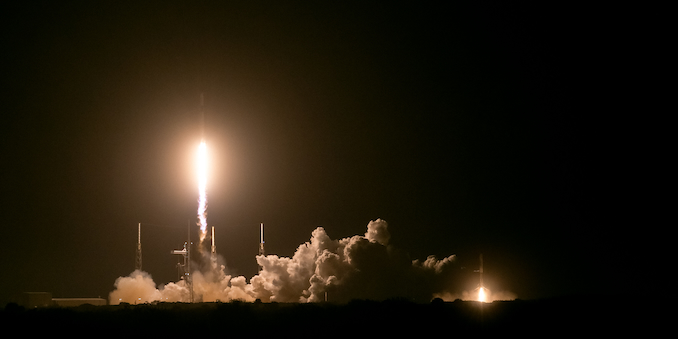
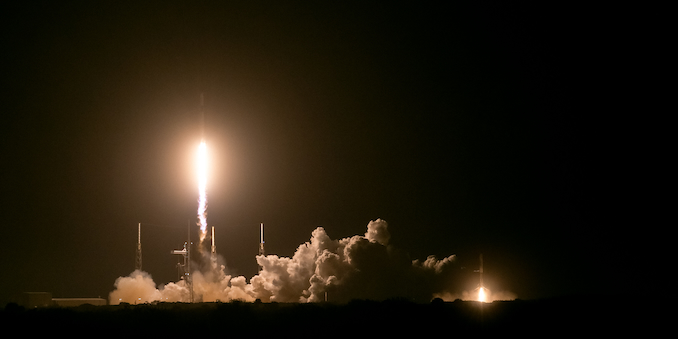
 A composite shot showing the liftoff of SpaceX’s Falcon 9 from Space Launch Complex 40 and the landing of the Falcon booster, 1101, at the new recovery site, Landing Zone 40, during NASA’s SpaceX Crew-12 mission on Friday, Feb. 13, 2026. Image: John Pisani/Spaceflight Now
Flying in the face of superstition, NASA and SpaceX conducted a smooth countdown and launch of three astronauts and a cosmonaut to begin the latest, long-duration mission to the International Space Station on Friday, Feb. 13.
The nine Merlin 1D engines roared to life at 5:15 a.m. EST (1015 UTC) following a smooth countdown. It was the first time that NASA conducted a crewed mission on a Friday the 13th.
“It turns out Friday the 13th is a very lucky day,” the SpaceX launch director quipped moments after the Dragon Freedom spacecraft separated from the Falcon 9 rocket’s upper stage. “Jessica, Jack, Sophie, Andrey, it’s been a pleasure training with you and preparing for your flight. For the entire Falcon launch team, thank you, good luck and god speed to the crew of Freedom.”
“Thank you team, that was quite a ride. Thank you, SpaceX, Falcon 9, and NASA teams,” Crew-12 commander and NASA astronaut Jessica Meir replied. “We have left the Earth, but the Earth has not left us. When we gaze at our planet from above, it is immediately clear that everything is interconnected.”
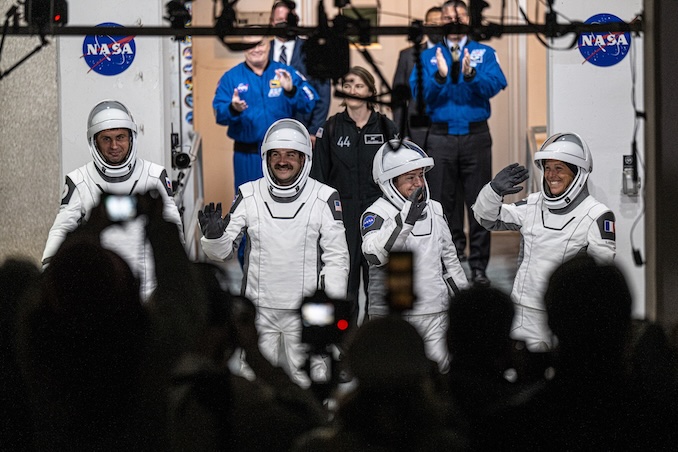 The four members of NASA’s SpaceX Crew-12 mission emerge from the Neil Armstrong Operations and Checkouts building to greet friends and family before heading out to Space Launch Complex 40 for their flight. Left to right: Roscosmos cosmonaut Andrey Fedyaev, NASA astronaut Jack Hathaway, NASA astronaut Jessica Meir, ESA astronaut Sophie Adenot. Image: Michael Cain/Spaceflight Now
Crew-12 marks the second trip to space for both Meir and Roscosmos cosmonaut Andrey Fedyaev and the first flight for NASA astronaut Jack Hathaway and European Space Agency astronaut Sophie Adenot.
The quartet are scheduled to arrive at the orbiting outpost at about 3:15 p.m. EST (2015 UTC) on Saturday, Feb. 14, to begin an eight-month mission.
The launch of Crew-12 was the first astronaut flight for NASA with Jared Isaacman serving in the role of NASA Administrator. A veteran of two commercial spaceflights himself, he said it was special to witness a crewed launch from his current vantage point.
“Felt like I might’ve had the second best seat in the house today going into the operations,” Isaacman said. “It was just wonderful to see everything in motion. Felt very privileged to be here alongside an extraordinary team preparing for an excellent mission, like Crew-12. Great to watch it.”
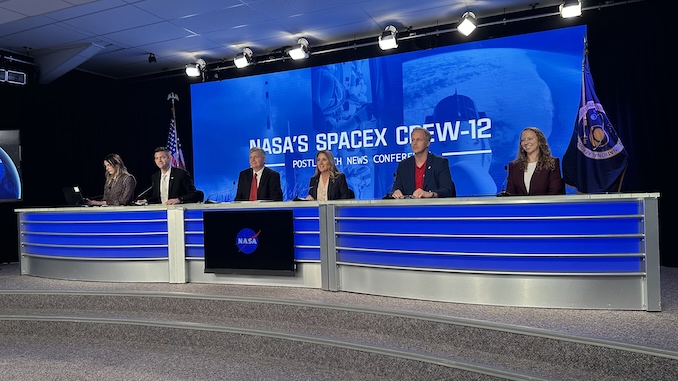 NASA, ESA, and SpaceX leadership discuss the early stages of the Crew-12 mission. From left to right, Bethany Stevens, NASA Press Secretary; Jared Isaacman, NASA Administrator; Steve Stich, Commercial Crew Program Manager; Dana Weigel, ISS Program Manager; Daniel Neuenschwander, ESA’s Human and Robotic Exploration Director; and Julianna Scheiman, SpaceX’s Director of NASA Science and Dragon Programs. Image: Will Robinson-Smith/Spaceflight Now
The launch also marked the debut of a new recovery site for SpaceX’s Falcon boosters: Landing Zone 40. SpaceX built out the site after the U.S. Space Force’s decision to require launch providers to move towards recovering orbital class rockets at locations adjacent to their launch pads, in order to free up real estate for other rocket companies.
The Crew-12 launch also marked the 20th human spaceflight mission for SpaceX to date.
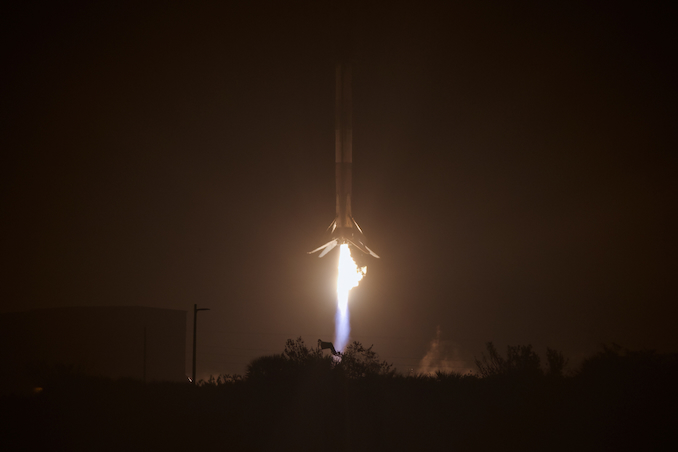 SpaceX’s Falcon 9 booster, tail number 1101, descends upon Landing Zone 40, adjacent to Space Launch Complex 40, where the Crew-12 mission took off roughly eight minutes prior. Image: Adam Bernstein/Spaceflight Now
The forthcoming arrival of Crew-12 at the ISS marks the beginning of a busy period for the orbiting outpost. At the end of February, SpaceX will undock its Cargo Dragon vehicle that’s flying the company’s 33rd Commercial Resupply Services (CRS-33) mission.
That will be followed by the unberthing of JAXA’s (Japan Aerospace Exploration Agency) HTV-X cargo vehicle in early March. Then in the mid-March two astronauts will conduct a spacewalk that was postponed with the early departure of Crew-11 from the space station.
Then at the end of March, Roscomos is set to launch its next Progress cargo vehicle. Finally, in April, SpaceX will launch Northrop Grumman’s next Cygnus spacecraft, on the NG-24.
“So a lot going on, as always. Very, very busy onboard space station,” said Dana Weigel, manager of NASA’s International Space Station Program. “We’re really looking forward to having the crew onboard.”
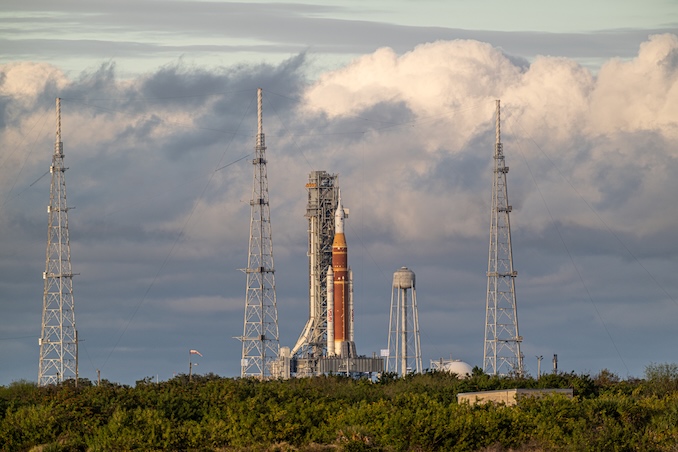 NASA’s Space Launch System rocket and Orion spacecraft are seen at Launch Complex 39B on Sunday, Jan. 18, 2026, a day after arriving at the pad for prelaunch testing. Image: John Pisani/Spaceflight Now
After the early return of Crew-11 from the space station, NASA and SpaceX aimed to launch the Crew-12 mission as soon as Feb. 11, barring potential conflicts with Artemis 2 activities or weather constraints.
As it turned out, weather along the ascent corridor proved insurmountable for both Feb. 11 and Feb. 12. While Crew-12 was unable to launch on Thursday, NASA took the opportunity to perform what Isaacman called “a series of mini wet dress rehearsals” with the Space Launch System rocket.
Isaacman said during the post-launch press briefing that more information on the tests would be forthcoming.
“The teams wanted to have a chance to get together and review the data before taking a position on whether or not we’re going to advance to a full wet dress two or undertake additional kind of mini tests,” Isaacman said. “We already communicated through a blog that we replaced some seals and now we want to do as many tests as we possibly can before stepping into a full wet dress rehearsal operation again, to just gain confidence.”
He said while the results at this point are preliminary, they do show some promise for the Artemis 2 prelaunch campaign.
“At least from some of the early views, we did not see some of the leaks for the portion of the test we were running that had a comparable period during the full Artemis 2 wet dress we did,” Isaacman said. “So, it’s an early indication, but we’ll share more details. We’ll share more details when we get into it tomorrow, but I think they idea is we will continue to do everything available to gain confidence going into the full wet dress.”