
Four astronauts headed for space station following Friday SpaceX launchNew crew replaces astronauts evacuated last month for medical reasonsLaunch comes just days after historic NASA lunar mission is delayed
A lonely NASA astronaut, left behind on the International Space Station following an unprecedented medical evacuation last month, is due to get some company following the successful launch of the SpaceX Crew-12 mission on Friday morning.
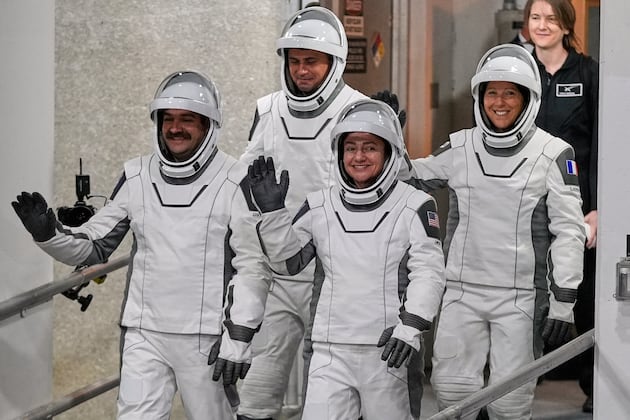
Four astronauts aboard a Dragon crew capsule powered by a SpaceX Falcon 9 rocket lifted off from Cape Canaveral, Florida, at 3:15 a.m. MDT Friday and are scheduled to dock with the ISS at 1:15 p.m. on Saturday afternoon. The crew includes NASA astronauts Jessica Meir and Jack Hathaway, European Space Agency astronaut Sophie Adenot and Roscosmos cosmonaut Andrey Fedyaev.
On Jan. 14, NASA astronauts Zena Cardman and Mike Fincke, Japanese astronaut Kimiya Yui and Russian cosmonaut Oleg Platonov returned to Earth following NASA’s decision to bring the crew home early because one of the astronauts had a medical emergency. It was NASA’s first medical evacuation from ISS.
NASA did not identify the affected crew member or the nature or severity of the medical issue, but the four were a part of a mission that originally had them scheduled to remain aboard the ISS until late February. Their departure left a single NASA astronaut, Christopher Williams, on the space station along with two cosmonauts, Sergey Kud-Sverchkov and Sergei Mikayev.
New NASA administrator Jared Isaacman said the research work on the ISS is just one facet of the U.S. space agency’s goals, which include returning astronauts to the moon and beyond.
“With Crew-12 safely on orbit, America and our international partners once again demonstrated the professionalism, preparation and teamwork required for human spaceflight,” Isaacman said in a press release. “The research this crew will conduct aboard the space station advances critical technologies for deep space exploration while delivering real benefits here on Earth.
“We undertake these missions with a clear understanding of risk, managing it responsibly so we can continue expanding human presence in low Earth orbit while preparing for our next great leap to the moon and onward to Mars.”
NASA’s historic lunar mission on hold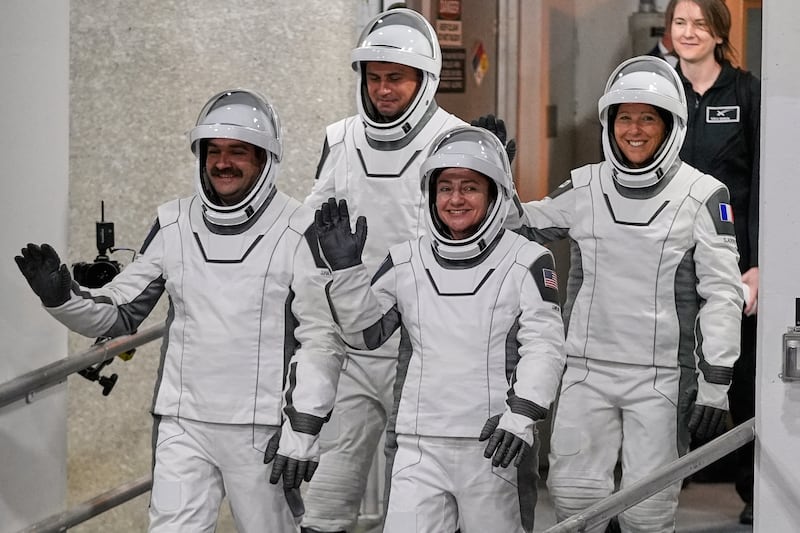 Crew 12 mission astronauts, from left, pilot Jack Hathaway, Russian cosmonaut Andrei Fedyaev, commander Jessica Meir and ESA astronaut Sophia Adenot, of France, leave the Operations and Checkout building before heading to pad 40 at the Cape Canaveral Space Force Station in Cape Canaveral, Fla., Friday, Feb. 13, 2026, on a mission to the International Space Station. | John Raoux, Associated Press
A NASA mission set to return astronauts to the moon for the first time in over 50 years, originally targeted to launch this month, was put on hold until March following detection of hydrogen leaks during a fueling procedure rehearsal on Feb. 4.
NASA said engineers spent several hours troubleshooting a liquid hydrogen leak in a fueling interface but ultimately were able to fill the tanks of the massive SLS rocket ship. But later, with just five minutes left on a practice countdown early Tuesday morning, the effort was shut down when monitoring equipment detected a spike in the liquid oxygen leak rate.
Hydrogen leak issues also contributed to delaying the Artemis I mission, which eventually completed a successful unmanned flight in 2022.
The next attempt to launch the Artemis II mission, slated to carry four astronauts on a nearly 260,000-mile journey to the moon and beyond, is postponed until March 6 at the earliest when the next launch window opens.
Four astronauts — commander Reid Wiseman, pilot Victor Glover and mission specialists Christina Koch and Jeremy Hansen — are lined up to fly the 10-day Artemis II mission, launching from Kennedy Space Center aboard the Orion capsule powered by the SLS rocket system. The crew’s flight will take them on a path arcing about 5,000 miles past the moon before returning to Earth for a planned splashdown landing in the Pacific Ocean off the coast of San Diego. If successful, the mission will take the crew further into space than any other manned flight in history.
Next month’s planned launch follows 2022’s Artemis I mission, a $4.1 billion effort which saw a successful 25-day unmanned flight that tested out the SLS rocket/Orion capsule package. That mission took the Orion spacecraft, carrying three dummies outfitted in spacesuits and monitoring gear, within 81 miles of the lunar surface before eventually traveling some 40,000 miles past the moon before returning to Earth.
If the Artemis II mission goes as planned, NASA intends to launch the SLS/Orion package on a mission in 2028 that will include a landing on the moon’s surface.
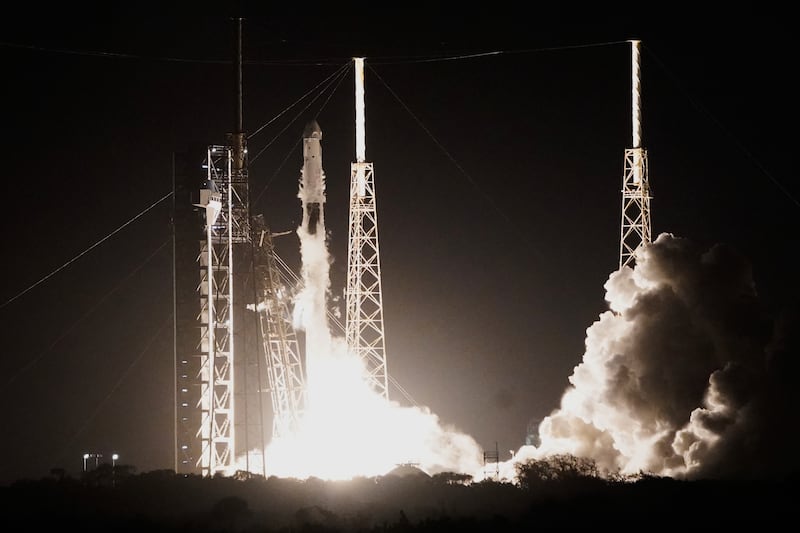 A SpaceX Falcon 9 rocket with a crew of four aboard the Dragon space craft lifts off from pad 40 at the Cape Canaveral Space Force Station in Cape Canaveral, Fla., Friday, Feb. 13, 2026. | John Raoux, Associated Press