
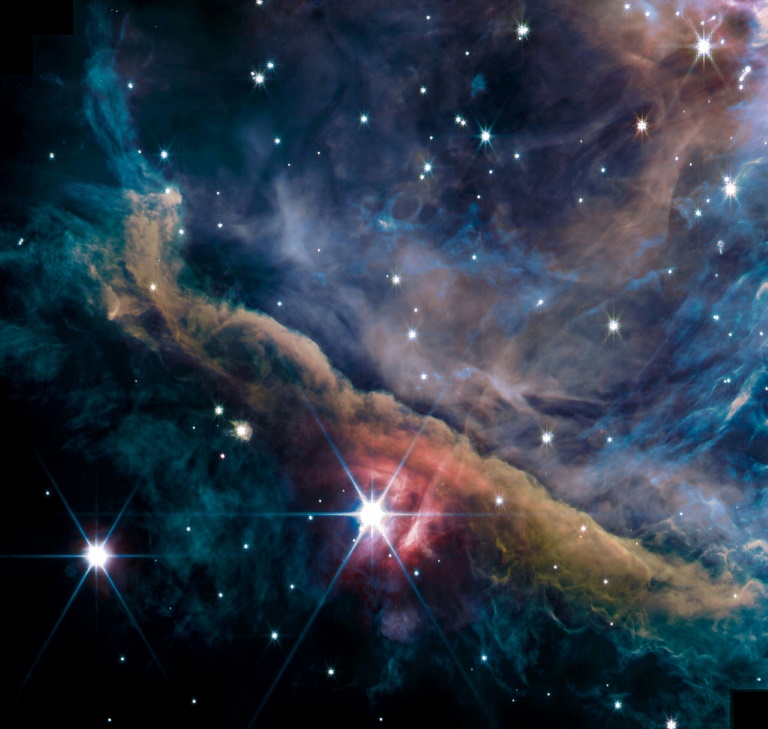
An international research team has revealed the first images of the Orion Nebula captured with the James Webb Space Telescope, leaving astronomers “blown away”
– Copyright AFP SERGEY BOBOK
Two scientists from the University of Sydney have performed a remarkable space science feat from Earth, the BBC reports. By using AI-driven software, the researchers have successfully corrected image blurring in NASA’s James Webb Space Telescope.
This innovation, called AMIGO, fixed distortions in the telescope’s infrared camera, restoring its ultra-sharp vision without the need for a space mission. This breakthrough restored the full precision of one of the telescope’s key instruments, achieving what would once have required a costly astronaut repair mission.
The corrective algorithms devised by the researchers ‘deblur’ the data, restoring the telescope’s full potential.
The implementation of AMIGO has led to remarkable improvements in the JWST’s imaging capabilities. With this software, the telescope has successfully captured clear images of faint celestial objects, including direct images of exoplanets and detailed observations of cosmic phenomena such as black hole jets and the surface of Jupiter’s moon Io. This demonstrates the power of combining innovative software solutions with advanced astronomical techniques.
The James Webb Space Telescope (JWST) is an advanced telescope designed to conduct infrared astronomy. It is the largest telescope in space, and is equipped with high-resolution and high-sensitivity instruments, allowing it to view objects too old, distant, or faint for the Hubble Space Telescope.
Australian science
This success builds on the JWST’s only Australian-designed component, the Aperture Masking Interferometer (AMI). This feature was created by Professor Peter Tuthill from the University of Sydney’s School of Physics and the Sydney Institute for Astronomy. The AMI allows astronomers to capture ultra-high-resolution images of stars and exoplanets.
The component works by combining light from different sections of the telescope’s main mirror, a process known as interferometry. When the JWST began its scientific operations, researchers noticed that AMI’s performance was being affected by faint electronic distortions in its infrared camera detector. These distortions caused subtle image fuzziness, reminiscent of the Hubble Space Telescope’s well-known early optical flaw that had to be corrected through astronaut spacewalks.
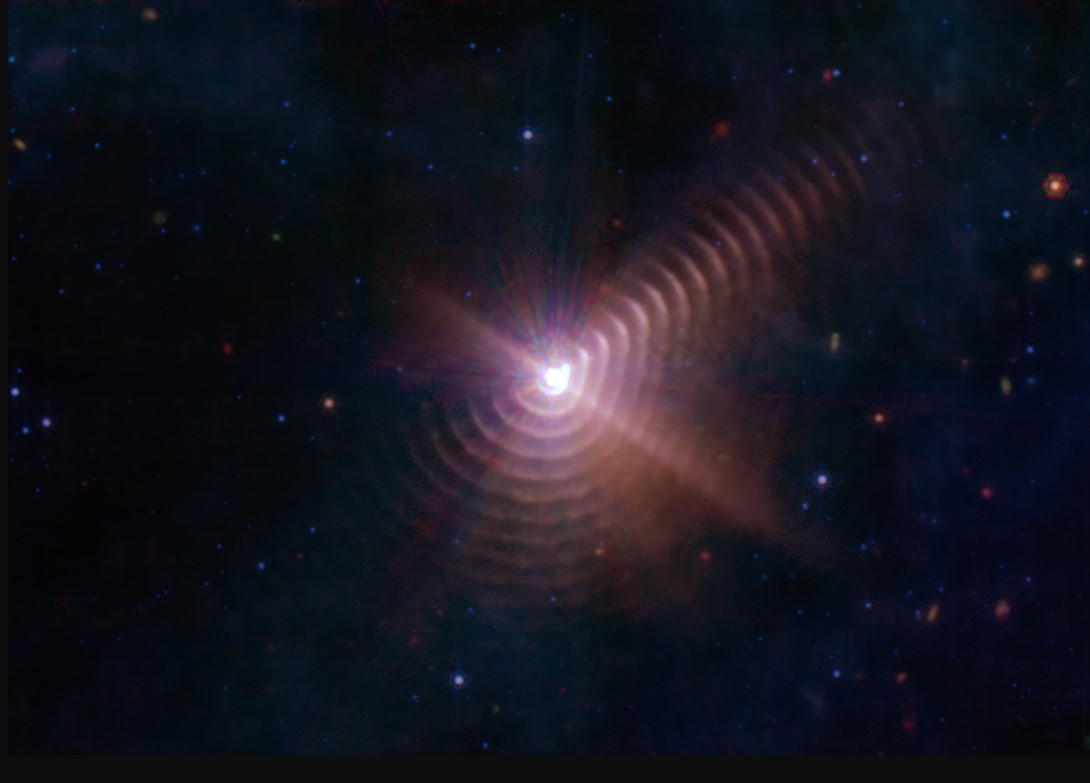 Two stars in Wolf-Rayet 140 produce shells of dust every eight years that look like rings, as seen in this image from NASA’s James Webb Space Telescope.
Credits: NASA, ESA, CSA, STScI, JPL-Caltech
Making the repair
Instead of attempting a physical repair, the researchers devised a purely software-based calibration technique to fix the distortion from Earth. In other words, using artificial intelligence (AI) to steer the restoration of the telescope’s intended functionality.
Their system, called AMIGO (Aperture Masking Interferometry Generative Observations), uses advanced simulations and neural networks to replicate how the telescope’s optics and electronics function in space. By pinpointing an issue where electric charge slightly spreads to neighbouring pixels — a phenomenon called the brighter-fatter effect — the team designed algorithms that digitally corrected the images, fully restoring AMI’s performance.
‘Crystal clear’
With AMIGO in use, the James Webb Space Telescope has delivered its clearest images yet, capturing faint celestial objects in unprecedented detail. This includes direct images of a dim exoplanet and a red-brown dwarf orbiting the nearby star HD 206893, about 133 light years from Earth.
Recently, using the improved calibration, the telescope produced sharp images of a black hole jet, the fiery surface of Jupiter’s moon Io, and the dust-filled stellar winds of WR 137 — showing that JWST can now probe deeper and clearer than before.
Space tattoo
The two scientists involved, Louis Desdoigts, now a postdoctoral researcher at Leiden University in the Netherlands, and his colleague Max Charles, celebrated their achievement with tattoos of the instrument they repaired inked on their arms.
The corrective research and practical solution appear in the journal arXiv, titled “AMIGO: a Data-Driven Calibration of the JWST Interferometer.”