
Six planets will form a rare planetary parade in the night sky throughout February. They will appear grouped across the sky in what astronomers describe as a planetary alignment.
The phenomenon offers skywatchers a chance to observe multiple worlds at once, a configuration that does not occur every month. A planetary parade occurs when at least four or five planets are visible together from Earth. This month’s event meets that threshold, with six planets appearing in close visual alignment.
Four Planets Visible To The Naked Eye
Planetary parades occur because each planet follows its own orbital path around the Sun, yet these paths lie in approximately the same plane. When several planets occupy positions on the same side of the Sun, they can appear aligned in Earth’s sky.
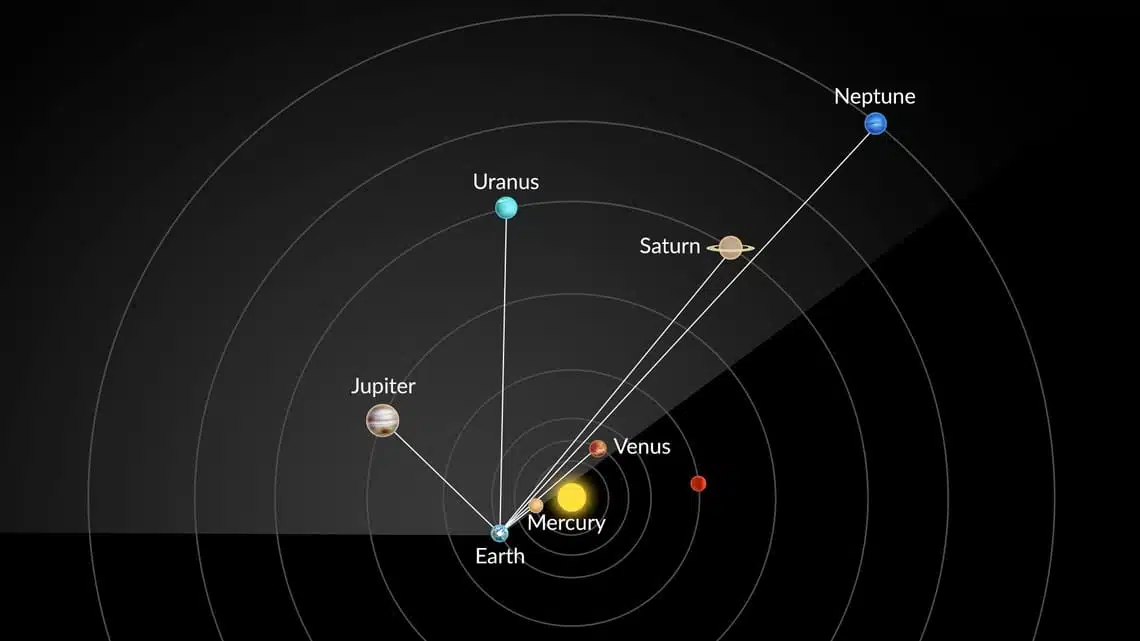 Visual representation of six planets aligned from Earth’s viewpoint. Credit: Vito Technology, Inc.
According to NASA, the effect is purely visual. Although the planets seem close together, they remain vastly distant from one another. Their apparent alignment is the result of orbital geometry rather than physical proximity.
Rare, Yet Not Without Precedent
Similar events have taken place before. On 27 February 2025, seven planets: Mercury, Venus, Mars, Jupiter, Saturn, Uranus and Neptune, aligned in a display that will not recur until 2040. As The Guardian reported, Greg Brown, an astronomer at the Royal Observatory Greenwich, said that smaller groupings of three to five planets are relatively common.
“Groups of three, four or even five planets being visible aren’t uncommon, regularly appearing throughout each year … But the more planets are involved, the more things need to be aligned to be visible at once. This makes full seven-planet parades fairly rare.”
When And How To Observe The February Alignment
As noted by Star Walk, the six-planet parade will be most impressive on 28 February, when the planets appear most tightly grouped in the evening sky. Multi-planet viewing opportunities can last from weeks to more than a month, as planetary motion is gradual.
“During the planetary alignment on February 28, six planets will be visible in the evening sky, but not all of them will be equally easy to spot. Some shine brightly, while others are fainter and require binoculars or a telescope”, as reported by the same source.
Four planets: Mercury, Venus, Mars and Jupiter, will be visible to the naked eye. Uranus and Neptune will require binoculars or a telescope. Mercury may be harder to spot because of its low position near the horizon. The optimal viewing time is about 30 minutes after local sunset. The source recommends looking low in the western sky with a clear, unobstructed horizon.