
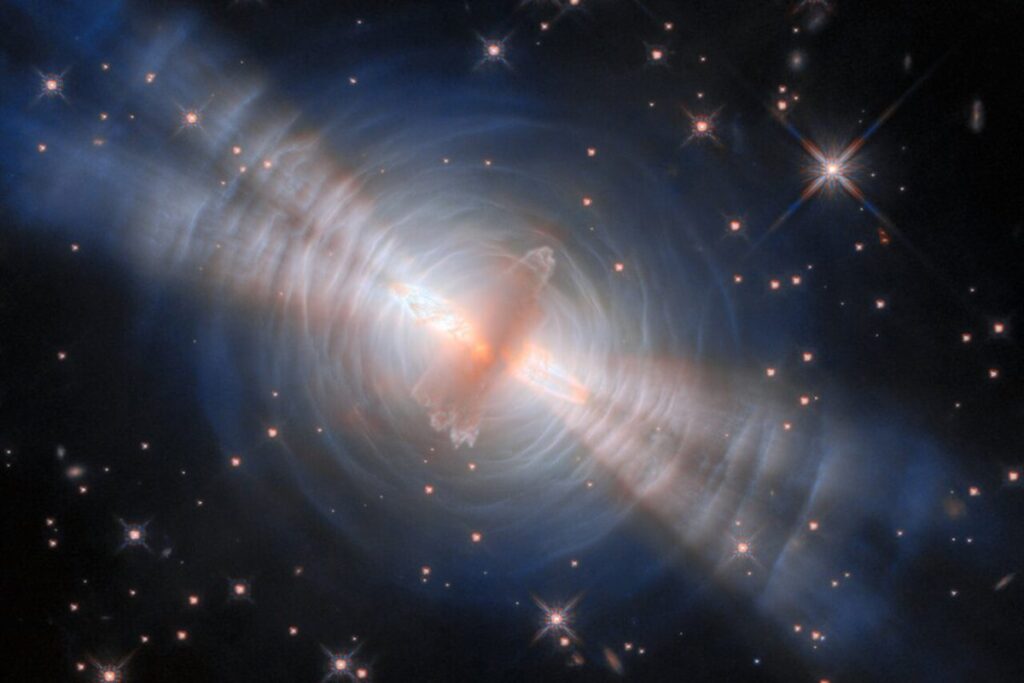
Dust ejected from an ageing star forms strange concentric rings, while powerful beams of light shoot outwards into space.
This is a nebula produced by a star that’s beginning to die, ejecting its outer layers of stardust out into the cosmos.
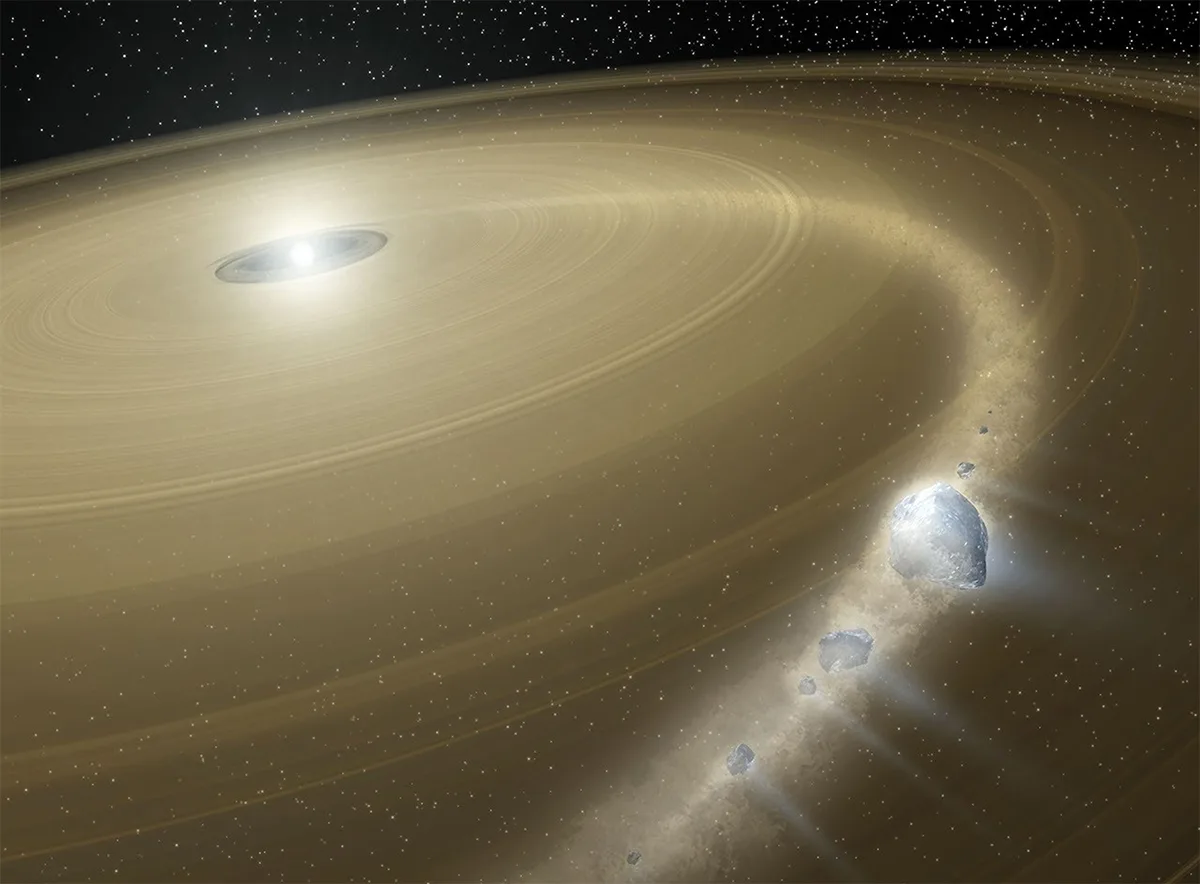 Credit: Artwork: NASA, Tim Pyle (NASA/JPL-Caltech)
The object is known as the Egg Nebula, and is a type of object known as a planetary nebula, which is one of the final stages of a Sun-like star’s long life.
The Hubble Space Telescope is giving astronomers an insight into what’s lurking beneath this shroud of spacedust, and the incredible cosmic processes at work.
Dying throes of a star – or two?
Planetary nebulae are well-studied phenomena in space.
They’re thought to be the final stages of a Sun-like star’s life, when the star has exhausted its fuel and can no longer fight against its own gravity.
It begins shedding its outer layers into space, often producing a spherical, puffed-out shape that resembles a planetary body.
This is why they’re called planetary nebulae, even though in reality they have nothing to do with planets.
The Egg Nebula is somewhat different. It’s ejecting its stellar material in concentric rings, and there are four beams of light emanating from the centre.
Also known as CRL 2688, the Egg Nebula is about 1,000 lightyears from Earth, and astronomers say it’s actually a pre-planetary nebula, the first of its kind ever discovered.
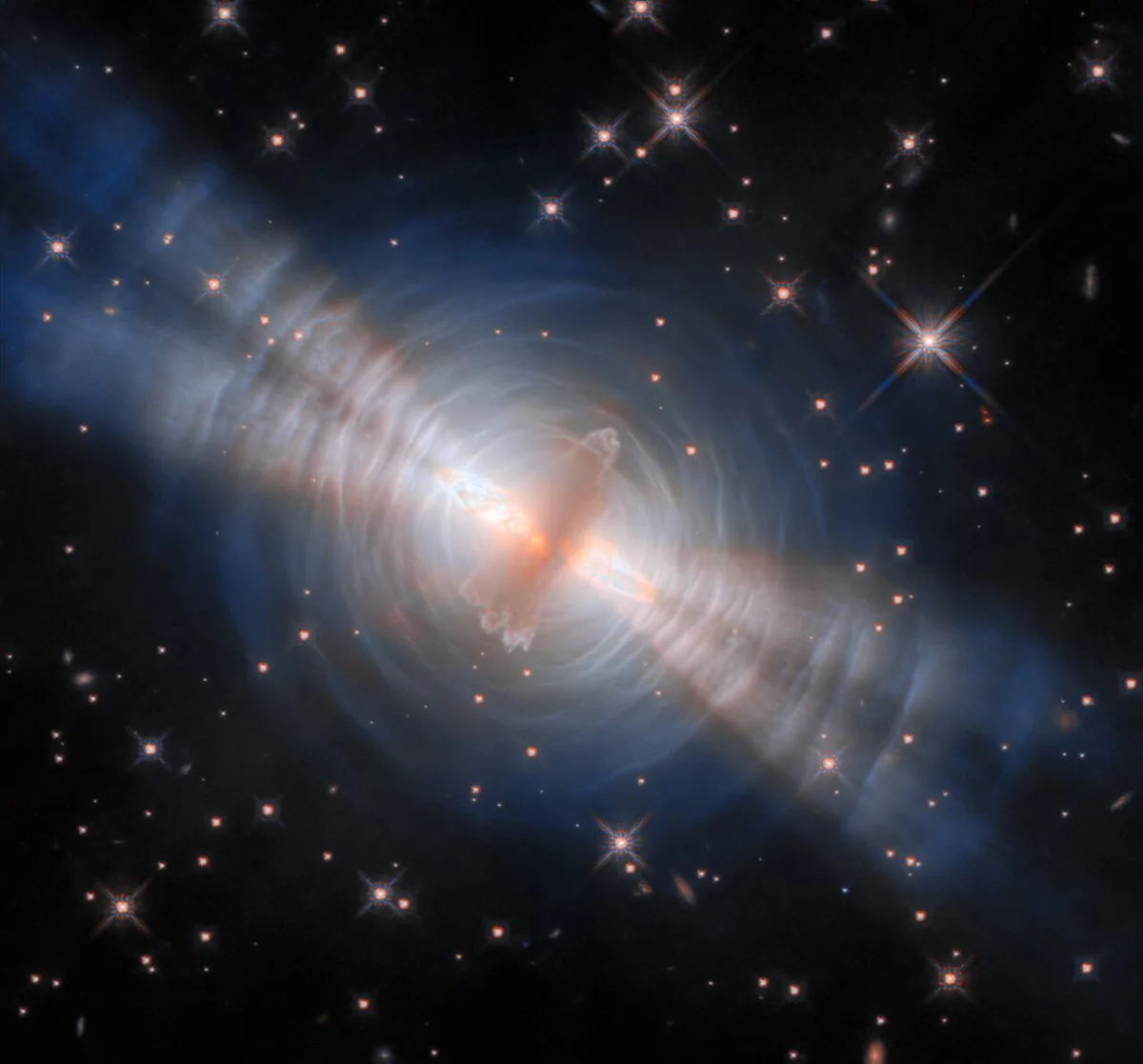 The Egg Nebula, the early stages of a planetary nebula, as seen by the Hubble Space Telescope. Credit: ESA/Hubble & NASA, B. Balick (University of Washington)
That means it’s in the very early stages of forming a planetary nebula.
It glows brightly as the expanding dust shell is illuminated by light from the central star, having been expelled just a few hundred years ago.
The twin beams shooting outwards from the star are illuminating polar lobes that are piercing an older series of arcs.
Astronomers say the evidence revealed by the arcs suggests there may be more than one star at the centre, gravitationally interacting yet obscured by thick dust.
The Egg Nebula is in a brief transitional phase, known as the pre-planetary stage, that lasts just a few thousand years.
That’s the blink of an eye in cosmic terms, so the discovery of the Egg Nebula is a fortunate opportunity to study the beginnings of the dust ejection process while it’s still going on.
Eventually, the dust expelled from this dying star may coalesce under gravity and form a new star system elsewhere in the Universe, and maybe even planets in orbit around it.
By learning more about the Egg Nebula, astronomers can learn not only about how Sun-like stars end their lives, but also about how they may seed the formation of future stars, as the cosmos recycles itself to allow for new worlds to be born.