
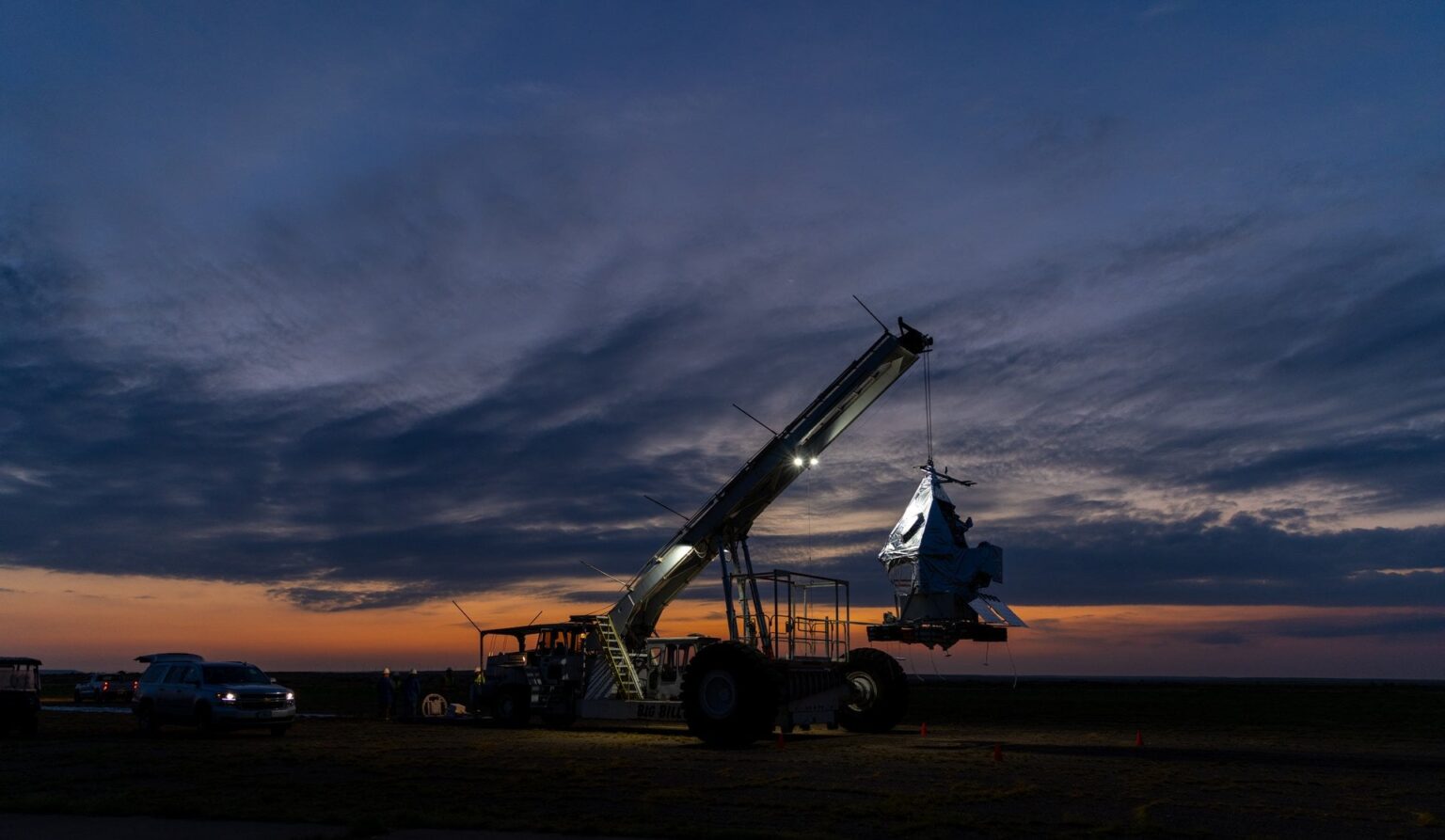
The atmospheres of exoplanets have been a focal point of the field lately, with the James Webb Space Telescope taking a look at as many as it can manage. But time on the world’s most powerful space telescope is valuable, and getting a complete picture of any such atmosphere is difficult without that significant time commitment. So a multidisciplinary team of researchers have come up with an alternative mission that is very specialized at capturing as much information as they can about exoplanet atmospheres, but also with a fraction of the budget of flagship missions like JWST. The mission, known as the EXoplanet Climate Infrared TElescope (EXCITE), has one feature the JWST doesn’t though – a gondola.
That’s because it’s attached to a balloon, designed to float at around 40 km up, above 99.5% of the Earth’s atmosphere. In cold “seeing” conditions, like those above Antarctica, it can point-and-stare at a target without interruption for days. That is exactly what is needed to capture the “phase curves” of hot Jupiter exoplanets that orbit their stars once every few days.
Most media attention in exoplanet discoveries is focused on either transits, where a planet passes in front of its host star, and temporarily shows its atmospheric edge at the beginning and end of the event, and secondary eclipses, when it passes behind the star, and an observer is able to again see the edges very briefly before and after it is blocked from view. However, these are temporary snapshots that provide at best a two-dimensional picture of the planet’s atmosphere.
How NASA uses scientific balloons. Credit – NASA Wallops YouTube Channel
Phase curves, on the other hand, take advantage of the fact that the hot Jupiters are close enough to their star to be tidally locked – meaning only one side ever faces the star, while the other only ever faces the vacuum of space. As a planet transits the star, that means its “terminator line”, where day meets night, moves along the surface of the planet from our observational perspective. Over the course of days, this moving line would allow researchers to create a full, 3D map of the planet’s temperature and atmospheric composition, something the snapshot of transits and secondary eclipses simply cannot do.
From these 3D maps, astronomers can build longitudinal weather maps that can showcase the hottest spot on a planet. They can even determine the pressure of the atmosphere, as different wavelengths of light are absorbed at different pressures, and EXCITE is designed to take spectroscopic curves that can differentiate between different wavelengths.
Ultimately, these enhanced features make EXCITE an exciting alternative to traditional, large-scale exoplanet observatories. In fact, it even has some advantages over the likes of JWST and Hubble. JWST has the problem of almost being too good – the PRISM mode that would be able to track these phase curves is too sensitive for the brightest candidate stars, as they would overwhelm the sensor. Hubble’s position in orbit is its weakness in this case, as it goes in and out of Earth’s shadow regularly as part of its Low Earth Orbit, causing massive thermal swings that require long settling times, and therefore gaps in observations that would be required to capture a full phase curve.
Actual launch of the EXCITE flight test. Credit – K YouTube Channel
To prove this system works, researchers ran a test flight back in August 2024. EXCITE floated above Fort Sumner, New Mexico for 10 hours, with the intention to test out the systems. Some things went right – the gondola could stabilize with sub-arcsecond precisions pointing, and the cryogenic system needed to cool the infrared detectors and optics works flawlessly. However, most flight tests have struggles as well, and in EXCITE’s case, the GPS system went down, and the aluminum housing surrounding the bearings contracted, restricting the telescopes ability to tilt and actually observe anything.
Those are exactly the types of growing pains one would expect for a flight test of new technology, and engineers are already working on solutions to them. They hope to have a long-duration flight during the 2026-2027 summer in Antarctica. If successful, that single mission could double the amount of exoplanet phase curves currently known to humanity. That sounds like a pretty great achievement for this relatively inexpensive mission.
Learn More:
T. D. Rehm et al. – The EXoplanet Climate Infrared TElescope (EXCITE): A balloon-borne mission to measure spectroscopic phase curves of transiting hot Jupiters
UT – Satellites on a Budget – High Altitude Balloons
UT – We Can Do More Exoplanet Science By Understanding the Dark Edge of It’s Star