
What did an 18-year-old spot in plain sight that a fleet of experts missed for years? The most surprising part isn’t what he found, but how he found it.
In Pasadena, an 18-year-old built an AI that sifted NASA’s NEOWISE archives to flag 1.5 million previously unknown cosmic objects. Where nearly 200 billion infrared detections had stymied experts, his convolutional neural network sped the job up about 100-fold. Guided at Caltech’s Infrared Processing Center by Davy Kirkpatrick, Matteo Paz turned a summer project into a paper in the Astronomical Journal. The haul includes 57 potential asteroids and two comets, a result that also earned him the Regeneron Science Talent Search’s third prize as NASA takes notice.
A cosmic breakthrough at 18
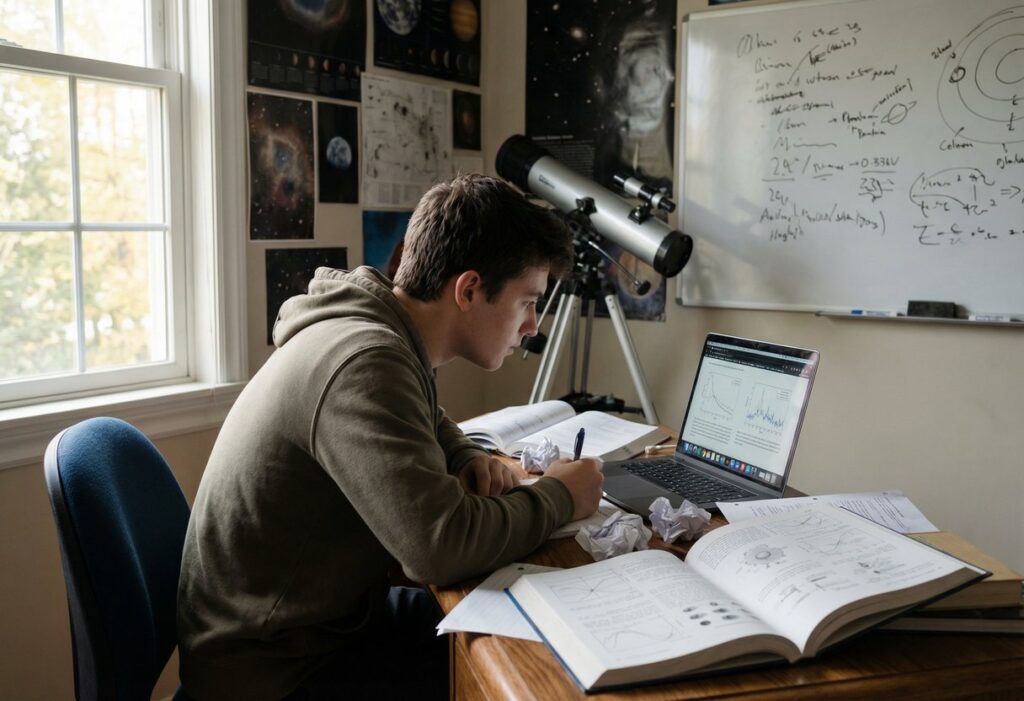
Some breakthroughs arrive without fanfare, then quietly rearrange the map. This is the case with Matteo Paz, a high school senior from Pasadena. From his bedroom desk, he sifted NASA’s cold archives and found them humming. What happens when patience meets code and a sky of numbers? He is 18, curious, and stubborn in the best way. The result feels both intimate and cosmic.
At just 18, he identified 1.5 million previously unknown cosmic objects buried in NEOWISE data. He worked alone, building an AI model during a Caltech summer program and refining it at home. The sweep wasn’t luck; it was methodical, repeatable, and documented for peers to inspect.
The challenge of NEOWISE data
The NEOWISE infrared telescope (launched in 2009) has scanned the sky for more than a decade. Over that time it produced roughly 200 billion detections, a deluge that humbled manual pipelines. Traditional filters crawled, flagging objects too slowly and missing the faintest signatures. Valuable clues sat idle, buried under volume and instrument noise.
Revolutionary AI and guidance from NASA
To crack the bottleneck, Paz trained a convolutional neural network, the workhorse that spots patterns in images. Under the mentorship of Davy Kirkpatrick at Caltech’s Infrared Processing and Analysis Center (IPAC), he tuned it to NEOWISE’s quirks. The result: a 100-fold jump in processing speed and sharper triage of genuine sources over artifacts. It became especially adept at pulling out:
asteroids barely brighter than the background glow
comets blended with dust and noise
distant galaxies masked by infrared clutter
Recognition and a promising future
Across 20 million images covering a 3rd of the sky, the system surfaced 1.5 million fresh sources, including 57 potential asteroids and 2 comets. His methods and catalog appeared in the Astronomical Journal (April 2025). The work also earned him 3rd prize at the Regeneron Science Talent Search and a $125,000 award.
Next comes college: astronomy at Caltech, and likely deeper ties with NASA. Paz wants to extend the model to full‑sky data and crossmatch with other surveys, according to his paper. In addition to new objects, the approach promises cleaner catalogs and faster alerts—evidence that rigorous, well‑aimed AI can expand the reach of human curiosity.