
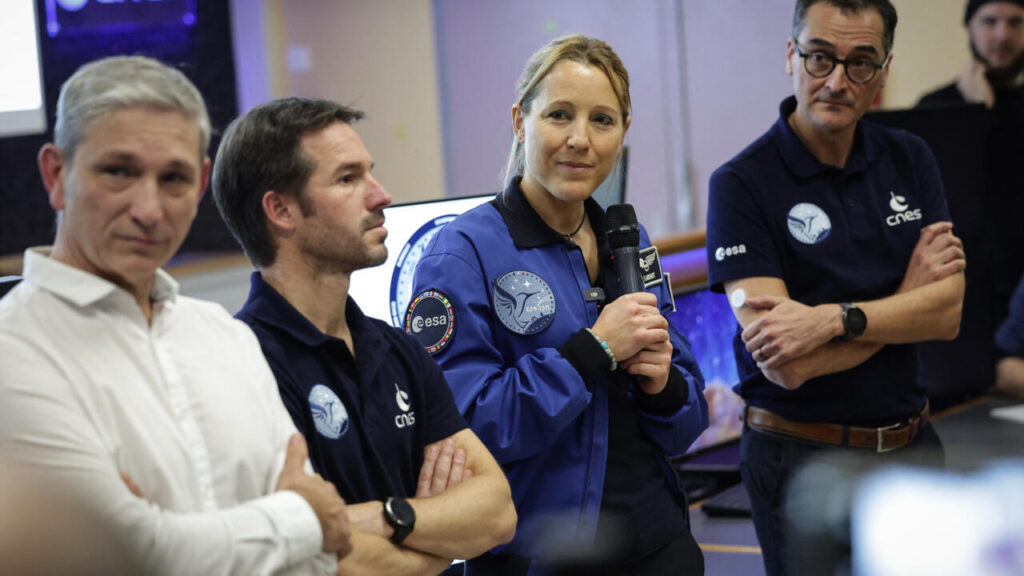
French astronaut Sophie Adenot is set to fly to the International Space Station on Friday, 13 February 2026. She will launch at around 11:00 CET from Cape Canaveral Space Force Station in Florida as part of NASA’s SpaceX Crew-12 mission. The launch was due to take place today, Thursday, but was postponed because of bad weather. They are due to dock with ISS on Saturday evening.
Issued on: 11/02/2026 – 21:07Modified: 11/02/2026 – 21:16
2 min Reading time
The crew will launch aboard a SpaceX Dragon spacecraft on a Falcon 9 rocket. Adenot will be joined by NASA astronauts Jessica Meir (mission commander), Jack Hathaway (pilot), and Russian cosmonaut Andrey Fedyaev (mission specialist).
Who is Sophie Adenot, the French engineer destined for space?
Adenot, 43, holds the rank of colonel in the French Air and Space Force. She will become only the second Frenchwoman in space in more than 30 years, following Claudie Haigneré’s historic missions in the 1990s and early 2000s.
France’s first woman in space in 25 years counts down to trip to the ISS
Haigneré first flew to space in August 1996 aboard Soyuz TM-24, spending 16 days on the Russian space station Mir during the Cassiopée mission. In October 2001, she became the first European woman to visit the International Space Station during the Andromède mission.
The Crew-12 mission will be Adenot’s first spaceflight. The European Space Agency has named her mission εpsilon (Epsilon). Selected as an ESA astronaut in November 2022 from a pool of 22,500 applicants, she became the first member of her class to receive a flight assignment.
Adenot earned an engineering degree from ISAE-SUPAERO in Toulouse, France, specialising in spacecraft and aircraft flight dynamics. She also holds a master’s degree in human factors engineering from the Massachusetts Institute of Technology in the United States.
France’s Sophie Adenot to spend nine months on ISS after medical evacuation
Before joining ESA, she became France’s first female helicopter test pilot in 2018, accumulating over 3,000 flight hours on 22 different types of helicopter.
Adenot’s experiments
Josef Aschbacher, Director General of the European Space Agency, said Adenot’s mission was very important for Europe as she would be conducting experiments during her six-to-eight-month stay on the International Space Station.
The aim is to develop space science and technology through these experiments. This forms a vital part of exploration work and is crucial for developing expertise in space, Aschbacher told RFI English following his press briefing in January.
According to CNES, France‘s space agency, Adenot will contribute to approximately 200 experiments during her stay. Seven have been specifically prepared for the Epsilon mission by CADMOS, CNES’s centre for the development of microgravity applications and space operations in Toulouse.
ESA at 50: looking back and launching forward
The experiments will focus on physiology, technology testing for future Moon and Mars missions, and educational outreach.
The mission name, εpsilon, is the fifth Greek letter and follows the French tradition of naming human spaceflight missions after celestial bodies.
Epsilon is also the fifth brightest star in the Leo constellation. The name symbolises the power of small yet impactful contributions in space exploration, with each team member playing a meaningful role in the collaborative international effort.