
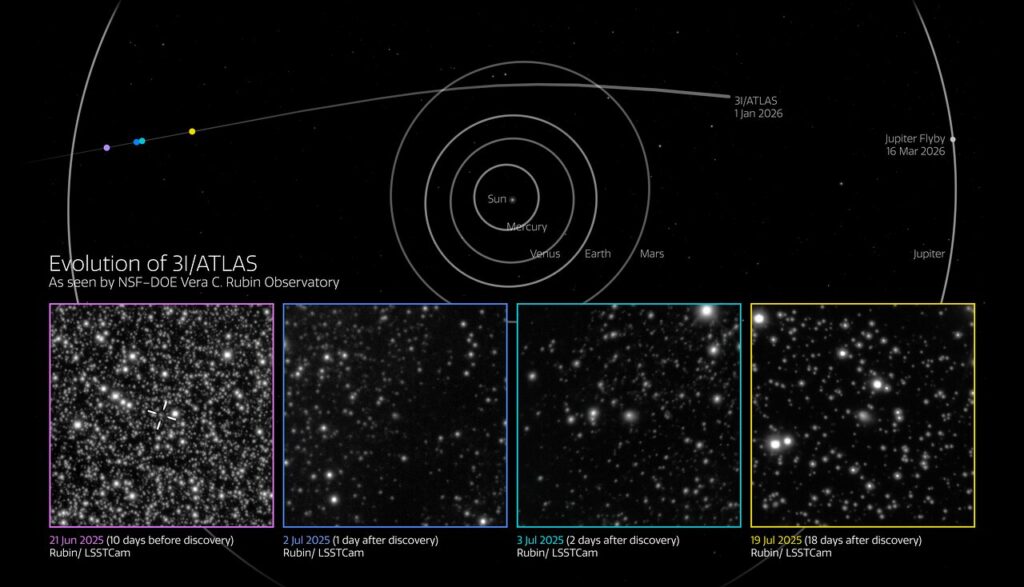
This Image of the Week features the famous interstellar object known as comet 3I/ATLAS, as seen by NSF–DOE Vera C. Rubin Observatory, jointly funded by the U.S. National Science Foundation (NSF) and the U.S. Department of Energy’s Office of Science (DOE/SC) and jointly operated by NSF NOIRLab and DOE’s SLAC National Accelerator Laboratory.
3I/ATLAS is only the third interstellar object ever discovered. It was first reported on 1 July 2025 by the Asteroid Terrestrial-impact Last Alert System (ATLAS). However, it appeared ten days earlier, on 21 June 2025, in high-resolution commissioning data captured with Rubin’s 3200-megapixel LSST Camera.
Rubin is currently preparing for the start of its mission: the ten-year Legacy Survey of Space and Time (LSST), slated to begin this year. At the time of these observations, the crews were in testing mode and initially weren’t aware of the interstellar comet’s appearance. But as soon as the first alert from ATLAS went out, a check of the camera’s data identified that Rubin, with its unparalleled field of view and light-collecting power, paired with a necessary portion of luck, detected the comet ten days before its discovery.
Rubin continued observing 3I/ATLAS until 20 July, when it was no longer observable while the Sun was below the horizon. The LSST Camera collected nearly 100 exposures that, when combined, show a nightly time-lapse of the interstellar object as it makes its way across the sky. Rubin captured fine details of the comet’s evolution as it approached the Sun.
Scientists predict that many interstellar objects exist and likely pass through our Solar System on a regular basis. But they are exceptionally difficult to capture since they are only visible if they’re bright or close enough, and our telescopes are pointing in the right place at the right time. For this reason, the astronomical community has been eagerly awaiting the LSST, during which Rubin will detect millions of changes in the sky every night and uncover an unpredictable number of never-before-seen interstellar objects.
Credit:
NSF–DOE Vera C. Rubin Observatory/NOIRLab/SLAC/AURA
Image Processing: C. Chandler (University of Washington), M. Zamani & D. de Martin (NSF NOIRLab)