
Researchers from Columbia University and the Breakthrough Listen project, which aims to search for extraterrestrial intelligence, have published new research findings. Scientists have discovered signs of a pulsar at the very center of the Milky Way.
Pulsar at the center of the Milky Way
Pulsars are rapidly rotating neutron stars with very powerful magnetic fields. They emit radio waves that are detected on Earth as periodic pulses. Each pulsar has its own unique “signature,” which is why they are often referred to as the beacons of the Universe.
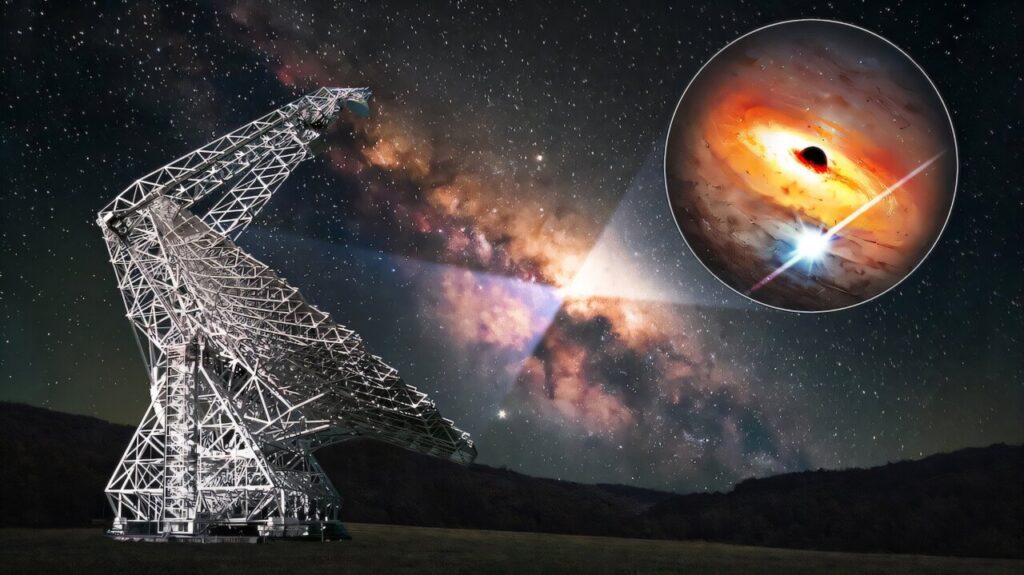
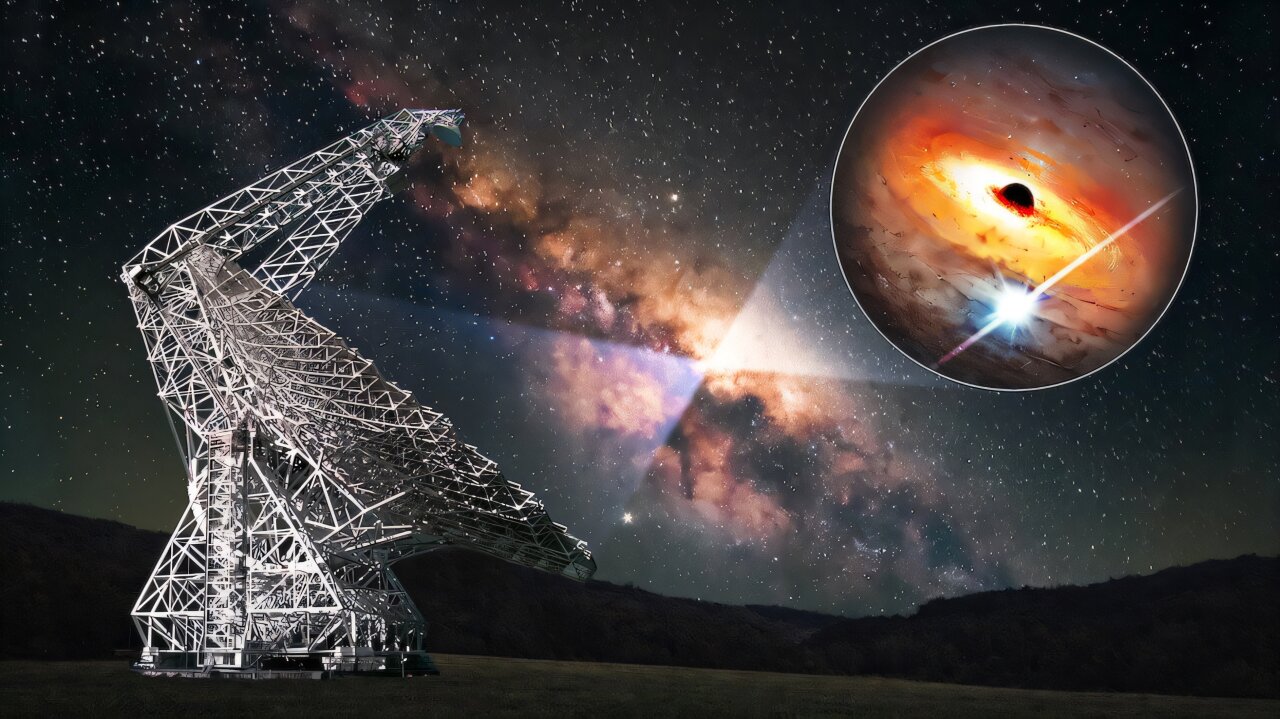 Illustration showing the observation of a pulsar in the center of the Milky Way by the Green Bank radio telescope. Source: Danielle Futselaar/Breakthrough Listen
During one of the most sensitive radio searches for pulsars ever conducted in the central region of the Milky Way, scientists managed to discover a very interesting candidate. Its rotation period is 8.19 milliseconds, and it is located near the supermassive black hole Sagittarius A*.
Why is this discovery important?
In the absence of any external influences, pulses from the pulsar reach telescopes with extreme regularity, so they can be considered very accurate clocks with highly predictable behavior. Millisecond pulsars, in particular, exhibit extremely stable behavior, similar to that of a clock.
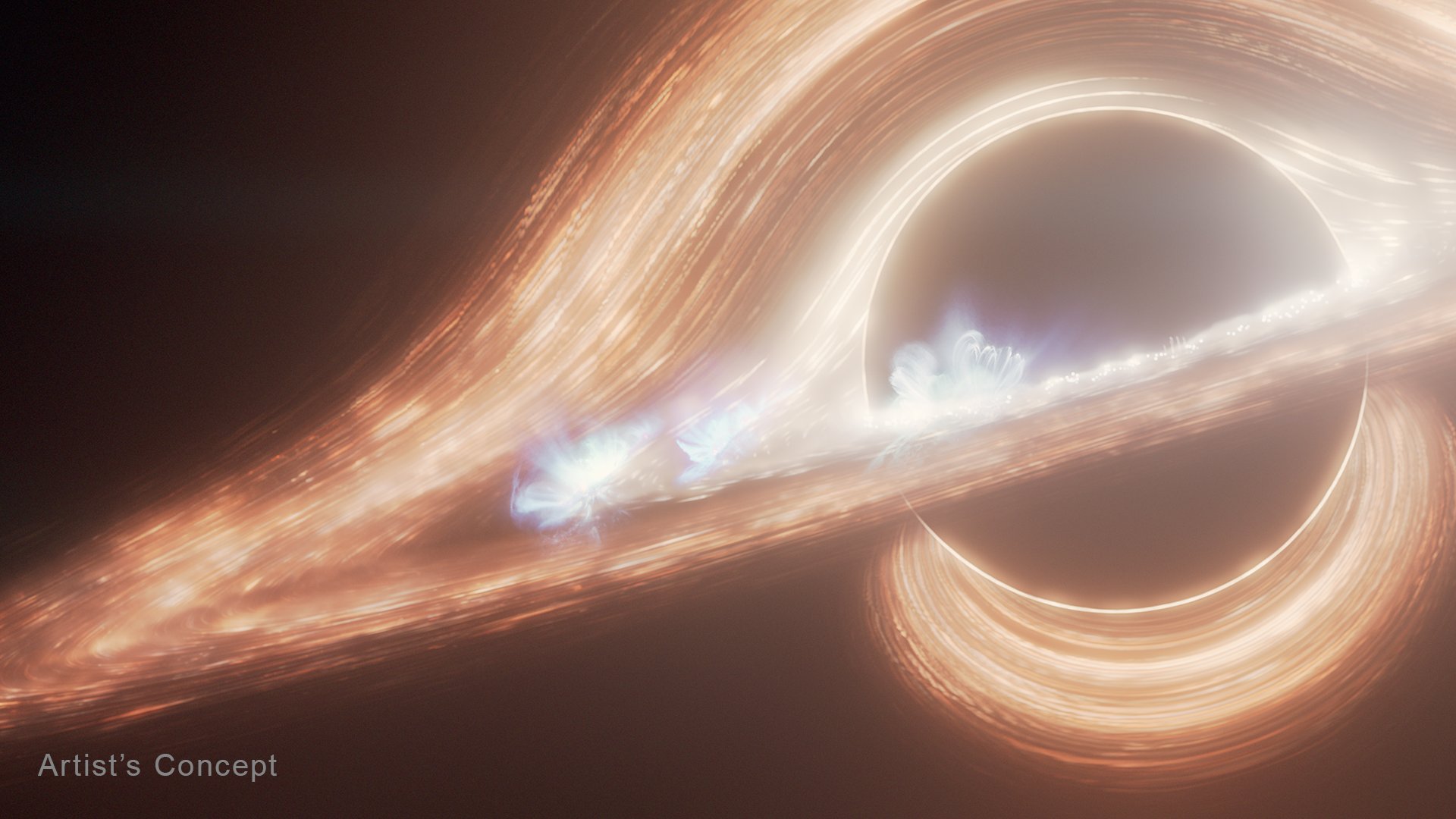 Sagittarius A* in an artist’s impression. Source: NASA, ESA, CSA, Ralf Crawford (STScI)
However, the pulsar candidate discovered by astronomers is located near Sagittarius A*, whose mass is approximately 4 million times greater than that of our Sun. Its gravity has a strong influence on its surroundings. According to scientists, if the existence of the pulsar is confirmed, it will allow them to conduct an unprecedented test of Einstein’s general theory of relativity, including precise measurements of space-time around a supermassive black hole.
“Any external influence on a pulsar, such as the gravitational pull of a massive object, would introduce anomalies in this steady arrival of pulses, which can be measured and modeled,” said study co-author Slavko Bogdanov. “In addition, when the pulses travel near a very massive object, they may be deflected and experience time delays due to the warping of space-time, as predicted by Einstein’s General Theory of Relativity.”
“We’re looking forward to what follow-up observations might reveal about this pulsar candidate,” added study leader Karen I. Perez. “If confirmed, it could help us better understand both our own Galaxy, and General Relativity as a whole.”
Earlier, we reported on the results of another study, according to which Sagittarius A* may not be a black hole, but rather a cluster of dark matter.
According to Columbia University