
Marois, C. et al. Direct imaging of multiple planets orbiting the star HR 8799. Science 322, 1348 (2008).
Zurlo, A. et al. Orbital and dynamical analysis of the system around HR 8799. New astrometric epochs from VLT/SPHERE and LBT/LUCI. Astron. Astrophys. 666, A133 (2022).
Ida, S. & Lin, D. N. C. Toward a deterministic model of planetary formation. I. A desert in the mass and semimajor axis distributions of extrasolar planets. Astrophys. J. 604, 388–413 (2004).
Nasedkin, E. et al. Four-of-a-kind? Comprehensive atmospheric characterisation of the HR 8799 planets with VLTI/GRAVITY. Astron. Astrophys. 687, A298 (2024).
Wang, J. Early accretion of large amounts of solids for directly imaged exoplanets. Astrophys. J. 981, 138 (2025).
Öberg, K. I., Murray-Clay, R. & Bergin, E. A. The effects of snowlines on C/O in planetary atmospheres. Astrophys. J. Lett. 743, L16 (2011).
Mordasini, C., van Boekel, R., Mollière, P., Henning, T. & Benneke, B. The imprint of exoplanet formation history on observable present-day spectra of hot Jupiters. Astrophys. J. 832, 41 (2016).
Mollière, P. et al. Interpreting the atmospheric composition of exoplanets: sensitivity to planet formation assumptions. Astrophys. J. 934, 74 (2022).
Konopacky, Q. M., Barman, T. S., Macintosh, B. A. & Marois, C. Detection of carbon monoxide and water absorption lines in an exoplanet atmosphere. Science 339, 1398–1401 (2013).
Xuan, J. W. et al. Are these planets or brown dwarfs? Broadly solar compositions from high-resolution atmospheric retrievals of ~10–30 MJup companions. Astrophys. J. 970, 71 (2024).
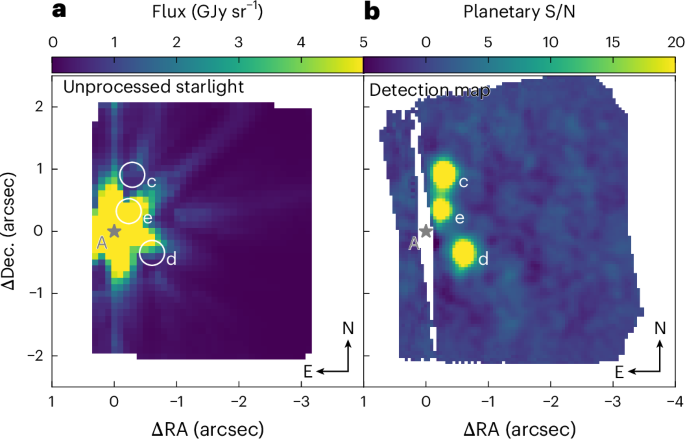
Ruffio, J.-B. et al. JWST-TST high contrast: achieving direct spectroscopy of faint substellar companions next to bright stars with the NIRSpec integral field unit. Astron. J. 168, 73 (2024).
Böker, T. et al. The near-infrared spectrograph (NIRSpec) on the James Webb Space Telescope. III. Integral-field spectroscopy. Astron. Astrophys. 661, A82 (2022).
Balmer, W. O. et al. JWST-TST high contrast: living on the wedge, or, NIRCam bar coronagraphy reveals CO2 in the HR 8799 and 51 Eri exoplanets’ atmospheres. Astron. J. 169, 209 (2025).
Law, D. D. et al. A 3D drizzle algorithm for JWST and practical application to the MIRI medium resolution spectrometer. Astron. J. 166, 45 (2023).
Mollière, P. et al. petitRADTRANS. A Python radiative transfer package for exoplanet characterization and retrieval. Astron. Astrophys. 627, A67 (2019).
Brown-Sevilla, S. B. et al. Revisiting the atmosphere of the exoplanet 51 Eridani b with VLT/SPHERE. Astron. Astrophys. 673, A98 (2023).
Zahnle, K. J. & Marley, M. S. Methane, carbon monoxide, and ammonia in brown dwarfs and self-luminous giant planets. Astrophys. J. 797, 41 (2014).
Lodders, K. & Fegley, B. Atmospheric chemistry in giant planets, brown dwarfs, and low-mass dwarf stars. I. Carbon, nitrogen, and oxygen. Icarus 155, 393–424 (2002).
Calamari, E. et al. Predicting cloud conditions in substellar mass objects using ultracool dwarf companions. Astrophys. J. 963, 67 (2024).
Baburaj, A. et al. A high-resolution spectroscopic survey of directly imaged companion hosts. I. Determination of diagnostic stellar abundances for planet formation and composition. Astron. J. 169, 55 (2025).
Balmer, W. O. et al. VLTI/GRAVITY observations of AF Lep b: preference for circular orbits, cloudy atmospheres, and a moderately enhanced metallicity. Astron. J. 169, 30 (2025).
Hoch, K. K. W. et al. Assessing the C/O ratio formation diagnostic: a potential trend with companion mass. Astron. J. 166, 85 (2023).
Kama, M. et al. Abundant refractory sulfur in protoplanetary disks. Astrophys. J. 885, 114 (2019).
Schneider, A. D. & Bitsch, B. How drifting and evaporating pebbles shape giant planets. II. Volatiles and refractories in atmospheres. Astron. Astrophys. 654, A72 (2021).
Turrini, D. et al. Tracing the formation history of giant planets in protoplanetary disks with carbon, oxygen, nitrogen, and sulfur. Astrophys. J. 909, 40 (2021).
Chachan, Y., Knutson, H. A., Lothringer, J. & Blake, G. A. Breaking degeneracies in formation histories by measuring refractory content in gas giants. Astrophys. J. 943, 112 (2023).
Tsai, S.-M. et al. Photochemically produced SO2 in the atmosphere of WASP-39b. Nature 617, 483–487 (2023).
Polman, J., Waters, L. B. F. M., Min, M., Miguel, Y. & Khorshid, N. H2S and SO2 detectability in hot Jupiters. Sulphur species as indicators of metallicity and C/O ratio. Astron. Astrophys. 670, A161 (2023).
Fu, G. et al. Hydrogen sulfide and metal-enriched atmosphere for a Jupiter-mass exoplanet. Nature 632, 752–756 (2024).
Inglis, J. et al. Quartz clouds in the dayside atmosphere of the quintessential hot Jupiter HD 189733 b. Astrophys. J. Lett. 973, L41 (2024).
Thorngren, D. P., Fortney, J. J., Murray-Clay, R. A. & Lopez, E. D. The mass-metallicity relation for giant planets. Astrophys. J. 831, 64 (2016).
Lee, E. J., Fuentes, J. R. & Hopkins, P. F. Establishing dust rings and forming planets within them. Astrophys. J. 937, 95 (2022).
Van Clepper, E., Price, E. M. & Ciesla, F. J. Three-dimensional transport of solids in a protoplanetary disk containing a growing giant planet. Astrophys. J. 980, 201 (2025).
Helled, R. & Bodenheimer, P. Metallicity of the massive protoplanets around HR 8799 If formed by gravitational instability. Icarus 207, 503–508 (2010).
Boley, A. C., Helled, R. & Payne, M. J. The heavy-element composition of disk instability planets can range from sub- to super-nebular. Astrophys. J. 735, 30 (2011).
Tobin, J. J. et al. The VLA/ALMA Nascent Disk and Multiplicity (VANDAM) survey of Orion protostars. II. A statistical characterization of class 0 and class I protostellar disks. Astrophys. J. 890, 130 (2020).
Lin, J. W., Lee, E. J. & Chiang, E. A balanced budget view on forming giant planets by pebble accretion. Mon. Not. R. Astron. Soc. 480, 4338–4354 (2018).
Chachan, Y. et al. Kepler-167e as a probe of the formation histories of cold giants with inner super-Earths. Astrophys. J. 926, 62 (2022).
Mamajek, E. E. Initial conditions of planet formation: lifetimes of primordial disks. AIP Conf. Proc. 1158, 3–10 (2009).
Howard, S. et al. Exploring the hypothesis of an inverted Z gradient inside Jupiter. Astron. Astrophys. 680, L2 (2023).
Owen, T. et al. A low-temperature origin for the planetesimals that formed Jupiter. Nature 402, 269–270 (1999).
Chiang, E. I. & Goldreich, P. Spectral energy distributions of T Tauri stars with passive circumstellar disks. Astrophys. J. 490, 368–376 (1997).
Johansen, A. & Lambrechts, M. Forming planets via pebble accretion. Annu. Rev. Earth Planet. Sci. 45, 359–387 (2017).
McClure, M. K. et al. An Ice Age JWST inventory of dense molecular cloud ices. Nat. Astron. 7, 431–443 (2023).
Eistrup, C., Walsh, C. & van Dishoeck, E. F. Molecular abundances and C/O ratios in chemically evolving planet-forming disk midplanes. Astron. Astrophys. 613, A14 (2018).
Bosman, A. D., Walsh, C. & van Dishoeck, E. F. CO destruction in protoplanetary disk midplanes: inside versus outside the CO snow surface. Astron. Astrophys. 618, A182 (2018).
Lunine, J. I. & Stevenson, D. J. Thermodynamics of clathrate hydrate at low and high pressures with application to the outer Solar System. Astrophys. J. Suppl. Ser. 58, 493 (1985).
Bar-Nun, A., Kleinfeld, I. & Kochavi, E. Trapping of gas mixtures by amorphous water ice. Phys. Rev. B 38, 7749–7754 (1988).
Bushouse, H. et al. JWST calibration pipeline. Zenodo https://doi.org/10.5281/zenodo.7692609 (2023).
Greenfield, P. & Miller, T. The Calibration Reference Data System. Astron. Comput. 16, 41–53 (2016).
Agrawal, S., Ruffio, J.-B., Perrin, M., Madurowicz, A. & Sappey, B. jruffio/breads: Accepted hd19467b paper. Zenodo https://doi.org/10.5281/zenodo.11391503 (2024).
Perrin, M. D., Soummer, R., Elliott, E. M., Lallo, M. D. & Sivaramakrishnan, A. Simulating point spread functions for the James Webb Space Telescope with WebbPSF. In Proc. SPIE Conference Series, Space Telescopes and Instrumentation 2012: Optical, Infrared, and Millimeter Wave, Vol. 8442 (eds Clampin, M. C. et al.) 84423D (SPIE, 2012).
Perrin, M. D. et al. Updated point spread function simulations for JWST with WebbPSF. In Proc. SPIE Conference Series, Space Telescopes and Instrumentation 2014: Optical, Infrared, and Millimeter Wave, Vol. 9143 (eds Oschmann, J. et al.) 91433X (SPIE, 2014).
Allard, F. et al. Model atmospheres and spectra: the role of dust. In Proc. Symposium of the International Astronomical Union, Brown Dwarfs, Vol. 211 (ed. Martín, E.) 325–332 (Cambridge Univ. Press, 2003).
Ruffio, J.-B. et al. Radial velocity measurements of HR 8799 b and c with medium resolution spectroscopy. Astron. J. 158, 200 (2019).
Wang, J. J., Kulikauskas, M. & Blunt, S. whereistheplanet: predicting positions of directly imaged companions. Astrophysics Source Code Library ascl:2101.003 (2021).
Mollière, P. et al. Retrieving scattering clouds and disequilibrium chemistry in the atmosphere of HR 8799e. Astron. Astrophys. 640, A131 (2020).
Xuan, J. W. et al. A clear view of a cloudy brown dwarf companion from high-resolution spectroscopy. Astrophys. J. 937, 54 (2022).
Zurlo, A. et al. First light of the VLT planet finder SPHERE. III. New spectrophotometry and astrometry of the HR 8799 exoplanetary system. Astron. Astrophys. 587, A57 (2016).
Xuan, J. W. et al. Validation of elemental and isotopic abundances in late-M spectral types with the benchmark HIP 55507 AB system. Astrophys. J. 962, 10 (2024).
Piette, A. A. A. & Madhusudhan, N. Considerations for atmospheric retrieval of high-precision brown dwarf spectra. Mon. Not. R. Astron. Soc. 497, 5136–5154 (2020).
Zhang, Z. et al. Elemental abundances of planets and brown dwarfs imaged around stars (ELPIS). I. Potential metal enrichment of the exoplanet AF Lep b and a novel retrieval approach for cloudy self-luminous atmospheres. Astron. J. 166, 198 (2023).
Zhang, Z., Mollière, P., Fortney, J. J. & Marley, M. S. Elemental abundances of planets and brown dwarfs imaged around stars (ELPIS). II. The Jupiter-like inhomogeneous atmosphere of the first directly imaged planetary-mass companion 2MASS 1207 b. Astron. J. 170, 64 (2025).
Morley, C. V. et al. The Sonora substellar atmosphere models. III. Diamondback: atmospheric properties, spectra, and evolution for warm cloudy substellar objects. Astrophys. J. 975, 59 (2024).
Ackerman, A. S. & Marley, M. S. Precipitating condensation clouds in substellar atmospheres. Astrophys. J. 556, 872–884 (2001).
Lei, E. & Mollière, P. easyCHEM: a Python package for calculating chemical equilibrium abundances in exoplanet atmospheres. J. Open Res. Softw. 10, 7712 (2025).
Rothman, L. S. et al. Hitemp, the high-temperature molecular spectroscopic database. J. Quant. Spectrosc. Radiat. Transf. 111, 2139–2150 (2010).
Hargreaves, R. J. et al. An accurate, extensive, and practical line list of methane for the HITEMP database. Astrophys. J. Suppl. Ser. 247, 55 (2020).
Polyansky, O. L. et al. ExoMol molecular line lists. XXX. A complete high-accuracy line list for water. Mon. Not. R. Astron. Soc. 480, 2597–2608 (2018).
Coles, P. A., Yurchenko, S. N. & Tennyson, J. ExoMol molecular line lists. XXXV. A rotation-vibration line list for hot ammonia. Mon. Not. R. Astron. Soc. 490, 4481–4488 (2019).
Barber, R. J. et al. ExoMol line lists. III. An improved hot rotation-vibration line list for HCN and HNC. Mon. Not. R. Astron. Soc. 437, 1828–1835 (2014).
Azzam, A. A., Tennyson, J., Yurchenko, S. N. & Naumenko, O. V. ExoMol molecular line lists. XVI. The rotation-vibration spectrum of hot H2S. Mon. Not. R. Astron. Soc. 460, 4063–4074 (2016).
Allard, N. F., Spiegelman, F., Leininger, T. & Molliere, P. New study of the line profiles of sodium perturbed by H2. Astron. Astrophys. 628, A120 (2019).
Bernath, P. F. MoLLIST: molecular line lists, intensities and spectra. J. Quant. Spectrosc. Radiat. Transf. 240, 106687 (2020).
Asplund, M., Grevesse, N., Sauval, A. J. & Scott, P. The chemical composition of the Sun. Annu. Rev. Astron. Astrophys. 47, 481–522 (2009).
Visscher, C. & Moses, J. I. Quenching of carbon monoxide and methane in the atmospheres of cool brown dwarfs and hot Jupiters. Astrophys. J. 738, 72 (2011).
Beiler, S. A. et al. A tale of two molecules: the underprediction of CO2 and overprediction of PH3 in late T and Y dwarf atmospheric models. Astrophys. J. 973, 60 (2024).
Buchner, J. et al. X-ray spectral modelling of the AGN obscuring region in the CDFS: Bayesian model selection and catalogue. Astron. Astrophys. 564, A125 (2014).
Feroz, F., Hobson, M. P., Cameron, E. & Pettitt, A. N. Importance nested sampling and the multinest algorithm. Open J. Astrophys. 2, 10 (2019).
Barman, T. S., Konopacky, Q. M., Macintosh, B. & Marois, C. Simultaneous detection of water, methane, and carbon monoxide in the atmosphere of exoplanet HR8799b. Astrophys. J. 804, 61 (2015).
Ruffio, J.-B. et al. Deep exploration of the planets HR 8799 b, c, and d with moderate-resolution spectroscopy. Astron. J. 162, 290 (2021).
Ruffio, J.-B. et al. Improving and assessing planet sensitivity of the GPI exoplanet survey with a forward model matched filter. Astrophys. J. 842, 14 (2017).
Doelman, D. S. et al. L-band integral field spectroscopy of the HR 8799 planetary system. Astron. J. 163, 217 (2022).
Zhang, Y. et al. The 13CO-rich atmosphere of a young accreting super-Jupiter. Nature 595, 370–372 (2021).
Milam, S. N., Savage, C., Brewster, M. A., Ziurys, L. M. & Wyckoff, S. The 12C/13C isotope gradient derived from millimeter transitions of CN: the case for Galactic chemical evolution. Astrophys. J. 634, 1126–1132 (2005).
Zhang, Y. et al. The ESO SupJup Survey. III. Confirmation of 13CO in YSES 1 b and atmospheric detection of YSES 1 c with CRIRES+. Astron. J. 168, 246 (2024).
Wilson, T. L. Isotopes in the interstellar medium and circumstellar envelopes. Rep. Prog. Phys. 62, 143–185 (1999).
Faramaz, V. et al. A detailed characterization of HR 8799’s debris disk with ALMA in band 7. Astron. J. 161, 271 (2021).
Phillips, M. W. et al. A new set of atmosphere and evolution models for cool T-Y brown dwarfs and giant exoplanets. Astron. Astrophys. 637, A38 (2020).
Saumon, D. & Marley, M. S. The evolution of l and T dwarfs in color-magnitude diagrams. Astrophys. J. 689, 1327–1344 (2008).
Smith, M. D. Estimation of a length scale to use with the quench level approximation for obtaining chemical abundances. Icarus 132, 176–184 (1998).
Gierasch, P. J. & Conrath, B. J. in Recent Advances in Planetary Meteorology (ed. Hunt, G. E.) 121–146 (Cambridge Univ. Press, 1985).
Mukherjee, S. et al. Probing the extent of vertical mixing in brown dwarf atmospheres with disequilibrium chemistry. Astrophys. J. 938, 107 (2022).
Jura, M. Lambda Boo abundance patterns: accretion from orbiting sources. Astron. J. 150, 166 (2015).
Kama, M., Folsom, C. P. & Pinilla, P. Fingerprints of giant planets in the photospheres of Herbig stars. Astron. Astrophys. 582, L10 (2015).
Kamp, I. et al. Light element non-LTE abundances of λ Bootis stars. II. Nitrogen and sulphur. Astron. Astrophys. 375, 899–908 (2001).
Ruffio, J.-B. NIRSpec IFU data for HR 8799 paper. Barbara A. Mikulski Archive for Space Telescopes https://doi.org/10.17909/zzg0-hq53 (2025).
Ruffio, J.-B. & Xuan, W. JWST/NIRSpec IFU spectra of HR 8799 c, d, e (2.9–5.2 um; R∼2,700). Zenodo https://doi.org/10.5281/zenodo.17536808 (2025).
Guillot, T. et al. Giant planets from the inside-out. In Proc. SPIE Conference Series, Protostars and Planets VII, Vol. 534 (eds Inutsuka, S. et al.) 2205.04100 (SPIE, 2023).
Atreya, S. K. et al. in Saturn in the 21st Century (eds Baines, K. H. et al.) 5–43 (Cambridge Univ. Press, 2018).