
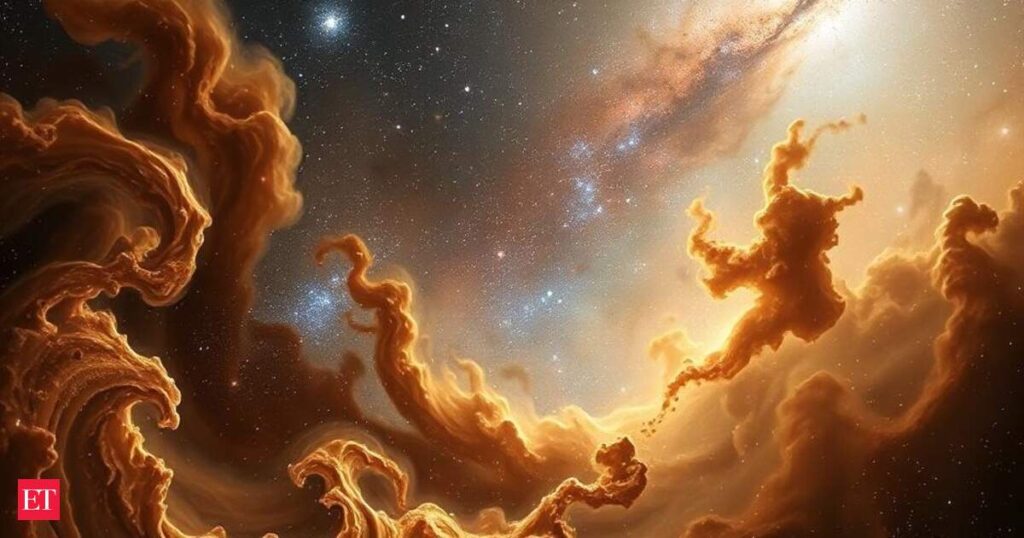
Did you know: When you look up at the night sky, the vastness of space may seem endlessly black, but that’s not the whole story. In a surprising twist, astronomers have calculated an average colour for the universe itself, and it’s far from pitch black. Dubbed “Cosmic latte”, this hue is a warm, creamy beige that represents the combined light coming from all the stars, galaxies and cosmic matter visible from Earth.Did you know: How the Universe Got Its ColourThe concept of a universal colour emerged from a 2002 study by astronomers Karl Glazebrook and Ivan Baldry at Johns Hopkins University, who analyzed light from more than 200,000 galaxies using the 2dF Galaxy Redshift Survey. Instead of simply cataloguing galaxies, the team computed the average spectrum of light emitted by the universe and converted it into a single colour that a human eye would perceive.
The result was a shade so subtle it might be mistaken for a latte poured just right, hence the playful name “Cosmic latte.” In computer terms, this hue corresponds to the hex triplet value #FFF8E7.
Did you know: Why It Isn’t Just “Black”Space itself appears dark because the universe is mostly empty and absorbs or scatters very little visible light. But when all light emitted by cosmic objects, including stars, gas clouds and galaxies, is averaged together, the picture changes dramatically. According to astrophysicists, the universe’s aggregate light tends towards an ivory-white shade, slightly tinged with beige, rather than stark black.
This average colour reflects the combination of all wavelengths from visible light, red, blue, yellow, and green, emitted across the cosmos. The balance of these wavelengths gives “Cosmic latte” its warm and neutral tone, not unlike blended light from countless stars spread across billions of light-years.
 Live Events
Did you know: What This Colour Tells Us About the CosmosWhile the designation of a universal colour might seem whimsical, it actually stems from genuine scientific inquiry. The cosmic spectrum measured in the study provides insights into star populations and their evolution over time. Young, hot stars emit more blue light, while older stars lean towards red and yellow wavelengths. As the universe ages and redder stars become more common, the overall hue shifts subtly, reflected in the averaged colour seen today.
Importantly, the colour isn’t just an average of what we see now, astronomers corrected for the redshift effect caused by the universe’s expansion. That means the “Cosmic latte” value represents light as originally emitted, not just how it appears after being stretched and altered over billions of years of cosmic expansion.Did you know: How It Got Its NameThe name “Cosmic latte” was chosen through a light-hearted vote among the research team, beating out other suggestions like cappuccino cosmico, cosmic cream and Big Bang beige. The coffee-inspired name also nods to the Italian latte, meaning “milk”, reflecting the colour’s milky, off-white character.
Astronomers enjoyed the name not just for its evocative quality, but also because of a linguistic connection to Via Lattea, Italian for Milky Way, tying cosmic colour to our own galaxy’s place in the universe.
Beyond A Fun Fact: Real Cosmic InsightAlthough “Cosmic latte” might sound like a quirky trivia answer, it actually provides a snapshot of the universe’s light output and star composition. The fact that the average colour leans warm and beige suggests a mature universe in which older stars, which emit longer wavelengths, are increasingly dominant.
This cosmic colour is also predicted to change slowly over billions of years as star populations continue to age and new star formation declines, offering scientists a unique way to visualize the universe’s evolution.
So next time someone says space is pitch black, you can offer a different cosmic perspective: the universe has a colour, and it’s a creamy, latte-like beige. Far from just empty void, the cosmos’s light tells a story of billions of stars and galaxies woven together in a vast tapestry of light that, when averaged across all its splendour, looks remarkably like a perfect cup of cosmic coffee.