
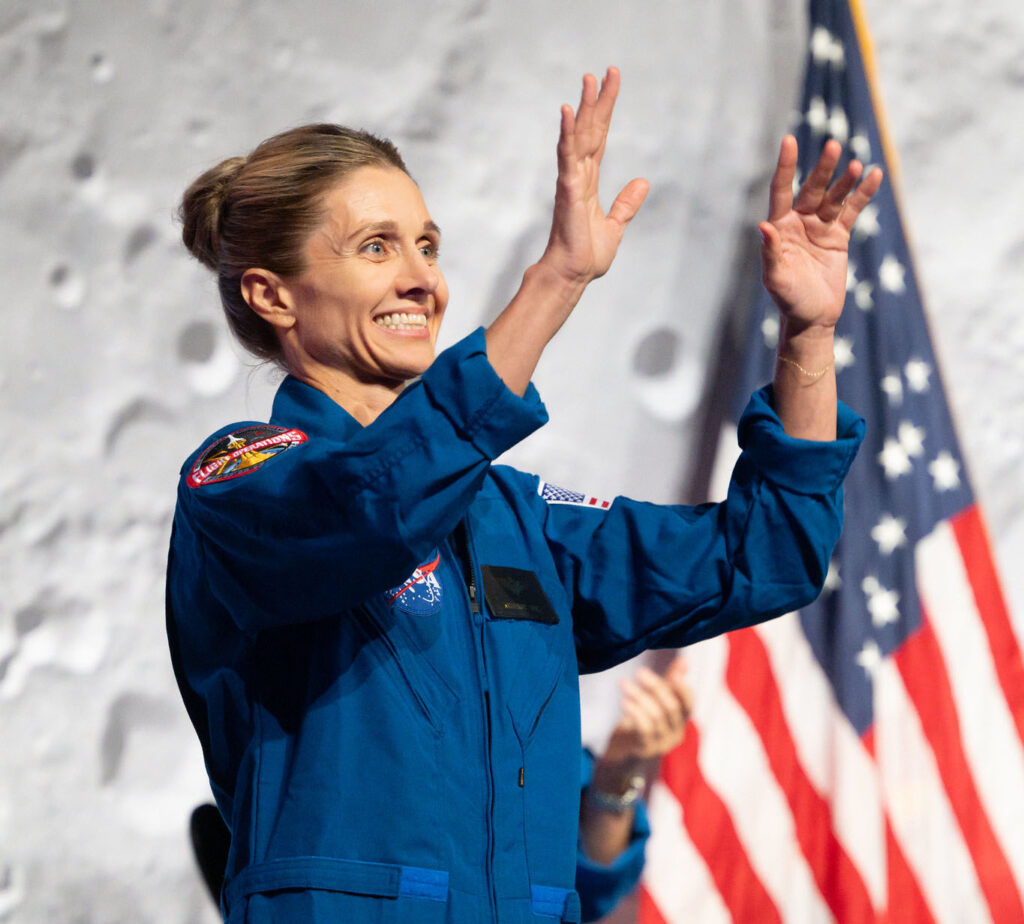
There is a moment many aerospace students share: standing outside one night, gazing up, wondering what might be possible. For Katherine Spies, that moment stretched across years, from campus to space. Once a chemical engineering undergraduate at USC, Spies is now training as a NASA astronaut candidate, drawing on lessons that took shape in University classrooms.
“I reflect on my time at USC as a critical part of how I became who I am today — specifically the transition from being a kid, to an adult, [to] a global citizen,” said Spies in an interview with the Daily Trojan. “The University didn’t let it escape that it mattered to show up as a contributing member of society, not just as an educated individual.”
Spies graduated from USC in 2004, and her path since then has taken her through military service, aviation, engineering leadership, and now, as of February, astronaut training. But she said the academic and personal growth she experienced at USC shaped how each step of her trajectory.
Daily headlines, sent straight to your inbox.
Subscribe to our newsletter to keep up with the latest at and around USC.
“I have such vivid memories of being in class with only 10 or 12 other people and the professor, and just diving really deep into different problem sets within the chemical engineering vertical,” Spies said. “I just found it to be an exceptional kind of space, to be challenged, to fail and then, really, inevitably, to grow.”
Garrett Reisman, a professor of astronautics practice at USC and a former NASA mission specialist astronaut, said alumni like Spies hold unique power when it comes to inspiring students.
“When the students looked at me when I came back [from space], it clicked to them that, ‘Hey, this is within the realm of possibility,’” Reisman said. “That is the most powerful thing that we can do to inspire the next generation.”
Reisman also said the gender makeup has changed since he first joined NASA.
“I [joined NASA] in 1998. I was there for 13 years,” Reisman said. “During that time, the astronaut office was only about 20% female. It varied a little bit over the years, but it was definitely less than 50%. If we’re only tapping into a half of the population … there’s just a tremendous amount of talent that we’re not taking advantage of.”
Theodore Tsotsis, a professor of chemical engineering and materials science, said Spies’ achievement carries meaning beyond prestige.
“It offers visibility for the place,” Tsotsis said. “Then also a role model for someone to look up to and say, ‘If she can do it, I can do it as well.’ Both of them are very significant.”
Tsotsis said that his approach to teaching focuses on confidence and purpose rather than narrow career outcomes.
“The main thing, at least, I want to instill in my students is self-confidence — the self-confidence that if you can make it at USC, you can make it anywhere,” Tsotsis said. “If you lose your sense of purpose, you’re not going to do well as a professional or as a human.”
Yannis Yortsos, dean of the Viterbi School of Engineering, said astronaut selection is one of the most competitive processes in engineering-related careers.
“In addition to the technical aspects that you need, you need to have the characteristics that are important for [these] type[s] of activities,” Yortsos said.
Yortsos said Viterbi has intentionally broadened how engineering is framed and taught, which has helped diversify pathways for students.
“We don’t look at engineering as simply kind of a nerdy profession,” Yortsos said. “We like this to have a much bigger, integrated view of things. What we are saying to students is that engineering is the purpose, and the purpose is to solve important problems.”
That shift has coincided with a milestone within the school. Now, for the seventh year, Viterbi’s undergraduate population has reached or neared gender balance, according to the 2025 Viterbi State of the School report, something that Spies said resonated deeply with her.
“It’s so exciting,” Spies said. “Coming from a background [in] engineering and aviation, you don’t always have a ton of women around you, and so it’s really wonderful to just see that starting to change.”
When asked what she hopes students take away from her story, Spies returned to a mindset that she said began forming at USC.
“The most [important thing] is to be open- minded about different opinions and solving a problem,” she said. “It’s really easy when you put all of your energy and care into a problem to think that you have found the best way. But what makes us better and what makes solving a problem better is being able to have a bunch of people who’ve thought of it differently.”
She paused, then offered a phrase she still carries with her about being open- minded when solving a problem.
“I always say, be in love with version 32.” Spies said. “Version one may be pretty good, but version 32 [is] the best.”