
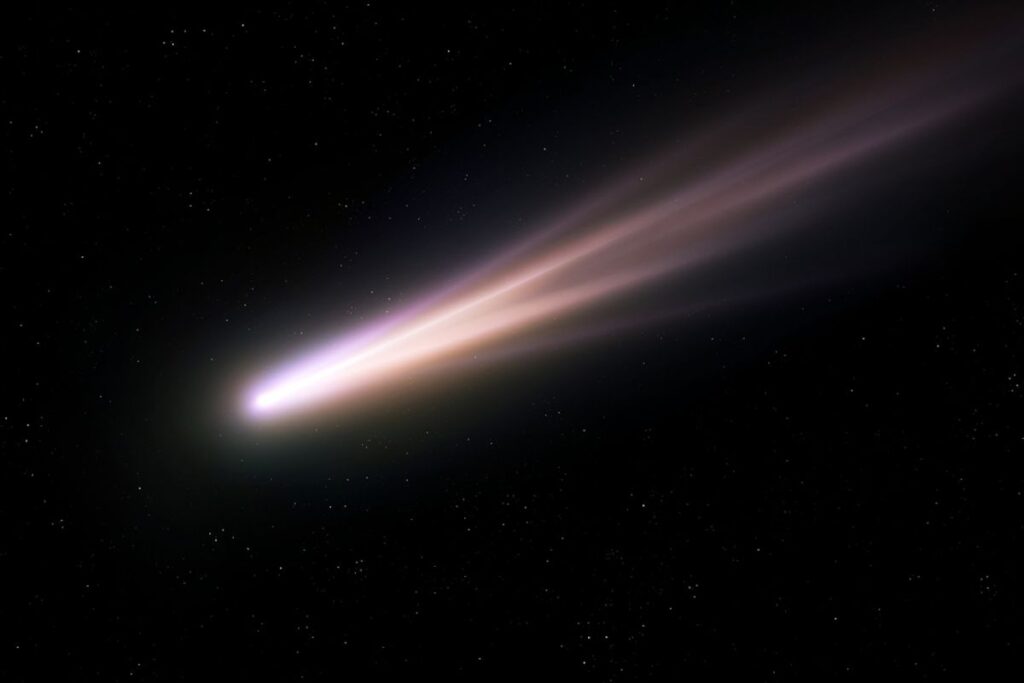
A team of amateur astronomers has discovered a new comet — and it may be bright enough to be visible in daylight when it reaches its perihelion later this year.
The discovery belongs to a group that includes the most striking comets in the night sky, some of which reach a brightness on par with the moon. The Kreutz sungrazing comets’ name stems from their daringly close approach to the sun, a perilous journey responsible for their (sometimes) dazzling appearance.
According to French astronomer Alain Maury, whose group MAPS first spotted the comet, C/2026 A1 (MAPS) will be at its closest to the sun (perihelion) in April, when it will fly within 125,000 miles (200,000 kilometers) of the star’s surface.
Read More: New Snapshots of Comet 3I/ATLAS Highlight a Dazzling Glow and Two Separate Tails
Comets That Fly Close to the Sun
Sungrazing comets refer to a special group of comets that fly particularly close to the sun, a feat that causes them to light up incredibly brightly and then, quite often, fracture into smaller pieces or disintegrate entirely, according to NASA.
“The close approach of the sungrazers exposes them to intense radiation from the sun, and powerful tidal dynamics,” Ed Bloomer, Senior Astronomy Manager at the Royal Observatory Greenwich, U.K., told Discover.
“The comet itself is basically a snowball (that’s simplifying things a bit), so many sungrazers are utterly destroyed by evaporation.”
The group is named after Heinrich Kreutz, a nineteenth-century astronomer who noticed these spectacular comets often follow a particular route, according to the ESA. It is thought that they originated from a larger comet that existed hundreds, possibly thousands, of years ago and has since fragmented.
Monitoring C/2026 A1 (MAPS)
The latest addition to the group, comet C/2026 A1 (MAPS), was first spotted using a remotely operated telescope in Chile’s Atacama Desert on January 13, 2026, 82 days before it will reach its perihelion. The discovery was made through the MAPS program, monitored by Maury, who worked as a professional astronomer before setting up a public observatory, and computer scientists Attard, Parrott, and Signoret.
“We have discovered a bit more than 300 new Earth-crossing asteroids and 8 comets since we started in 2021, and each time it’s a good surge of adrenaline,” Maury told Discover.
“But this one is notable because its orbit is quite special, it will come very close (too close?) from the sun and is part of a large family of comets.”
C/2026 A1 (MAPS) is currently nearing Mars and moving at approximately 15 miles per second (25 kilometers per second), said Maury. Its speed will ramp up as it passes Earth in early March and eventually reach around 340 miles per second (550 kilometers per second) as it approaches the sun. As for what will happen to it then, time will tell.
“It’s hard to predict the outcome: some sungrazers do survive their journey close to the sun, but it depends on size and makeup of the cometary material itself,” Bloomer told Discover. “The fate of so many sungrazers suggests the chances of survival this time are relatively slim… but there’s a chance!”
And while some sungrazers, such as the “Great Comet” of 1882, have been bright enough to view in daylight, brightness is also hard to predict:
“Sungrazers can become visible to the naked eye, and in fact, the 1882 comet was very important to the understanding of sungrazers and comet dynamics,” said Bloomer. “But whether we’ll see something as impressive this time? We just don’t know.”
According to Maury, “We have a French expression saying ‘il ne faut pas tirer de plan sur la comète,’ which you say when you can’t plan the future.”
“So far, we just have to wait and cross our fingers,” Maury told Discover.
Read More: Saying Goodbye to Comet 3I/ATLAS, the Interstellar Visitor That Briefly Called Our Solar System Home
Article Sources
Our writers at Discovermagazine.com use peer-reviewed studies and high-quality sources for our articles, and our editors review for scientific accuracy and editorial standards. Review the sources used below for this article: