
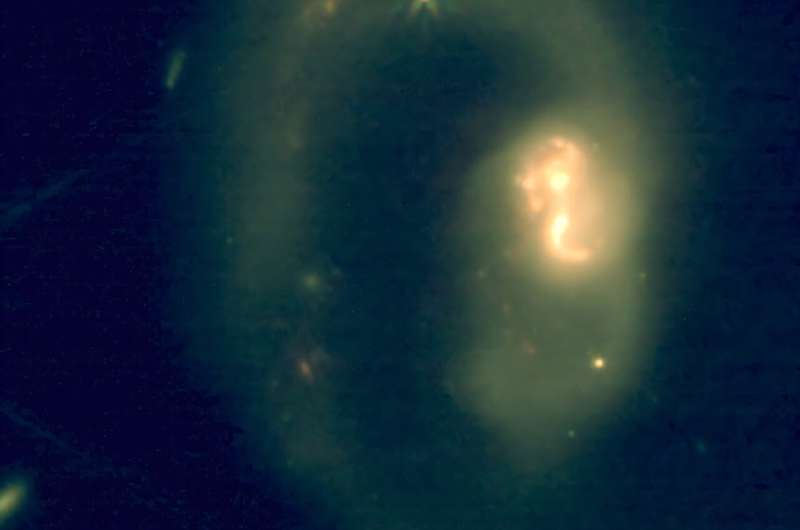
Scientists used the James Webb Space Telescope to study the nucleus of the galaxy IRAS 07251–0248, which is located not very far from us. It turns out that it contains many organic compounds, in particular polycyclic aromatic hydrocarbons.
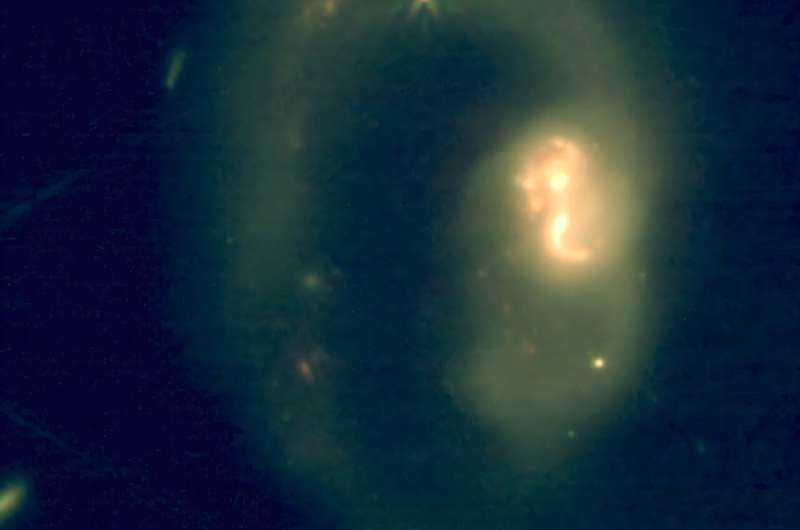 Galaxy IRAS 07251-0248. Source: phys.org
The nucleus of the galaxy IRAS 07251-0248
A study conducted by the Center for Astrobiology (CAB), CSIC-INTA, using modeling techniques developed at Oxford University, has revealed an unprecedented abundance of small organic molecules in the deep, dark nucleus of a nearby galaxy, thanks to observations made with the James Webb Space Telescope.
A study published in Nature Astronomy provides new insights into how complex organic molecules and carbon are processed in some of the most extreme environments in the Universe. The study focuses on IRAS 07251-0248, a bright infrared galaxy whose core is hidden behind enormous masses of gas and dust. This material absorbs most of the radiation produced by the central supermassive black hole, making it extremely difficult to study with conventional telescopes.
However, the infrared wavelength range penetrates dust and provides unique information about these regions, revealing the dominant chemical processes in this extremely dusty nucleus.
Hydrocarbon wealth
The team used spectroscopic observations from JWST covering the 3–28 micron wavelength range, combining data from the NIRSpec and MIRI instruments. These observations allow us to identify chemical signatures of molecules in the gas phase, as well as the characteristics of ice and dust grains.
Thanks to this data, researchers were able to characterize the quantity and temperature of numerous chemical compounds in the nucleus of this buried galaxy.
Observations revealed an extremely rich supply of small organic molecules, including benzene (C₆H₆), methane (CH₄), acetylene (C₂H₂), diacetylene (C₄H₂), and triacetylene (C₆H₂), as well as methyl radical. In addition to molecules in the gas phase, a large amount of solid molecular material, such as carbon grains and water ice, was detected.
“We found an unexpected chemical complexity, with abundances far higher than predicted by current theoretical models,” explains lead author Dr. Ismael García Bernete, formerly of Oxford University and now a researcher at CAB. This indicates that there should be a constant source of carbon in these galactic nuclei that feeds this rich chemical network.
These molecules may play a key role as fundamental building blocks for complex organic chemistry of interest to life-related processes.
Factories of organic molecules in the Universe
Analysis, including methods and theoretical models of polycyclic aromatic hydrocarbons (PAHs) developed by a group from Oxford, indicates that the observed chemical processes cannot be explained by high temperatures or turbulent gas movements.
However, the results point to cosmic rays, which are abundant in these extreme nuclei, as the cause of the fragmentation of PAHs and carbon dust grains, releasing small organic molecules into the gas phase.
The study also revealed a clear correlation between hydrocarbon richness and cosmic ray ionization intensity in similar galaxies, confirming this scenario. These results suggest that deeply obscured galactic nuclei may act as factories for organic molecules, playing a key role in the chemical evolution of galaxies.
This work opens up new opportunities for studying the formation and processing of organic molecules in extreme space conditions and demonstrates the enormous potential of JWST for exploring previously hidden regions of the Universe.
According to phys.org