
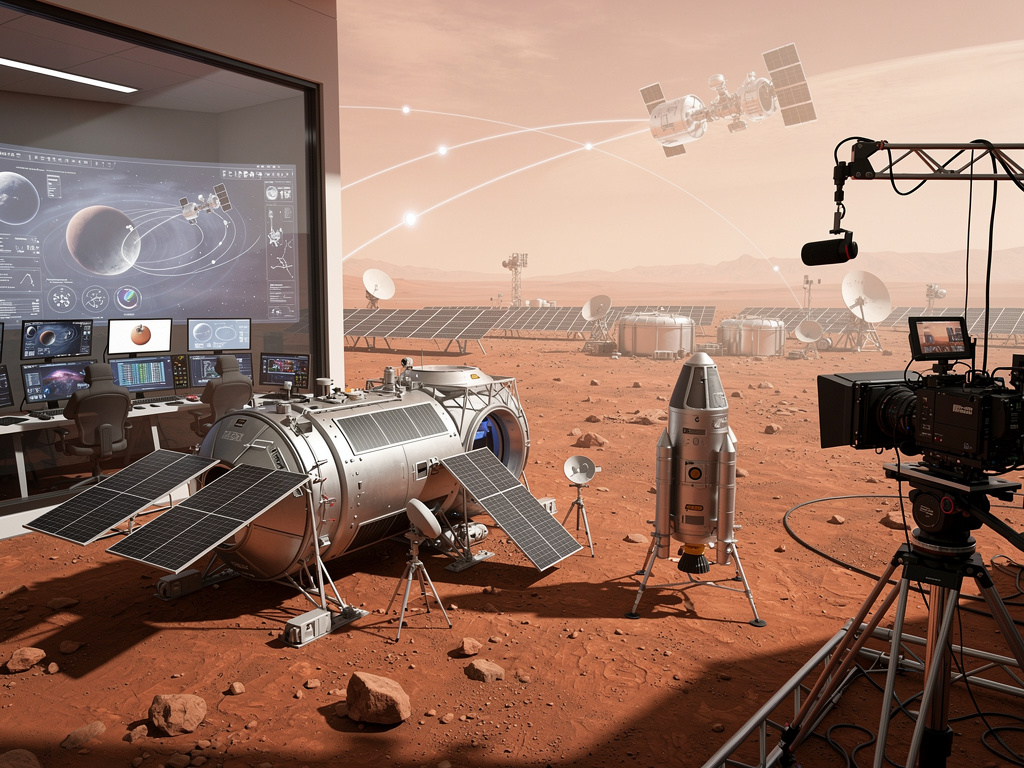
For decades, Hollywood has taken extraordinary liberties with the laws of physics, orbital mechanics, and the realities of space travel. Explosive decompression scenes, sound in the vacuum of space, and astronauts casually surviving impossible scenarios have long been staples of the science fiction genre. But in 2015, one film arrived that changed the conversation entirely — and NASA itself has singled it out as the most scientifically accurate portrayal of rocket science ever committed to celluloid.
That film is Ridley Scott’s The Martian, based on Andy Weir’s bestselling novel of the same name. Starring Matt Damon as astronaut Mark Watney, who is stranded on Mars and must use his ingenuity and scientific knowledge to survive, the movie earned widespread praise not only for its gripping storytelling but for its painstaking commitment to real science. According to MakeUseOf, NASA has publicly acknowledged that The Martian contains the most realistic depiction of rocket science of any major motion picture, a distinction that carries significant weight given the agency’s own role in consulting on the film.
From Novel to Screen: How Andy Weir Built a Foundation of Hard Science
The scientific credibility of The Martian begins not with Hollywood, but with the meticulous research of its author. Andy Weir, a former software engineer, spent years researching orbital mechanics, Martian geography, botany, and chemistry before self-publishing his novel in 2011. Weir has spoken extensively about how he used real NASA data, actual Mars mission trajectories, and legitimate scientific principles to construct every survival challenge that Mark Watney faces on the Red Planet. The novel’s approach was so rigorous that it attracted the attention of actual scientists and engineers long before it became a blockbuster film.
When 20th Century Fox acquired the film rights and Ridley Scott signed on to direct, the production team made a deliberate decision to preserve Weir’s scientific integrity. NASA itself became a collaborator, offering technical consultation, access to facilities, and expert guidance. The agency’s Jet Propulsion Laboratory (JPL) and Johnson Space Center both contributed to ensuring that the film’s depiction of Mars habitats, EVA suits, propulsion systems, and mission architecture reflected real-world engineering as closely as possible. As reported by MakeUseOf, NASA’s involvement went far beyond a cursory review — the agency was deeply embedded in the filmmaking process.
What NASA Got Right — and What the Film Nails About Life on Mars
Several specific elements of The Martian have been highlighted by NASA scientists as particularly accurate. The film’s portrayal of the Martian surface, while filmed in Jordan’s Wadi Rum desert with extensive visual effects augmentation, closely mirrors the terrain data collected by NASA’s Mars rovers. The depiction of the Hab — the pressurized habitat where Watney lives — reflects genuine NASA research into inflatable habitat modules that the agency has been developing for future crewed Mars missions. The concept of growing food on Mars using Martian soil (regolith) supplemented with human waste as fertilizer, while simplified for dramatic purposes, is grounded in real agricultural science experiments that NASA has conducted.
The orbital mechanics depicted in the film are another area where The Martian distinguishes itself from typical Hollywood fare. The Hermes spacecraft’s trajectory, the resupply mission logistics, and the climactic rescue maneuver all adhere to principles of real astrodynamics. Weir himself calculated the orbital trajectories by hand and with custom software, and these calculations survived the translation to screen largely intact. The film also accurately portrays the communication delay between Earth and Mars, which ranges from approximately 4 to 24 minutes depending on the planets’ relative positions — a detail that most science fiction films conveniently ignore for the sake of dramatic pacing.
Where Science Meets Storytelling: The Necessary Compromises
No film achieves perfect scientific accuracy, and The Martian is no exception. NASA scientists and independent experts have pointed out that the inciting incident of the film — a massive Martian dust storm powerful enough to topple a rocket and endanger the crew — is the movie’s most significant scientific liberty. Mars’s atmosphere is roughly one percent the density of Earth’s, meaning that even hurricane-force winds on Mars would feel like a gentle breeze. Andy Weir himself has acknowledged this as the film’s biggest scientific inaccuracy, calling it a necessary dramatic concession to set the story in motion.
Other minor liberties include the depiction of Martian gravity. Mars has approximately 38 percent of Earth’s gravitational pull, but the film largely portrays Watney moving as though he is on Earth. Filming in reduced gravity would have required either extensive wire work or parabolic flight sequences, both of which would have been prohibitively expensive and potentially distracting. Despite these compromises, the overwhelming consensus among space scientists is that The Martian gets far more right than it gets wrong — a rarity in the genre.
NASA’s Broader Relationship With Hollywood: A Strategic Alliance
NASA’s endorsement of The Martian is part of a broader, decades-long strategy by the agency to engage with popular culture as a means of inspiring public interest in space exploration. The agency maintains an active office that works with filmmakers, providing technical consultation and access to facilities in exchange for more accurate portrayals of space science. This relationship has yielded mixed results over the years — films like Armageddon (1998) famously prompted NASA to use it as a training exercise where new employees identify the scientific inaccuracies, reportedly finding over 160 errors.
By contrast, The Martian represents the best-case scenario for NASA’s Hollywood partnerships. The film’s release coincided with a period of heightened public interest in Mars exploration, including the announcement of evidence of liquid water on the Martian surface. NASA leveraged the film’s popularity to promote its own Journey to Mars initiative and real-world technologies being developed for eventual crewed missions to the Red Planet. The symbiotic relationship benefited both parties: NASA gained a powerful public engagement tool, and the film gained an imprimatur of authenticity that elevated it above its science fiction peers.
How ‘The Martian’ Stacks Up Against Other Scientifically Praised Films
The conversation about scientific accuracy in cinema inevitably invites comparisons with other critically acclaimed space films. Christopher Nolan’s Interstellar (2014), which employed Nobel Prize-winning physicist Kip Thorne as a scientific consultant, is frequently cited for its groundbreaking visualization of black holes and relativistic time dilation. Alfonso Cuarón’s Gravity (2013) earned praise for its depiction of orbital debris and the visceral experience of microgravity, though it took significant liberties with orbital mechanics and the proximity of different space stations. Stanley Kubrick’s 2001: A Space Odyssey (1968) remains a touchstone for its prescient depiction of space travel mechanics, including the use of centrifugal force for artificial gravity.
Yet what sets The Martian apart, according to NASA’s assessment, is the breadth and depth of its scientific accuracy. While Interstellar excels in theoretical physics and Gravity captures the terror of orbital emergencies, The Martian covers an unusually wide range of scientific disciplines — botany, chemistry, orbital mechanics, aerospace engineering, and planetary science — and gets the vast majority of them right. It is this comprehensive fidelity to real science, rather than excellence in any single domain, that earned it NASA’s top distinction as reported by MakeUseOf.
The Lasting Impact on Public Perception and Future Filmmaking
The commercial and critical success of The Martian — it grossed over $630 million worldwide and earned seven Academy Award nominations — demonstrated that scientific accuracy and mainstream entertainment are not mutually exclusive. The film proved that audiences are not only willing to engage with hard science but are actively hungry for it when presented within a compelling narrative framework. This lesson has not been lost on Hollywood, where subsequent space-themed productions have increasingly sought scientific consultation and prioritized technical realism.
For NASA, the legacy of The Martian extends beyond public relations. The film has become a recruiting tool, with agency officials noting increased interest in STEM careers and Mars-related research following its release. Engineers at JPL have spoken about how the film captures the problem-solving culture that defines their work — the ethos of confronting seemingly impossible challenges with creativity, resourcefulness, and rigorous scientific thinking. In Mark Watney’s famous declaration that he would “science the hell out of” his predicament, audiences found not just a memorable movie line but an authentic reflection of how real space exploration works.
As NASA continues to develop the Artemis program and lay the groundwork for eventual crewed missions to Mars, the agency’s relationship with storytellers will only grow more important. The Martian stands as proof that when filmmakers and scientists collaborate in good faith, the result can be something that entertains millions while simultaneously advancing public understanding of the extraordinary challenges — and possibilities — of human space exploration. It remains, by NASA’s own reckoning, the cinematic benchmark against which all future depictions of rocket science will be measured.