
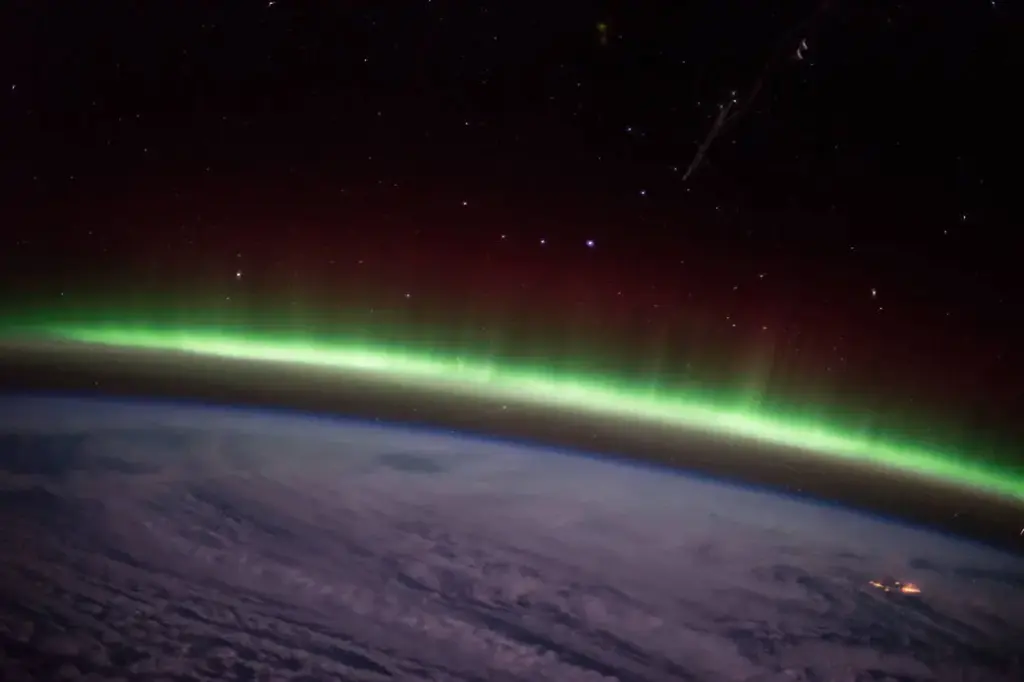
The Aurora Borealis and Australis have dazzled and inspired all those who have beheld them since time immemorial. Much like the Moon, stars, constellations, and planets, they are considered a permanent part of our shared cultural heritage. These awe-inspiring displays of light are the result of charged particles from our Sun interacting with Earth’s magnetic field. However, there remain unanswered questions about the mechanisms that power aurorae that scientists have been hoping to resolve for decades. For example, there’s the question of what powers the electrical fields that accelerate these particles.
In a new study, researchers from the Department of Earth and Planetary Sciences at The University of Hong Kong (HKU) and the Department of Atmospheric and Oceanic Sciences at the University of California, Los Angeles (UCLA), have provided the answer. According to their analysis, the plasma waves traveling along Earth’s magnetic field lines (Alfvén waves) act as a natural accelerator. By analyzing how charged particles move and gain energy across different regions of space, the team demonstrated that these waves supply the energy that drives charged particles into the atmosphere, producing aurorae.
The team analyzed data from multiple Earth-orbiting satellites, including NASA’s Van Allen Probes and the Time History of Events and Macroscale Interactions during Substorms (THEMIS) mission. As they described in a paper published in Nature Communications, the data showed how Alfvén waves maintain the electric fields that would otherwise dissipate by continuously transferring energy to the acceleration region. Professor Zhonghua Yao at HKU leads a dedicated team in space and planetary science. As he said in a HKU press release:
This discovery not only provides a definitive answer to the physics of Earth’s aurora, but also offers a universal model applicable to other planets in our solar system and beyond. Our team at HKU has long focused on the auroral processes of giant planets. By applying this knowledge to the high-resolution data available near Earth, we have bridged the gap between Earth science and planetary exploration.
The research was made possible thank to the interdisciplinary expertise both teams brought to the table. The UCLA team, led by Dr. Sheng Tian, contributed extensive expertise in Earth’s auroral physics, while Professor Yao and the HKU team leveraged their deep expertise in planetary physics and planetary magnetospheres (like those of Jupiter and Saturn).