
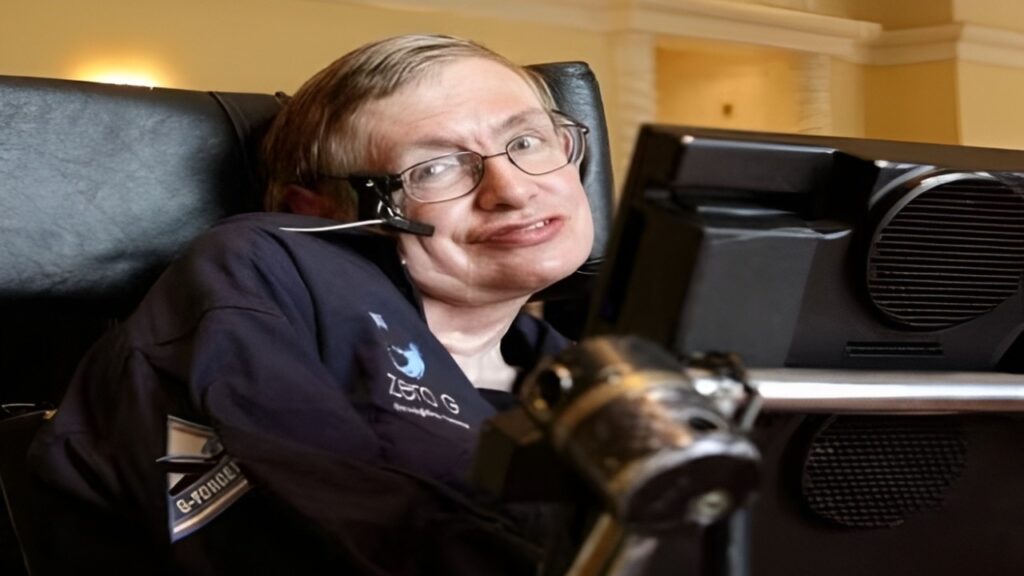
“My expectations were reduced to zero,” he would later recall. Diagnosed with amyotrophic lateral sclerosis (ALS), a degenerative motor neuron disease, Hawking was told he had just a few years to live.
For a young doctoral student at Cambridge, the prognosis was brutal. His body would weaken, speech would fade, and independence would slip away. What no doctor could predict was that this moment of collapse would mark the beginning of one of the most influential scientific journeys of the 20th century.
Everything that followed, Hawking said, was a bonus.
WHEN THE BODY FAILED, THE MIND EXPANDED
As Hawking’s physical world narrowed, his intellectual universe widened. In the 1960s, physics was grappling with uncomfortable questions about the origins of the universe. Using Einstein’s theory of general relativity, Hawking along with mathematician Roger Penrose demonstrated that the universe must have begun with a singularity, a point where space and time themselves break down. The Big Bang, once debated on philosophical grounds, now had mathematical proof.
For Hawking, these abstract questions were not academic exercises. Confined increasingly to thought rather than movement, he lived almost entirely inside equations. The illness that stripped him of physical freedom seemed, paradoxically, to sharpen his focus. Distractions fell away. What remained were the biggest questions science could ask: Where did the universe come from? How does it end? What happens inside a black hole?
Rewriting what we know about black holes
In the 1970s, Hawking made the discovery that would cement his place in scientific history. Black holes, long believed to trap everything even light were not entirely black after all. By applying quantum mechanics to gravitational fields, Hawking showed that black holes emit radiation and can slowly evaporate over time.
The idea, later named Hawking radiation, shocked the physics community. It challenged decades of accepted theory and forced scientists to rethink the relationship between gravity and quantum mechanics. More importantly, it raised unsettling questions about information, reality, and whether the universe obeys absolute laws or probabilistic ones.
As Hawking’s body deteriorated, his influence grew. A computer-generated voice gave him a way to speak, and A Brief History of Time turned one of the world’s most complex subjects into a global bestseller. He became not just a scientist, but a public intellectual a rare bridge between cutting-edge theory and popular imagination.
Yet Hawking never romanticised his journey. He resisted being framed as an inspirational figure. Curiosity, not courage, drove him. “Everything since then has been a bonus,” he said, reflecting on the diagnosis that once threatened to end his life but instead reshaped how humanity understands the universe.
– Ends
Published By:
Megha Chaturvedi
Published On:
Feb 9, 2026