
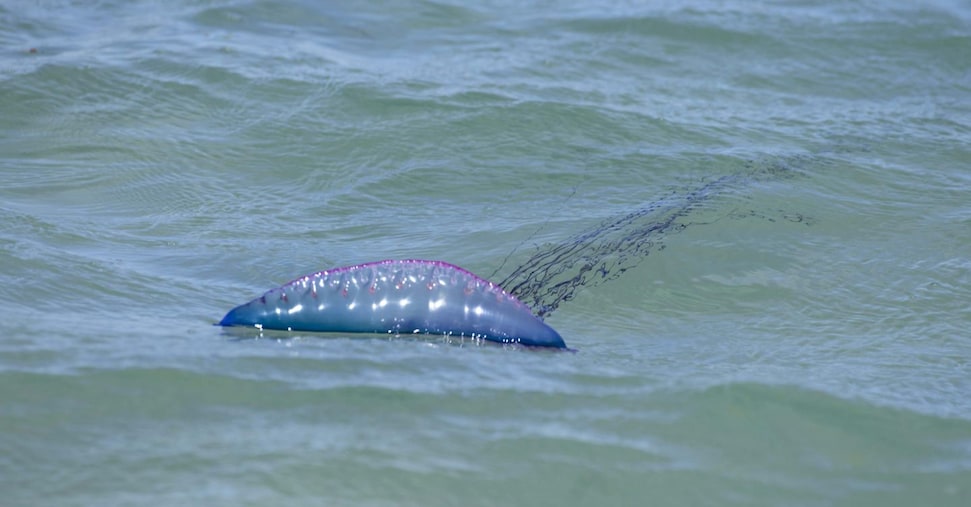
The latest sighting is the Portuguese Caravel. It was reported by an inhabitant of the island of Favignana. The specimen, whose scientific name is Physalia physalis, the Marine Protected Area of the Egadi has alerted the Ispra researchers, initiating the procedure to recover and preserve the organisms for scientific analysis, is but one of the alien species that populate the Mediterranean.
In the Mediterranean from the Strait of Gibraltar
The Portuguese caravel, as the Ispra experts point out, ‘is a colonial hydrozoan of Atlantic origin, which can reach the Mediterranean through the Strait of Gibraltar carried by the currents’. In Italia, the most frequent reports come from Sardinia, the Pelagie Islands and the Messina coast. It moves an average of 20 metres per minute and, in favourable wind conditions, travels between 15 and 28 kilometres per day. A species that, according to experts, in Australia alone (especially on the east coast) is responsible for more than 10 thousand bites on humans.
Avoid contact and report
Recognising this species, as experts point out, is easy, ‘thanks to the pneumatophore, the floating structure visible at the surface, but it also has long, highly stinging tentacles’. Precisely for this reason, it is recommended to avoid contact and report its presence to the local authorities.
Because of the presence of so-called alien species, awareness and information campaigns have been conducted for some time.
The initiatives in the field
The ‘Attenti a quei 4!’ initiative promoted by Ispra with the Institute for Biological Resources and Marine Biotechnology of the National Research Council in Ancona dates back to last summer.