
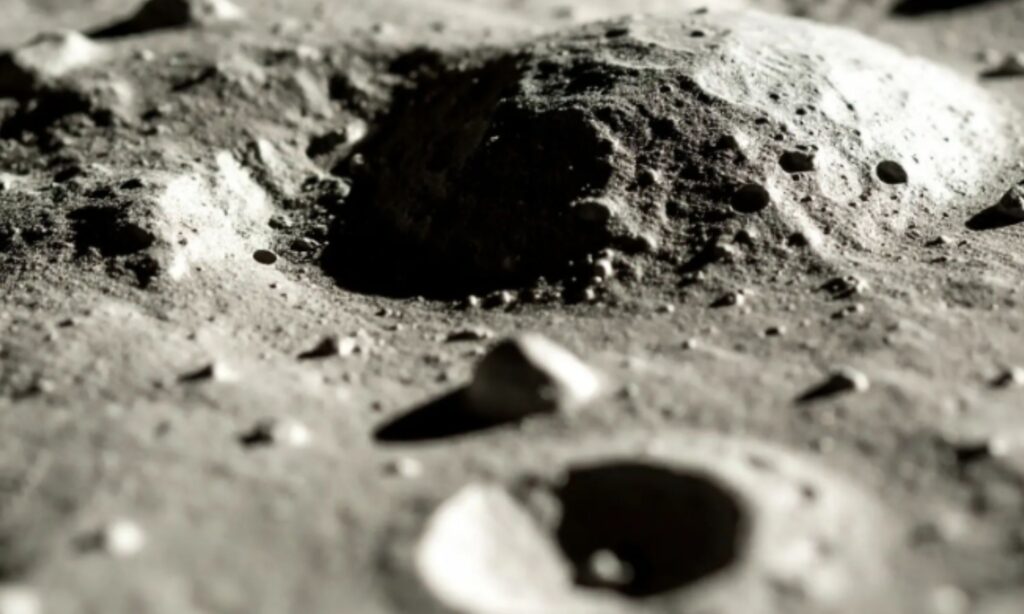
NASA has selected three lunar experiments that can read underground heat, surface temperatures, and radiation without astronauts setting foot on the Moon.
Together, they turn routine robotic landings into advanced scouts that shape where people can safely land, work, and stay alive.

These instruments will operate directly on the lunar surface, turning commercial landers into quiet observers of heat, dust, and radiation.
That approach grew out of work at Texas Tech University (TTU) where planetary geophysicist Dr. Seiichi Nagihara developed the LISTER probe by drilling and measuring heat beneath lunar soil.
Growing field of lunar exploration
NASA’s Commercial Lunar Payload Services program (CLPS) uses privately built robotic landers to deliver science to the Moon,
Under CLPS, Nagihara’s instrument now joins EMILIA-3D and SELINE payloads that will map temperature patterns and radiation conditions across the Moon.
The selections extend a growing pipeline of lunar exploration, using research that expands understanding of the Moon’s history and environment while shaping future human safety and navigation on the surface and beyond.
Drilling for heat
LISTER drilled into the lunar ground to measure heat moving upward, the clearest clue to what the Moon still holds inside.
Pressurized gas cleared a narrow hole, then the probe paused to record temperature and thermal conductivity.
In one article, LISTER reached about 3 feet and measured temperature at eight different depths. Those readings revealed only one small patch of ground, so NASA now needs more sites to map the Moon’s underground heat.
Heat tells a backstory
Heat escaping from the Moon carries a record of how quickly its interior cooled after it formed.
By drilling down and comparing temperatures at different depths, researchers can estimate the energy coming up from deeper rock.
A reanalysis traced much of the uncertainty in Apollo heat flow to tricky soil measurements. Without new drill data from fresh terrain, models of the Moon’s deep composition will keep carrying wide error bars.
Mapping hot and cold
Extreme day-to-night swings force landers and spacesuits to handle both baking heat and deep cold.
Thermal images reveal where regolith, the Moon’s loose dust and broken rock, traps heat or loses it quickly. When those temperature patterns line up with 3D terrain, engineers can spot slopes that stay unstable or too cold.
A map built in sunlight can miss shadows and long nights, so crews still need margins for surprises.
Earliest delivery date
Because these instruments can work almost anywhere, NASA can send them on CLPS landers without waiting for a perfect landing bullseye.
The PRISM call, NASA’s competitive process for selecting science instruments to operate on the Moon, described them as site-agnostic, able to collect data without a special target location.
That same document set 2028 as the earliest delivery date, leaving years for testing and vendor selection.
The long lead time slows the first results, but it also reduces pressure to rush hardware onto the Moon.
Radiation without Earth’s shield
Away from Earth’s magnetic protection, the lunar surface receives a steady spray of radiation that crews cannot ignore.
Much of it comes from galactic cosmic rays, high-energy particles that fly in from deep space. When those rays hit the ground, the impact can throw off secondary particles, new radiation created inside the soil.
That mix makes shielding harder to design, and it pushes NASA to measure radiation right at the surface.
Counting ions and neutrons
SELINE aims to track the charged particles that arrive and the neutrons that bounce back from the lunar soil.
Because they carry no electric charge, neutrons, uncharged particles that can penetrate shielding, can raise the dose even behind metal.
SELINE can separate those counts from other particles, giving mission doctors a cleaner picture of what a suit blocks.
Better numbers can guide when crews go outside, how long they stay, and where a lander should keep a storm shelter.
Dust that alters hardware
Lunar dust clings to seals and joints, and it can turn simple moving parts into a slow grinding problem.
Sharp-edged grains scrape hard because the Moon lacks wind and water that would round them down.
Repeated heating and cooling can also pump dust into cracks, so drills and cameras need careful covers.
By tracking where surfaces warm and cool fastest, mission teams can predict where dust may loosen and drift during activity.
A lunar economy in motion
Each robotic delivery adds practice for industry, and CLPS turns that practice into regular trips instead of rare stunts.
Companies build landers, NASA buys payload space, and scientists get data without paying for an entire spacecraft.
That setup lets NASA test navigation tools, temperature maps, and radiation sensors before astronauts rely on them.
If launches slip or landers fail, the program can try again on the next flight rather than waiting a decade.
By measuring heat below the surface, temperatures across terrain, and radiation in place, these payloads turn unknowns into design targets.
The data should help pick safer landing zones and work schedules, but real confidence will come only after repeated missions.
—–
Like what you read? Subscribe to our newsletter for engaging articles, exclusive content, and the latest updates.
Check us out on EarthSnap, a free app brought to you by Eric Ralls and Earth.com.
—–