
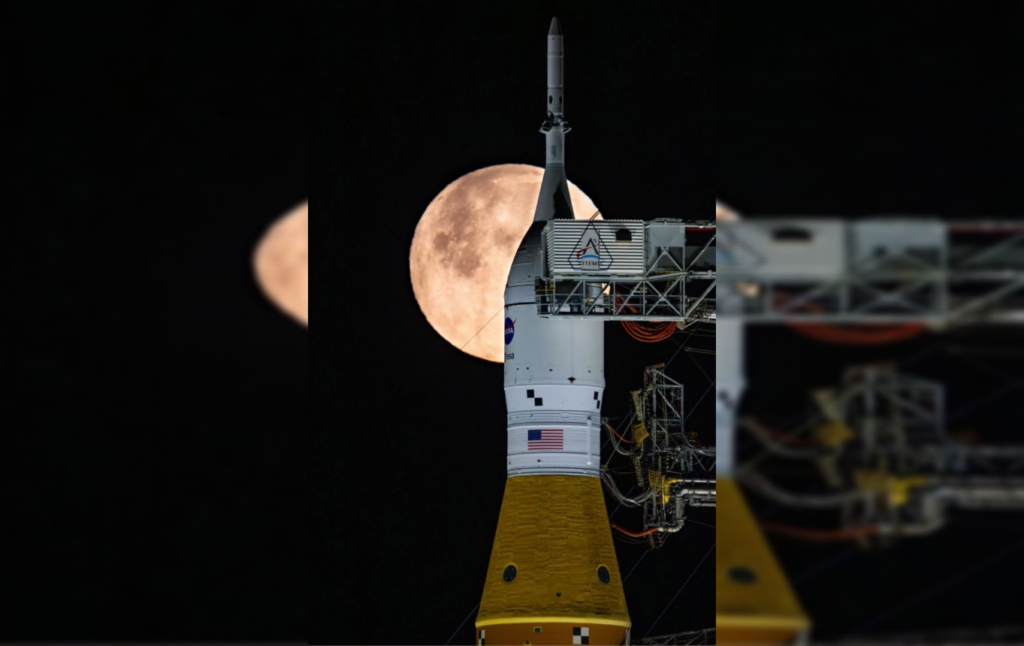

Artemis II sits at Launch Pad 39B at The Kennedy Space Center shortly after midnight Sunday.
Courtesy of NASA
Artemis II, NASA’s first-ever crewed Artemis mission, has rescheduled its 10-day flight around the moon for early March.
The Artemis II mission plan has been underway since the successful completion of the 25-day mission around the moon for NASA’s unmanned Artemis I rocket back in November 2022.
The Artemis II rocket was set to launch from Launch Complex 39B at the Kennedy Space Center on Feb. 8, within a launch window from Feb. 6-11. However, the event has been postponed for a third time due to issues arising during the rocket’s wet dress rehearsal.
NASA leaders discussed the change in the program’s launch pace during a media press conference streamed virtually by NASA on Tuesday.
“The wet dress rehearsal we had last night was a critical milestone on the way to Artemis II, and that was the reason we went to the pad, to do those tests,“ Amit Kshatriya, NASA associate administrator, said. “It allowed our teams to test all the systems required in the all-up configuration. I think it’s clear, based on what we saw in real time, we are now targeting no earlier than March for the Artemis II launch.”
The rocket’s crew has been released from quarantine as of Feb. 3 due to the change in launch date and program pace. The astronaut crew flying in Artemis II this March will include Commander Reid Wiseman (NASA), Pilot Victor Glover (NASA), Mission Specialist Christina Koch (NASA) and Mission Specialist Jeremy Hansen (Canadian Space Agency).
The Artemis II astronaut crew, Christina Koch (left), Victor Glover (top), Reid Wiseman (bottom) and Jeremy Hansen (right).
Courtesy of NASA
When breaking down the results of the team’s wet dress rehearsal early Tuesday morning, the team achieved full tanking of the rocket’s hydrogen on the first try. This was a major success compared to previous Artemis I challenges. In terms of NASA’s Artemis II program, ‘hydrogen tanking’ refers to the critical, complex process of filling the Space Launch System with over 600,000 gallons of super-chilled, cryogenic liquid hydrogen (LH2) at the launch pad.
This fuel, stored at minus 423 degrees Fahrenheit, is used to power the four RS-25 engines in the rocket’s core stage, according to NASA’s Mission Update page.
However, a significant hydrogen leak was found in Artemis II’s tail service mast umbilical interface during filling operations, and again during the engine’s core stage pressurization, according to NASA. The mission update page stated that the hydrogen leak increased to the system’s limit (12-14%) and a ‘stop-flow revert’ was enacted to decrease the leak for further inspection.
“We were a little bit behind getting out of the pad and we got a gopher tanking right around 11:30 p.m local time. We got into chill-down for both locks in hydrogen that went very well,” Charlie Blackwell-Thompson, Artemis launch director, said. “When we got into the LH2 fast-fill, which was around 12:29 a.m, we picked up our first leak in the TSMU in the cavity where the flight and the ground plate come together.”
UCF’s Program Director of Space Commercialization and Strategy Initiation, Zaheer Ali, also known as the “Space Paladin,” spoke about the mission’s rescheduling.
Ali, who has an extensive background in space technology, policy and innovation, said that commercialized space programs, such as SpaceX and Blue Origin, have taken great strides in progress against government-funded programs such as NASA.
Industry-built spacecraft are associated with lower cost, especially for lower-risk classification C and D projects. However, for higher-risk class A and B projects, the developer type has no significant effect, according to a comparative research study by Aerospace Research Central.
Additionally, the spacecraft developer type does not significantly affect the total project cost, regardless of the risk classification for either funded group, according to Aerospace Research Central.
Ali added that the organization needed to “take advantage of the accelerated nature of commercial space.”
“If we’re actually going to field something on the moon with people by 2028, then we really need to get on a horse and get this going,” Ali said. “And a 2-year cycle to assemble a rocket and then have six months of launch schedule slips does not work.”
Further and more current information regarding the official Artemis II mission launch updates is made readily available on NASA’s website.