
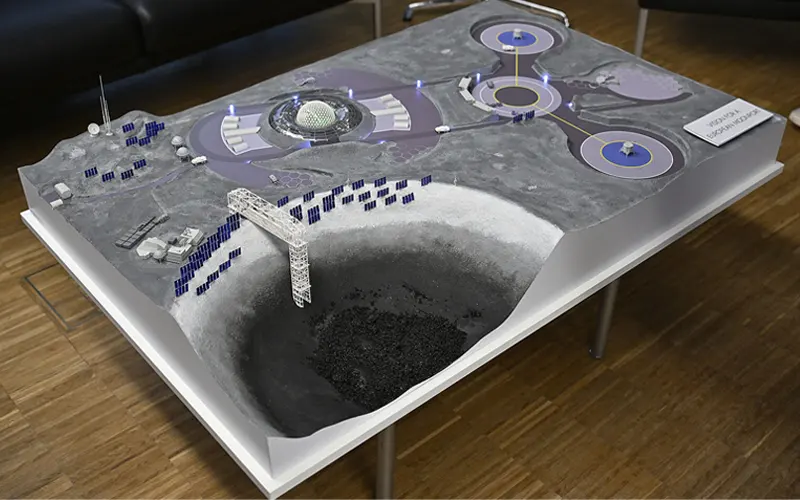
 Credit: OHB
German space technology company OHB announced on 4 February that it has established a new subsidiary, the European Moonport Company, to consolidate all its efforts related to future missions to the Moon.
While only recently made public, company records show that the subsidiary, registered as Luna Europa – European Moonport Company, was founded in May 2025, with OHB CEO Marco Fuchs and Sabine von der Recke, OHB’s head of political relations and communications, serving as its managing directors.
“With the founding of the European Moonport Company, we are supporting Europe’s ambition to establish a permanent presence on the Moon independently, thereby laying the foundation for future scientific missions and economic activities,” said Fuchs in a statement.
According to company records, the subsidiary will focus on lunar exploration and the development of infrastructure for a sustained presence on the Moon’s surface. In the near term, however, the company says it will primarily serve to consolidate OHB’s existing Moon-related activities. This is the second such company OHB has founded recently, having announced the European Spaceport Company in November 2025 to consolidate its existing terrestrial launch infrastructure projects.
In terms of its current portfolio of Moon-related projects, OHB is involved as a subcontractor on several European lunar missions. In late 2025, Thales Alenia Space selected the company to provide multiple subsystems for the descent element of the European Space Agency’s (ESA) Argonaut lunar lander. Designed to ferry a variety of payloads to the surface of the Moon, the agency is expected to launch the first Argonaut lander in 2031. OHB is also a subcontractor on the ESPRIT module, one of ESA’s major contributions to NASA’s lunar Gateway space station. These contributions form part of Europe’s barter arrangements with NASA, helping to secure flight opportunities for European astronauts to the future outpost in lunar orbit.
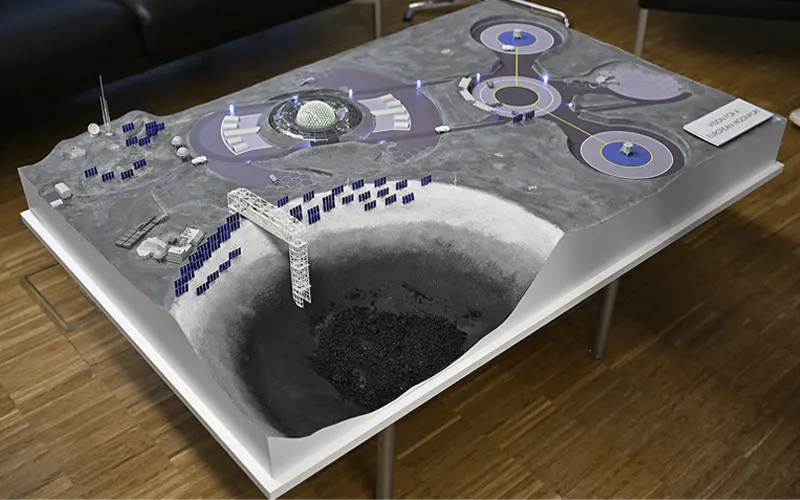
With its 4 February announcement, OHB unveiled a concept for a central launch and landing base on the lunar surface, a project it developed with Munich Airport International. The project does, however, appear to be nothing more than a high-level concept and not indicative of anything beyond an initial concept and a model used for the press event.
Notably, in its press release, OHB highlights that Europe needs to “formulate and consistently implement its own strategy for a sustainable presence on the Moon.” It then implies that Germany took a lead role in this regard at the European Space Agency’s (ESA) Ministerial Council meeting in November 2025 (CM25). That claim is not clearly supported by the available evidence.
Following the conclusion of CM25, ESA announced that Member States had committed €2.98 billion to Exploration, €797 million short of the €3.77 billion envelope requested by the agency. While Germany contributed the largest single share to Exploration, with €885 million, that contribution was made at the programme level rather than being earmarked at the element level. This approach does give Germany flexibility to later allocate its funding across LEO, Moon, Mars, Exploration Science, or ExPeRT (Exploration Preparation Research and Technology) once programme priorities and industrial returns become clearer. However, it does not, in itself, amount to taking a lead role in any specific exploration destination.
Based on the element-level commitments published as of December 2025, Italy has committed by far the largest share to ESA’s Moon Exploration element, with €284.20 million. The next largest commitment comes from Hungary, at €80 million.
Keep European Spaceflight Independent
Your donation will help European Spaceflight to continue digging into the stories others miss. Every euro keeps our reporting alive.