
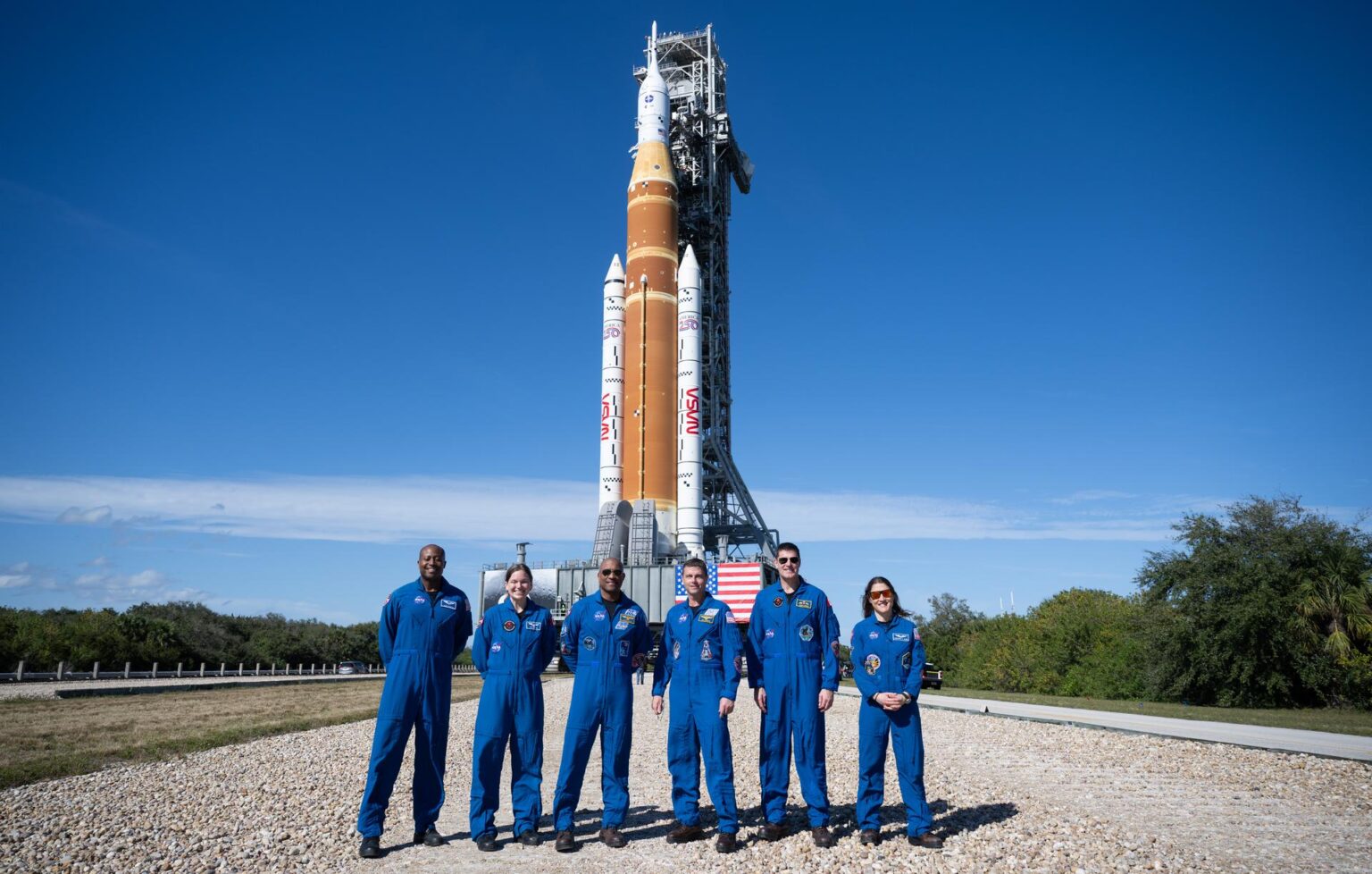
 From left: Artemis II backup crewmembers NASA astronaut Andre Douglas and CSA (Canadian Space Agency) astronaut Jenni Gibbons and prime crewmembers NASA astronauts Victor Glover, Reid Wiseman, CSA (Canadian Space Agency) astronaut Jeremy Hansen, and NASA astronaut Christina Koch, pose for a picture with NASA’s Space Launch System (SLS) rocket and Orion spacecraft, secured to the mobile launcher, as it makes the 4.2 mile journey from the Vehicle Assembly Building to Launch Pad 39B, Saturday, Jan. 17, at NASA’s Kennedy Space Center in Florida. NASA’s Artemis II test flight will take Commander Reid Wiseman, Pilot Victor Glover, and Mission Specialist Christina Koch from NASA, and Mission Specialist Jeremy Hansen from the CSA (Canadian Space Agency), around the Moon and back to Earth no later than April.
(NASA/Joel Kowsky)
HAMPTON — NASA will launch the Artemis II mission as early as March and a few NASA Langley Research Center scientists and engineers had a hand in creating parts of its technology.
Artemis II is NASA’s first crewed mission of the Artemis program and a critical step toward returning humans to the Moon, a feat that has not been accomplished by the U.S. since 1972.
According to NASA, the mission will send four astronauts aboard the Orion spacecraft, launched by the Space Launch System rocket, on a multi-day journey beyond Earth orbit and around the Moon. Unlike Artemis I, which was uncrewed, Artemis II is designed to test Orion’s life-support systems, navigation, propulsion, and human operations in deep space. The crew will fly past the Moon and return to Earth without landing on the moon, validating that the spacecraft and systems are safe for astronauts.
During an event on Feb. 3, Langley Research Center scientists and engineers met with members of the media to discuss the various ways that members of the Hampton facility contributed to the project.
Scientists and engineers at Langley were key in the development and testing of the Orion spacecraft, developed the Orion Launch Abort system, provided wind tunnel facilities to test the aerodynamics of the rocket, and will provide flight data analysis support with scientifically calibrated in-flight imagery.
One of Langley’s largest projects that contributes to the mission is the creation and updating of the Launch Abort System. The system is one of the newest safety features built specifically for the Orion Spacecraft.
“If we have to use it one day, it’s going to be brutal for the astronauts, but it’s going to save their lives. They may break a few ribs along the way, but they will survive,” Jeremy Pinier, SLS projects lead at Langley Research Center, said.
The concept of the Launch Abort System is to evacuate the crew in various phases of flight, should something cause an issue and evacuation is necessary. The system pulls the crew away from the main rocket and fires its own rockets to move the crew up and away to safety before they are parachuted into the ocean.
The engineers behind the technology at Langley have tried to exhaust every safety issue that could arise when creating this new mechanism.
“We try to plan for all the situations. We’ve seen a lot of rockets blow up recently with SpaceX and others. Rocket launches are really hard and can be scary. We don’t want any incidents to happen, but if something does, we’ve got a plan to get the crew to safety,” Pinier said.
Artemis II lays the groundwork for Artemis III, which aims to land astronauts on the lunar surface, and supports NASA’s broader goal of establishing a sustained human presence on the Moon as preparation for future missions to Mars.
Pinier says that astronaut safety is at the top of every engineer’s mind as the Launch Abort System was created.
“We think about their safety every single day. As engineers, I’ve been working on this rocket for the past 15-plus years and I don’t think there has been a day that at some point, I don’t think of the goal in the end, which is taking humans back to the Moon. We take our jobs extremely seriously and there is nothing more important to us than to get this crew back safely so we can begin working on Artemis III,” Pinier said.
The test flight launch, which will take place at Cape Canaveral and the Kennedy Space Center, will be live-streamed to the NASA website.