
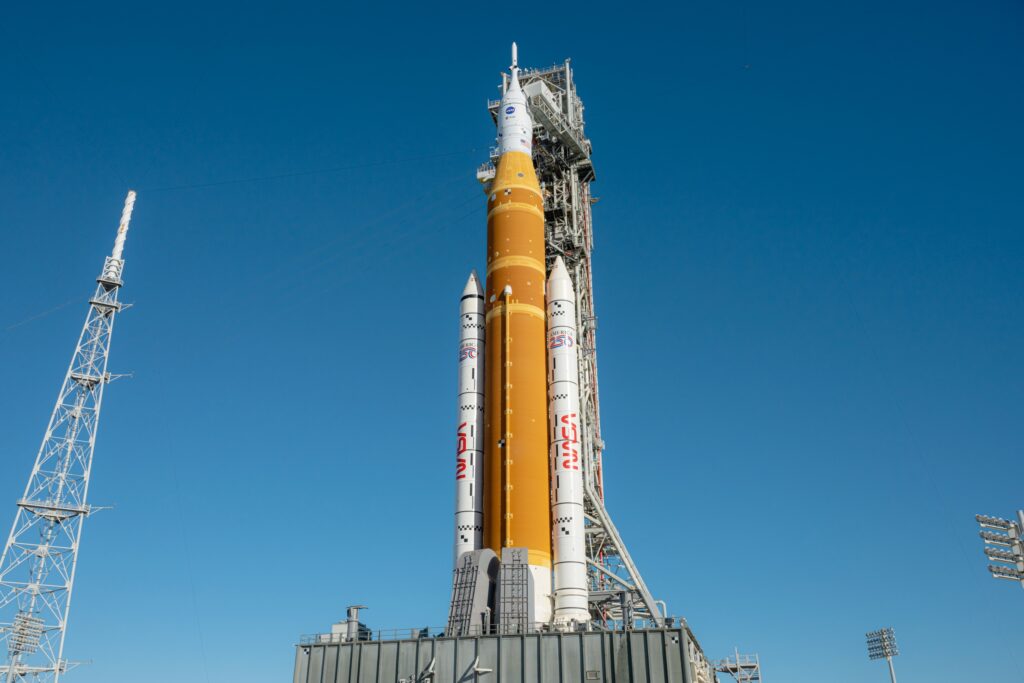
Depending on when you read this, NASA will be weeks — perhaps days — from one of its biggest missions in years. On Jan. 17, NASA rolled out the Space Launch System rocket, with Orion spacecraft mounted on top, to the launch pad for the Artemis 2 mission. The launch will be the first time anyone has ventured beyond low Earth orbit since Apollo 17 in 1972, with multiple firsts among its four-person crew.
With the first launch opportunity as soon as Feb. 6, you might expect a drumbeat of news coming out of NASA about the mission. [Editor’s note: After this article was originally written and published in print, Artemis 2 has been delayed to March at the earliest.] Instead, the opposite is true. In the weeks leading up to the first launch opportunity for Artemis 2, the agency has, if anything, been underplaying the next step in its ambitions to return humans to the lunar surface.
After two days of briefings about Artemis 2 in late September, including interviews with the crew, the agency went silent for six weeks because of the government shutdown. Yet, even after the shutdown ended, NASA provided few updates about preparations for the launch. It wasn’t until Jan. 9 that NASA announced plans for the rollout and published the roughly five-day-long launch periods in February, March and April available for the mission.
New NASA Administrator Jared Isaacman said on social media in early January he was waiting for the rollout to share more details: “Artemis II is the first step in America’s grand return to the Moon, and we will be very transparent about technical readiness and timelines after rollout.” Asked why he couldn’t be “very transparent” sooner, he responded, “Because I want more data to ensure we set proper expectations.”
Yet after the rollout, updates about launch preparations remain intermittent. NASA might want to manage expectations about when Artemis 2 will be ready to launch, but it could provide regular updates about the progress it is making. Compare that to the International Space Station program, where NASA publishes extensive updates every day about the research and maintenance going on there.
Some of the publicity NASA has generated has been counterproductive. On Jan. 9, Isaacman convened a meeting at NASA Headquarters to be briefed on the Orion heat shield, which encountered problems during Artemis 1 that contributed to the extensive delays of Artemis 2. Notably, he invited a couple former astronauts skeptical of NASA’s analysis that the heat shield is safe, as well as two reporters to the otherwise closed-door meeting.
“That level of openness and transparency is exactly what should be expected of NASA,” Isaacman said after the meeting, according to the one published account of it.
NASA declined to discuss the meeting further beyond a statement that Isaacman agreed that the heat shield was safe. One of the former astronauts invited, Charles Camarda, came away still skeptical and let the world know. As a result, an issue that seemed closed more than a year ago when NASA wrapped up the heat shield investigation appeared open for debate again.
The low level of attention could give the perception that the agency isn’t quite sure Artemis 2 will be ready to go in February, or later; burned, perhaps, by the delays with Artemis 1 in 2022. But in briefings around the rollout, agency officials expressed confidence in their preparations and said a launch in February was possible despite a tight schedule.
Meanwhile, the Canadian Space Agency, whose astronaut, Jeremy Hansen, is on Artemis 2, is moving at full speed to promote the launch. Its website and social media channels are filled with updates and videos with Hansen and others discussing the mission. It is even helping people organize watch parties for the launch across Canada.
If NASA is serious about openness and transparency — and as a taxpayer-funded civil agency, it should be — the last thing to do is underplay a historic mission. Sharing more information, good and bad, about progress toward launch can help keep the public engaged and ready when the SLS does finally lift off.
This article first appeared in the February 2026 issue of SpaceNews Magazine.
Related