
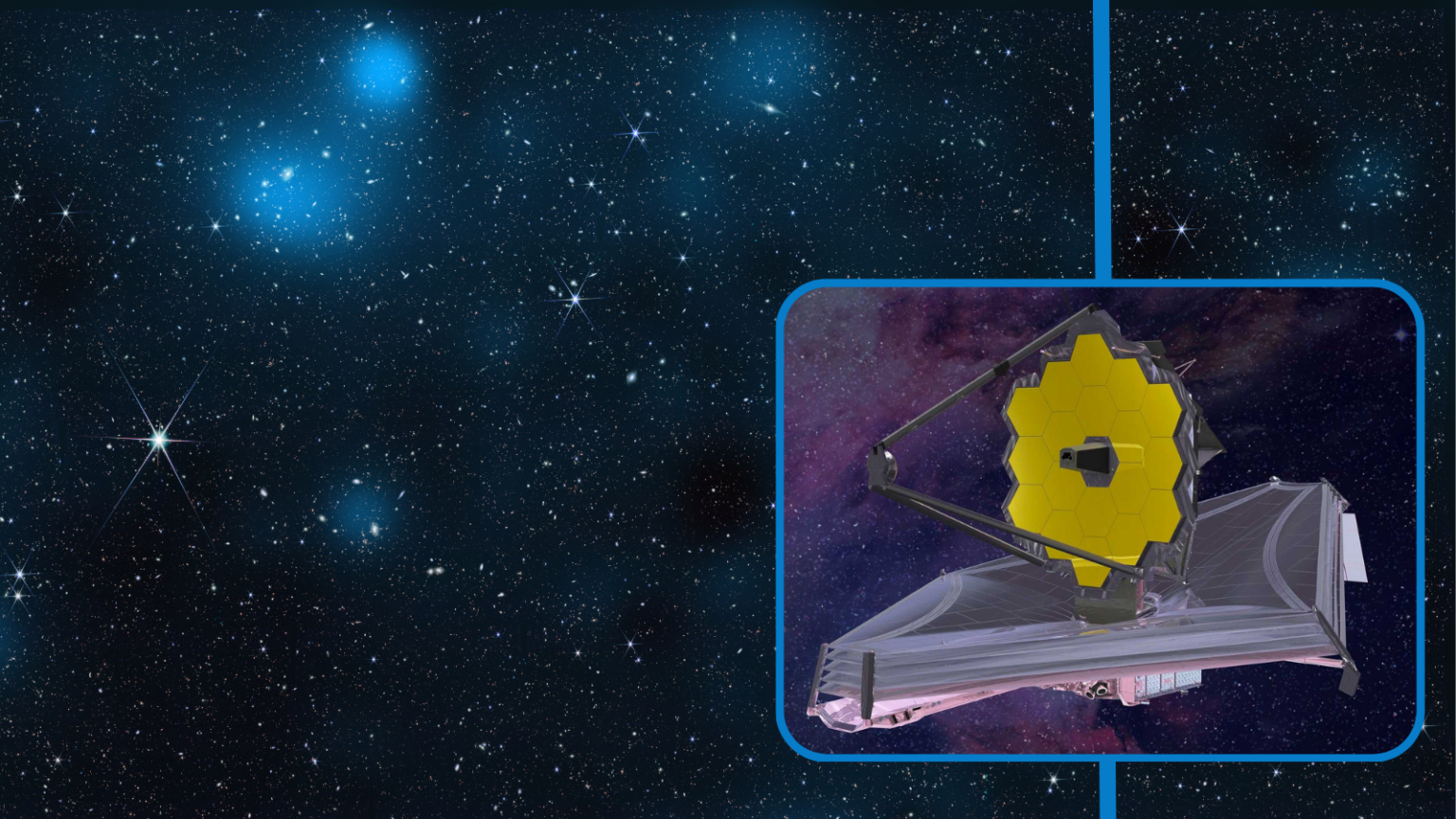
Using the James Webb Space Telescope, astronomers have built a detailed map of dark matter, showing the density of this mysterious stuff across a field of view that encompasses around 800,000 galaxies.
Dark matter is so puzzling to scientists because it doesn’t interact with electromagnetic radiation, or simply light,, and is thus effectively invisible to us. This tells researchers that dark matter isn’t just difficult-to-see ordinary matter made up of protons, neutrons and electrons, which are particles that do interact with light. Hence, the search for particles that could comprise dark matter has been a complicated one. To make matters even more complex, these particles appear to outweigh particles that comprise ordinary matter in the cosmos by a ratio of five to one.
Fortunately, dark matter does interact with gravity, therefore influencing the very fabric of space and time. And the curvature of space caused by large concentrations of dark matter — like dark matter haloes that envelope galaxies and galactic clusters — can influence the passage of light in a process called gravitational lensing first predicted by Albert Einstein back in 1915. It is through its gravitational influence that astronomers were able to use the James Webb Space Telescope (JWST) to build this new map of dark matter.
You may like
The area of the sky analyzed with this investigation is around 2.5 times the size of the full moon (as seen from our vantage point on Earth) and located in the constellation of Sextans. The JWST studied this region for around 255 hours with its Near-Infrared Camera (NIRCam) instrument as part of the Cosmic Evolution Survey (COSMOS).
COSMOS is conducted by around 15 different telescopes, including the JWST’s trusty sibling the Hubble Space Telescope. These eyes on the universe all repeatedly study a larger section of the sky equivalent to around 10 full moons. This repetition with instruments that see the cosmos in different ways allows scientists to investigate how galaxies grow, with Hubble and JWST data helping to unravel the role dark matter plays in things like galactic evolution.Additionally, Hubble observed the same region involved in the new study back in 2007, and the section has since been investigated by many other ground-based telescopes independently. But the immense sensitivity of the JWST has helped scientists produce a map with around 10 times more galaxies than those produced by ground telescopes and twice as many as seen in the Hubble map.

The JWST’s view of 800,000 galaxies with the blue indicating dark matter concentrations. The more intense the blue, the denser the dark matter (Image credit: NASA/STScI/J. DePasquale/A. Pagan)
Using these JWST observations, the team inferred the distribution of dark matter using “weak gravitational lensing” in particular, which is the subtle distortion of light from thousands of background galaxies caused as it passes warped space caused by concentrations of dark matter.
Additionally, observing the region with the JWST’s other main instrument, Mid-Infrared Instrument (MIRI), allowed the researchers to better measure the distances to the galaxies in this section of the sky.
The new dark matter map is just another example of how the JWST is revolutionizing our view of space, both near and far, while redefining our understanding of familiar bodies as well as the most mysterious aspects of the cosmos.