
A group of physicists from the University of Massachusetts has published the results of a study explaining the nature of the “impossible” neutrino. According to the scientists, it was produced by an exploding black hole.
Key to the fundamental nature of the Universe
Scientists have a fairly good understanding of the life cycle of black holes. A giant star exhausts its supply of thermonuclear fuel, explodes in a powerful supernova, and leaves behind an area of space-time with such intense gravity that nothing, not even light, can escape it. This is known as a stellar-mass black hole. There are also intermediate-mass black holes and supermassive black holes located at the centers of most galaxies. Such objects are incredibly heavy and, in essence, stable.
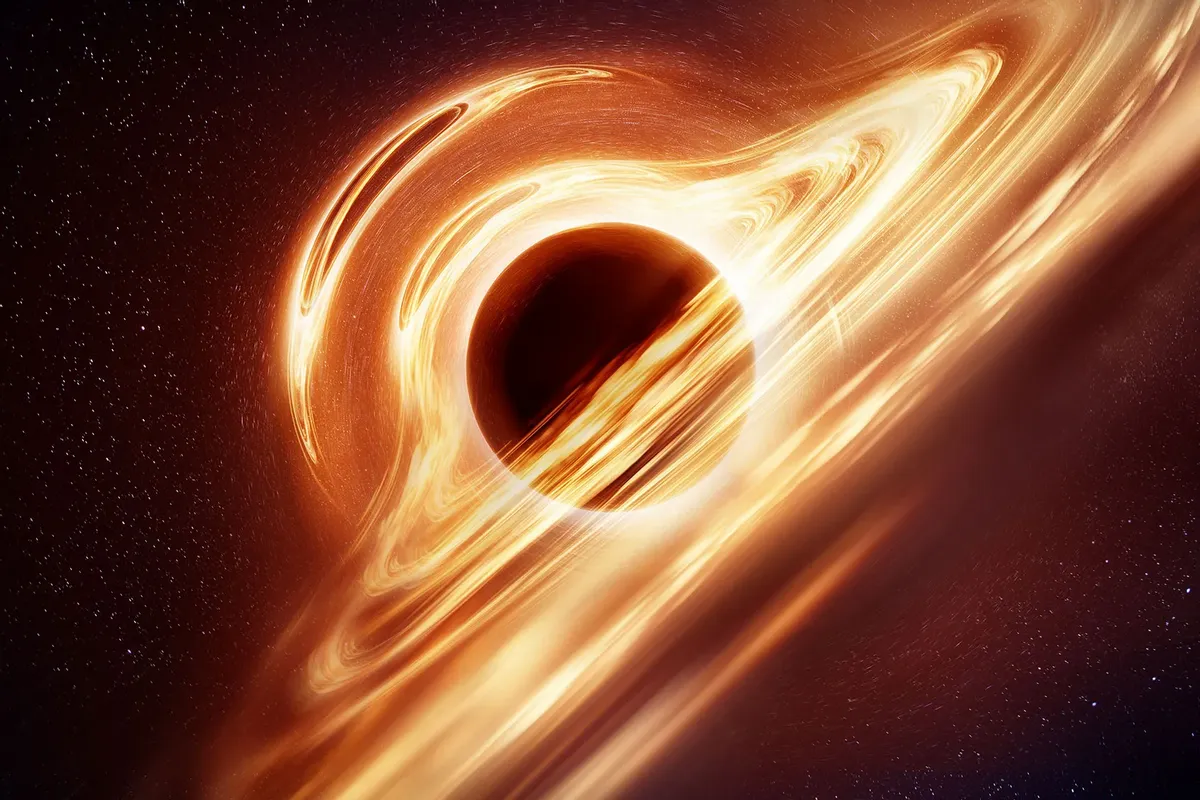 Active black hole (concept). Source: Getty Images/solarseven
However, as physicist Stephen Hawking pointed out in 1970, there is another type of black hole — primordial black holes (PBHs). These were not formed as a result of gravitational collapse, but rather due to the initial conditions of the Universe shortly after the Big Bang. Like standard black holes, they are so dense that almost nothing can escape them — hence the name “black.”
However, despite their density, PBHs may be much lighter than the black holes we have observed so far. In addition, Hawking showed that PBHs can slowly emit particles through what is now known as “Hawking radiation” if they are heated sufficiently. As they evaporate, they become lighter and therefore hotter, radiating even more intensely in a process that accelerates and culminates in their explosion.
In their previous study, scientists from the University of Massachusetts showed that PBH explosions can occur every 10 years, which is much more frequently than previously thought. Earth-based telescopes can detect such explosions. If astronomers could see it, it would give us a definitive catalog of all existing subatomic particles, including dark matter particles, as well as everything else that is still completely unknown to science.
Black holes and dark matter
Until recently, all this remained theoretical. However, scientists now have the first evidence of a black hole explosion.
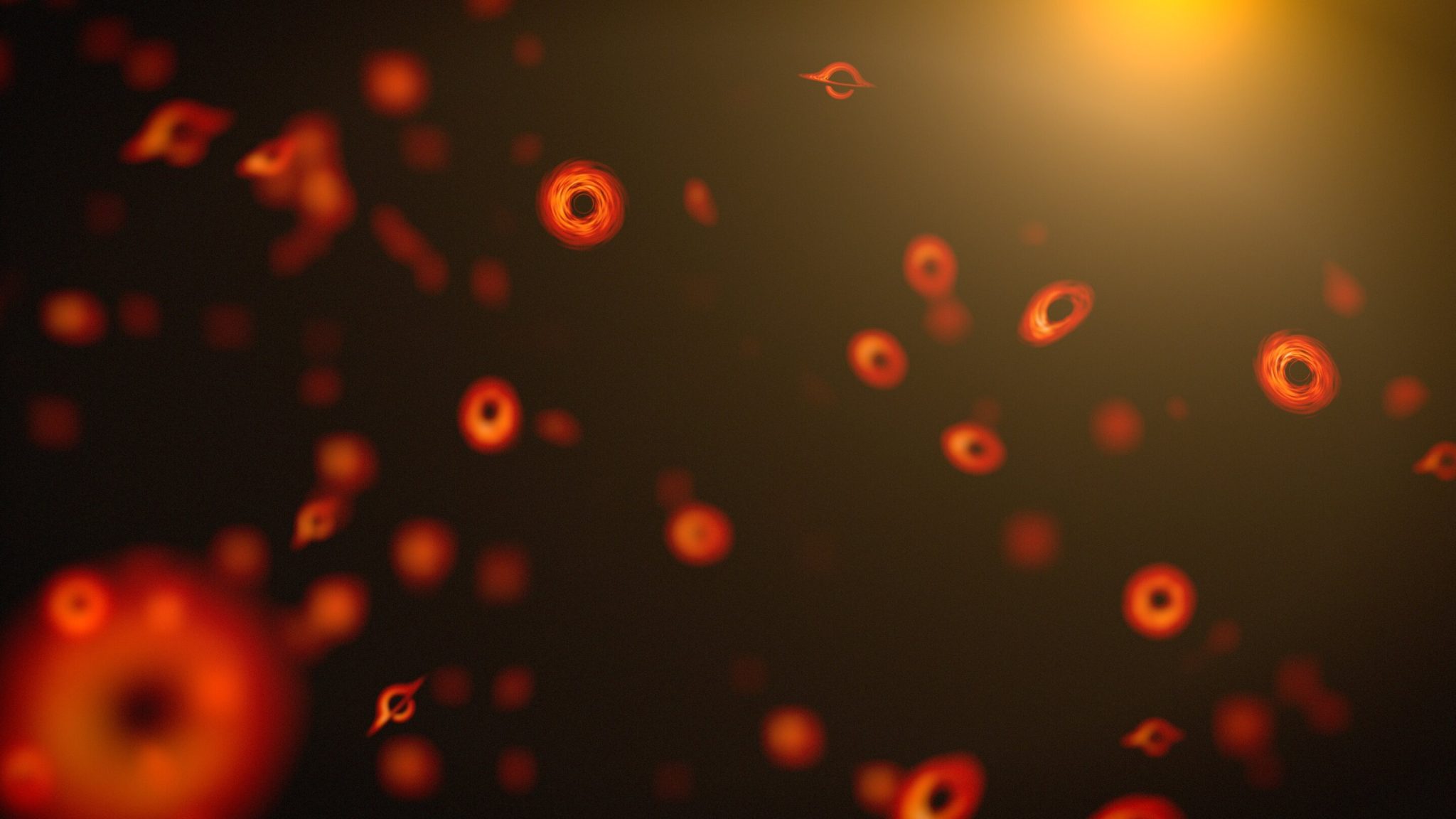 Primordial black holes in an artist’s impression. Source: NASA’s Goddard Space Flight Center
In 2023, during an experiment called KM3NeT Collaboration, scientists managed to detect an “impossible” neutrino. Its energy exceeded the energy of the highest-energy particle ever produced by the Large Hadron Collider by 100,000 times. There is no known source anywhere in the Universe capable of producing such energy. According to scientists, the only possible explanation is the explosion of a primordial black hole.
However, there was one problem: a similar experiment called IceCube, also designed to detect high-energy cosmic neutrinos, not only failed to record this event, but had never recorded anything even a hundredth of its power. If there are relatively many PBHs in the Universe and they often explode, shouldn’t we be bombarded with high-energy neutrinos? How can this discrepancy be explained?
“We think that PBHs with a ‘dark charge’—what we call quasi-extremal PBHs—are the missing link,” said Joaquim Iguaz Juan, a postdoctoral researcher in physics at UMass Amherst and one of the paper’s co-authors. Dark charge is essentially a copy of ordinary electrical power as we know it, but incorporating a very heavy hypothetical version of the electron, which the team calls the “dark electron.”
“There are other, simpler models of PBHs out there,” says Michael Baker, co-author and associate professor of physics at the University of Massachusetts Amherst. “Our dark-charge model is more complex, which means it may provide a more accurate model of reality. What’s so cool is to see that our model can explain this otherwise unexplainable phenomenon.”
The team is confident that their PBH model with dark charge can not only explain neutrinos, but also unravel the mystery of dark matter. If the dark charge hypothesis is correct, it implies the existence of a significant population of primordial black holes, which would be consistent with other astrophysical observations and explain all the missing dark matter in the Universe.
“Observing the high-energy neutrino was an incredible event,” Baker concludes. “It gave us a new window on the universe. But we could now be on the cusp of experimentally verifying Hawking radiation, obtaining evidence for both primordial black holes and new particles beyond the Standard Model, and explaining the mystery of dark matter.”
According to University of Massachusetts Amherst