
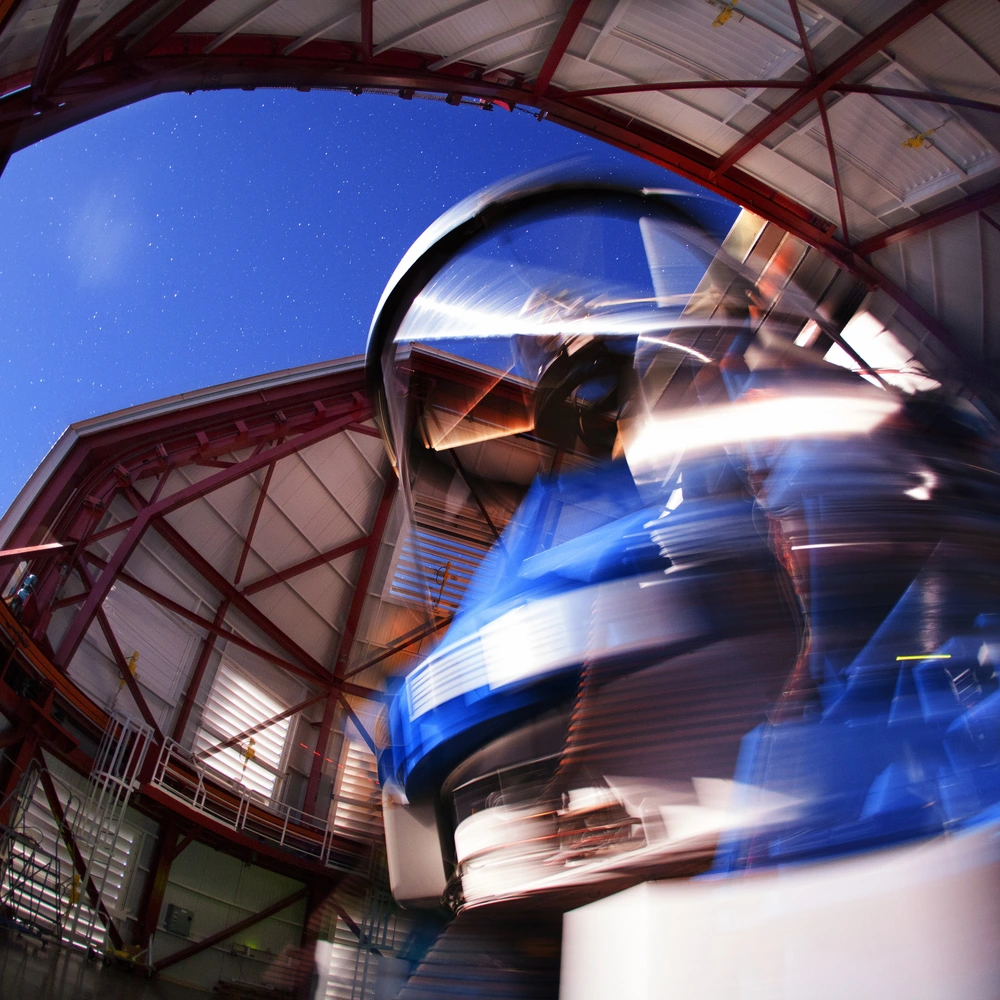
For more than a century, Carnegie Science has been among the world’s elite when it comes to telescopes and the instruments that expand their capabilities. From the historic Mount Wilson Observatory to modern our facilities in Chile, Carnegie teams combine mechanical craftsmanship, optical design, and astrophysical expertise to create tools that push the limits of discovery.
Because many of these tools are designed on campus—a rarity today—astronomers and theoretical astrophysicists can work closely with machinists and engineers. That close integration enables rapid iteration, creativity, and instruments tailored to specific scientific goals.
How the instrumentation team works
Jeff Crane, Associate Director for Technological Affairs at the Observatories, emphasizes the distributed and collaborative nature of Carnegie’s effort.
“One of the interesting aspects of what our group is doing is that it touches so many different facilities at Las Campanas,” Crane said, giving an overview of projects that span from the Henrietta spectrograph—which will be installed on the Swope telescope in March 2026—to concept-phase instruments like Falcon.
“We have an instrumentation effort that’s distributed,” Crane explained. “Some people are spending all their time on one instrument, but most people are working part time on multiple projects. As things get closer to completion, the work is more targeted. When we’re still figuring out concepts, teams are scrappier.”
This flexibility allows expertise to flow between projects, accelerating problem solving and innovation.
Carnegie’s instrumentation efforts are accomplished by an interdisciplinary mix of staff scientists, postdocs, engineers, and machinists working together to bring a project to fruition. Crane notes that having so much talent at every stage contained on one campus “enables collaboration, agility, and creativity.”
He adds: “It’s an extraordinary value and a real privilege to be able to work directly with the machine shop because we get some really interesting and helpful feedback from them when we’re doing design work.”
Homegrown innovation and flexibility
One of Carnegie’s hallmarks is the ability to design equipment from scratch rather than relying on commercial solutions.
“People might not realize how homegrown most of our research equipment is at Las Campanas,” Crane notes. “We design it from scratch, and we make optics and parts and bolt them all together. When I got into this field, I thought that if you needed a spectrograph on a telescope, you’d call up the spectrograph store. But it doesn’t work that way at all. And it’s really fun to combine science and engineering in such a creative way!”
This aproach lets astronomers tailor instruments precisely to scientific requirements—whether that means extreme precision in measuring stellar motions or specialized imaging for faint, distant targets. It also provides the flexibility to update and repurpose instruments as new questions arise and technologies advance.
Collaboration, learning, and broader impact
Keeping design, prototyping, and construction tightly integrated accelerates the pathway from concept to on-sky capability. Concentrated expertise on campus not only generates new instrument ideas but allows scientists who have not previously worked in instrumentation to collaborate with engineers and machinists, broadening the base of innovation.
Carnegie Science’s hands-on, collaborative approach to instrument development will translate into new discoveries when these instruments take their places on some of the world’s most powerful telescopes. Learn about five major Carnegie-led instrumentation projects at various stages of completion:
Under development at the Observatories, the Magellan Infrared Multi-object Spectrograph (MIRMOS) will be a first-of-its-kind spectrograph built to excel at observing both faint objects, like distant galaxies, and bright sources, like stars hosting exoplanetary systems, in the infrared. Infrared light is key to many of the most active research topics in astrophysics, including the early universe’s first structures, the breakneck galaxy growth that occurred more than 10 billion years ago, and the atmospheres of distant exoplanets. Once installed on the Magellan telescopes at Las Campanas Observatory in Chile, MIRMOS will enable astronomers to answer fundamental questions about galaxy formation, including as how primordial galaxies changed their surroundings, whether a galaxy’s birthplace determines its destiny, and how galaxies grow within the enormous reservoirs of gas that comprise their cosmic ecosystems. It will also enable a novel census of exoplanetary atmospheres, which will be key to understanding the diversity and evolution of planetary systems beyond our own.
Investigators from the Carnegie Science Observatories, the Center for Astrophysics | Harvard & Smithsonian, Stanford University, and Yale University are preparing to use the entire Milky Way galaxy as a laboratory in order to probe and uncover the elusive nature of dark matter. The Milky Way is surrounded by more than a hundred stellar streams. These long, arcing bands of stellar material orbit our galaxy and its halo of dark matter. Impacts from small clusters of dark matter disperse stars out of these streams, and an exciting new initiative called the Via Project will search for the unique signatures of these disruptions in order to detect the otherwise invisible dark matter structures for the first time. To accomplish this thrilling goal, the Via Project team are designing and building two extremely sophisticated spectrographs, which will enable them to study the Milky Way’s galactic halo at never-before-seen resolution. These precision instruments will be installed on telescopes in both hemispheres–the Magellan Clay at Carnegie Science’s Las Campanas Observatory in Chile and the MMT Observatory in Arizona.
Once installed on the Swope telescope at Carnegie Science’s Las Campanas Observatory in Chile, Henrietta will expand our understanding of planets beyond our Solar System by detecting their atmospheres. Henrietta is designed to be the first ground-based spectrograph specifically designed to study exoplanet atmospheres in the near-infrared, where our eyes can’t see. This wavelength range gives us critical insights into the chemical composition and physical processes that occur in exoplanet atmospheres. This instrument is named in honor of the esteemed astronomer Henrietta Hill Swope, who studied variable stars called Cepheids, which have a fixed relationship between their luminosity and their period, enabling astronomers to use them as distance calibrators.
The Commissioning Camera will capture the first multi-color images taken with the next-generation extremely large telescope—the Giant Magellan Telescope—when it goes live at Carnegie Science’s Las Campanas Observatory. Once completed the Giant Magellan will enable astronomers to probe the universe with fresh eyes and the Commissioning Camera will play an integral role in its efforts. As well as being a critical tool for determining the telescope’s functionality, it will also enable science that ranges from studying the evolution of individual stars to providing insight on the structure and formation of the universe. Key scientific objectives for the instrument will include studying stellar populations in nearby galaxies and dwarf galaxies, the identification of distant clouds of gas and dust surrounding dying stars from which the subsequent generations of stars are born; young galaxies with intense star-forming activity, and black holes at the centers of galaxies.
Falcon will be a multi-purpose, workhorse facility instrument for the 6.5-meter Magellan Baade telescope at Carnegie’s Las Campanas Observatory in Chile. It is designed to enable astronomical research across a variety of disciplines including, tomographically mapping the intergalactic medium at high redshift over a wide field, measuring stellar dynamical motions at high precision in nearby galaxies, and mapping and understanding the cycle by which matter is processed through galaxies and stars. A conceptual design is underway, with a goal to build Falcon at the Carnegie Science Observatories in Pasadena and install it at Magellan by the end of the decade. The project’s name comes from the layout of the instrument’s optics, which resemble a bird.
Keep Reading