
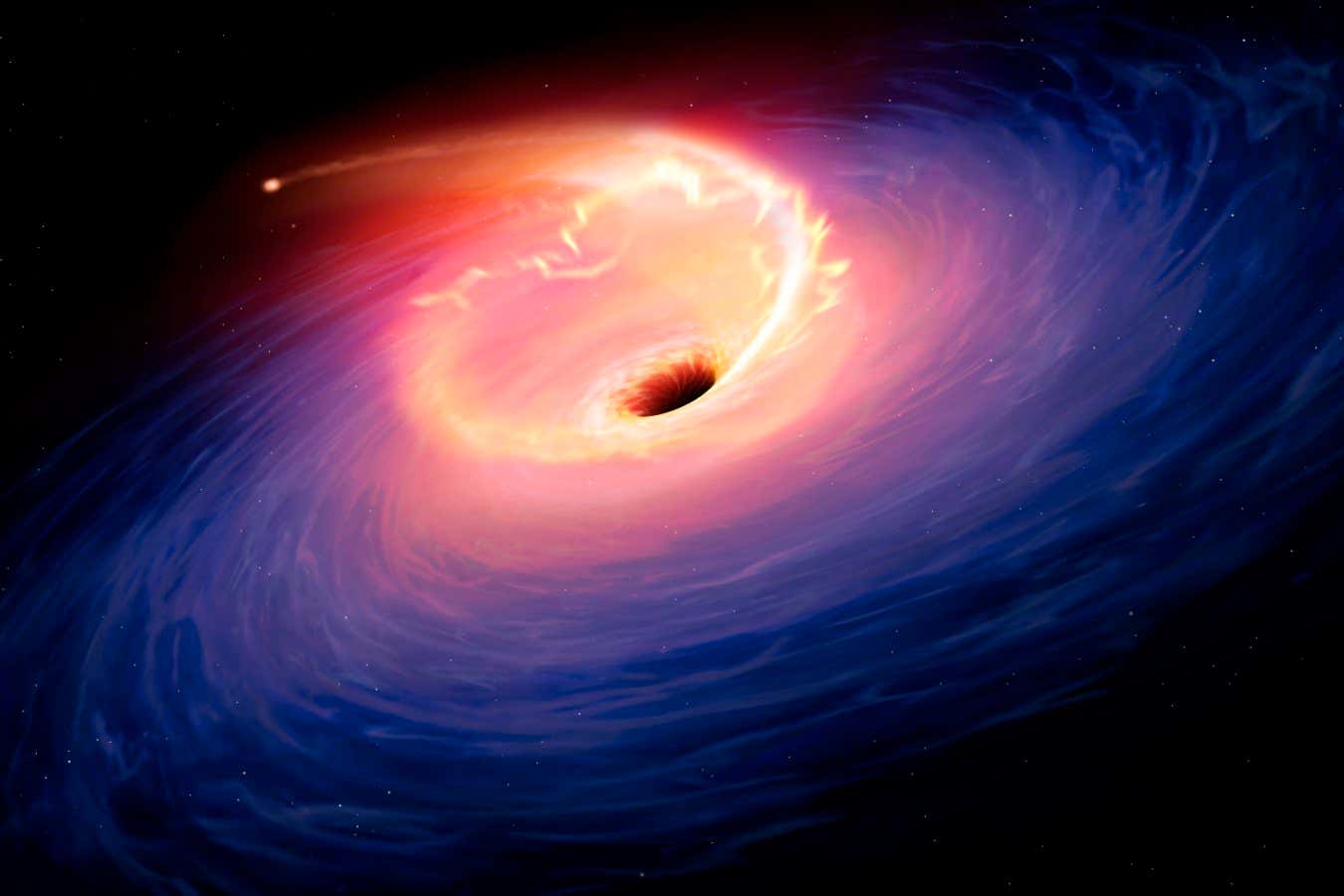
No tour of the cosmos is complete without a description of black holes
MARK GARLICK/SCIENCE PHOTO LIBRARY
A Brief History of Universe
Sarah Alam Malik, Simon & Schuster (UK, 12 February) William Morrow (US, 5 May)
IN 1988, Stephen Hawking published A Brief History of Time, an exploration and explanation of cosmology by the renowned physicist that became an unlikely, and huge, bestseller. Shameful admission: I set out to read an updated edition as a curious, literature-studying teenager, and struggled. I never finished it.
Thirty-eight years later, particle physicist Sarah Alam Malik is here to help with her own exploration of cosmology, with a nod to Hawking in her title: A Brief History of the Universe (and our place in it).
Hawking started with Aristotle arguing for a geocentric model of the universe in 340 BC. Malik opens her brief history earlier, around the 7th century BC, as the Babylonians track the movements of the sun, moon and stars in “astronomical diaries” written in cuneiform. But we are soon into Aristotle and Ptolemy, and then the flourishing of astronomical knowledge in the Islamic world in the 6th century AD.
Since this is a brief history, by page 47 we have dashed through Galileo Galilei and his discovery of Jupiter’s four moons and Isaac Newton watching his apple fall, to arrive at Albert Einstein and general relativity. From there, we canter through galaxies and black holes to the eventual heat death of the universe. From the macro to the micro: “The cosmos’s building blocks have turned out to be no less wondrous than the cosmic structures they created,” writes Malik, taking her readers through the discoveries that led to quantum mechanics and the unveiling of the subatomic world.
She gets less deep into the nitty-gritty of the physics than Hawking, painting with a broader brush and focusing a little more on bringing the people she’s writing about to life. This ranges from Dmitri Mendeleev, the youngest in a family of over a dozen children in a small Siberian town, coming up with the periodic table while visiting a cheese factory, to Fritz Zwicky positing dark matter in the 1930s, but being so disagreeable the idea didn’t catch on for four decades.
Malik, writing decades later than Hawking, captures a more diverse cast of characters. These range from the Islamic astronomers of the Middle Ages to women like Vera Rubin, who overcame widespread misogyny to carry out groundbreaking work on galactic rotation curves.
Not only is the tone different, but she takes us inside developments Hawking couldn’t have included back in 1988 – for example, the Large Hadron Collider (on which Malik worked) and the Higgs boson. Some of the audience wept during the announcement of its discovery, she writes, in one of the book’s many delightful anecdotes.
This is indeed a “brief history of the universe”, but what lies inside the brackets, “and our place in it”, is just as important. It is a book about our discovery of the universe, how we stood on the shoulders of giants to get this far, and what may come next. It is full of awe – “It remains a marvel of human existence that we can comprehend worlds far removed from our own” – and humility – “Humanity has written and rewritten the story of the universe many times, and each era has, for the most part, believed the story of its time.”
The book was at its best journeying deep into space and the quantum – unsurprising, given Malik’s field (dark matter). Chapters on life’s origin, its future and machine intelligence felt slighter.
Much of what Malik recounts will be familiar to New Scientist readers, but she is a warm, clear writer who covers an awful lot in a small space (my edition is just 223 pages). I think 18-year-old me might just have made it through this one – and then have been ready for Hawking.
Topics: