
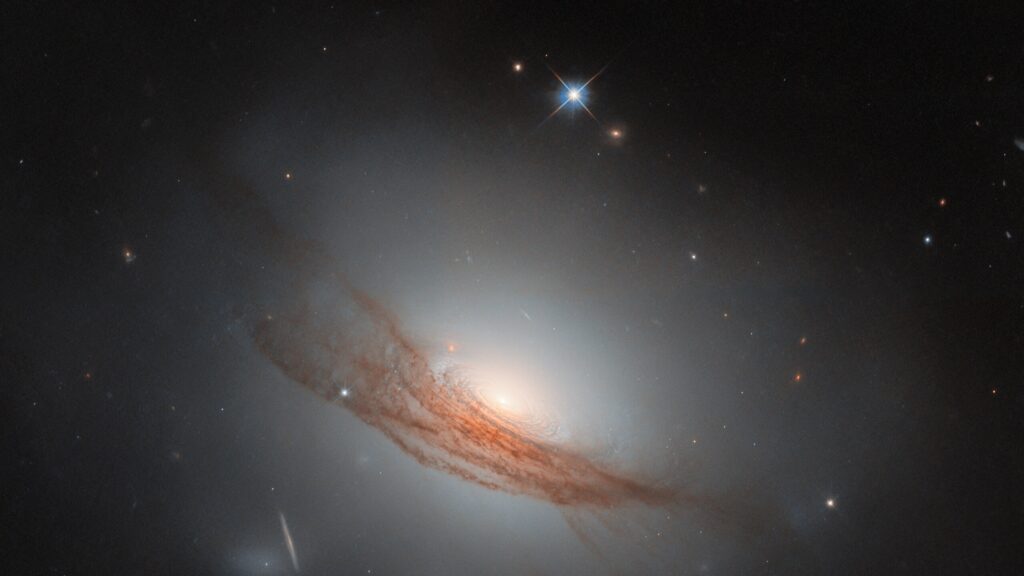
The Hubble Space Telescope has given us an impressive portrait of the unusual galaxy NGC 7722. This lenticular galaxy, located 187 million light-years away in the constellation Pegasus, combines features of both spiral and elliptical galaxies, making it a true cosmic “transitional link.”
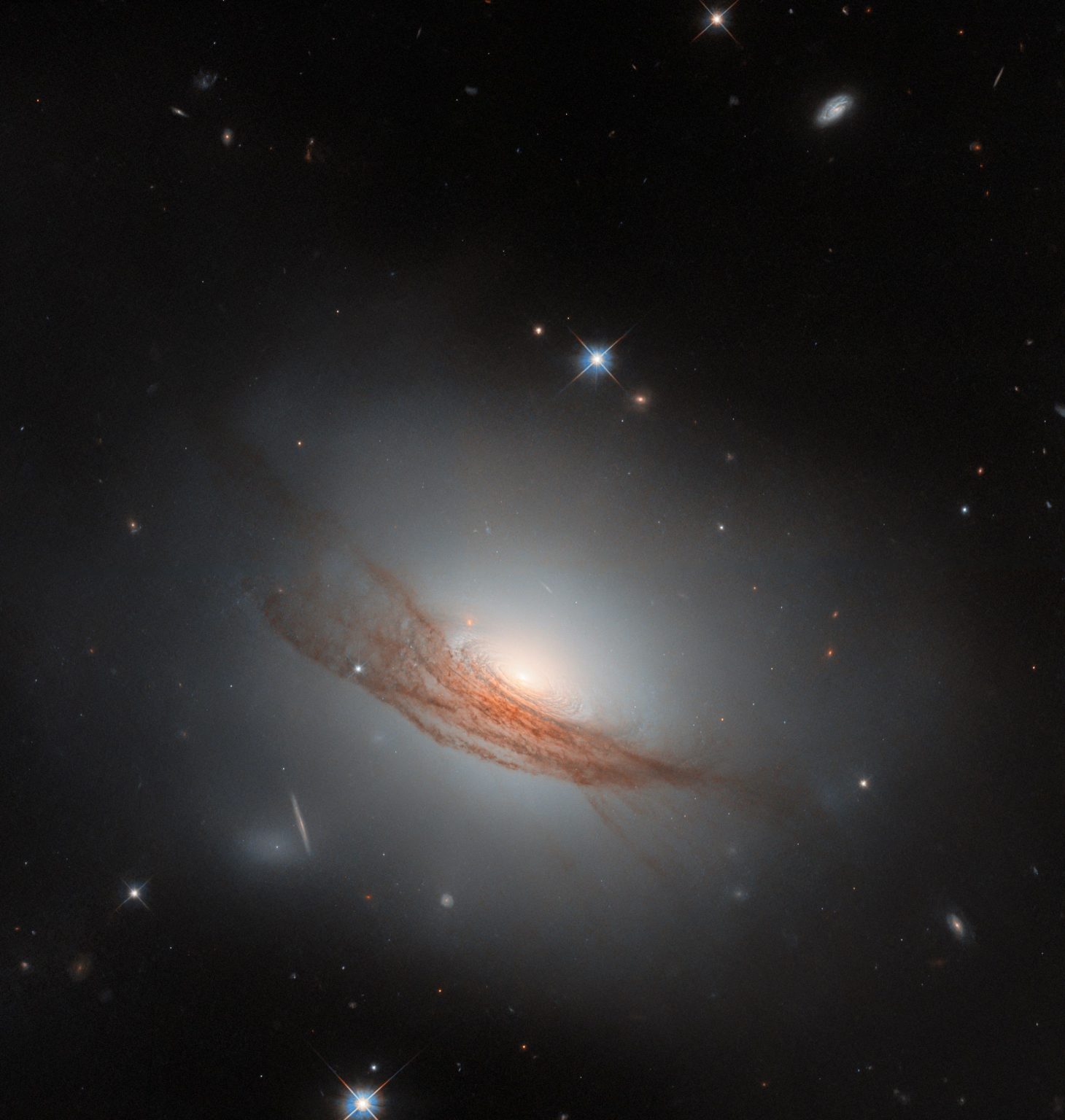 Photograph of the lenticular galaxy NGC 7722, taken by the Hubble Space Telescope, located about 187 million light-years away from us. Source: ESA/Hubble & NASA, Dark Energy Survey/DOE/FNAL/DECam/CTIO/NOIRLab/NSF/AURA
NGC 7722 does not have distinct spiral arms. Instead, it has a bright central bulge and an extended bright halo characteristic of elliptical galaxies. However, unlike elliptical galaxies, it has a disk. The most striking feature of the galaxy is the long, winding bands of dark red dust contrasting against the smooth halo. This dust is likely a remnant of a turbulent past.
Traces of cosmic merging
Astronomers believe that the characteristic dust bands of NGC 7722 are a direct result of a merger with another galaxy in the past. Such gravitational interactions transform galaxies, depleting their gas and bringing in new dust, forming a lens-like appearance. Thus, NGC 7722 is, so to speak, an archaeological artifact that preserves the history of an ancient cosmic catastrophe.
Although NGC 7722 is not active in star formation, in 2020, supernova SN 2020SSF flared up in it. It was a Type Ia supernova — the explosion of a white dwarf that had been “absorbing” mass from a companion star. Such explosions have a standard brightness, making them invaluable tools for measuring distances in the Universe. Studying them is key to understanding the scale of space.
A look back after the explosion
Hubble took this photograph two years after the supernova faded, specifically to finally see what the bright flare had hidden. The telescope’s sharp vision allows astronomers to investigate the aftermath of the explosion: searching for remnants of radioactive elements, studying neighboring stars, and attempting to detect a surviving companion star.
According to Phys.org